
Category: Podcast

This Is Insane. Or Is It?

By Steve Moran
I just read a Wall Street Journal piece titled “No Skirts, No Shoes: The Team-Building Exercise Where You Climb on the Boss.” My initial reaction was NO WAY! People would hate it, but then I got to wondering …
Here is what is happening.
Companies in Spain are doing team building by building human towers. Actual human towers, where employees climb on each other’s backs, shoulders, and yes, sometimes each other’s backsides. It’s a centuries-old Catalan tradition called castells, and it’s now a full-blown corporate team-building offering.
Continue reading on Practical Passionate Leadership (Substack) for free.

More Wondering: Why Not Collaborate?

By Jack Cumming
LeadingAge prides itself on being the trusted voice for aging. Full membership in the organization, however, is limited to provider organizations and corporate partners. There is also a class of associate members with limited benefits and organizational rights, but there is no direct membership for residents. Residents only have a semblance of membership derived from the provider member that houses them.
Grassroots Democracy
As an advocacy organization in a democratic society, one might think that an organization for aging would want to represent as many older people as possible. That grassroots thinking would suggest elevating residents to primary membership. LeadingAge, though, seems to be dedicated to the business interests of nonprofit senior housing enterprises.
Top-line, LeadingAge’s 2026 Policy Platform aims “to continually make America a better place to grow older.” Wouldn’t that start by empowering older people, particularly residents, to have the central voice? That’s where I stumble on the question, “Why not collaborate?”
Digging into the advocacy specifics reveals a reactive agenda calling for minor tweaks in the status quo. In an era when there is a need for a major overhaul of America’s healthcare system; when artificial intelligence and robotics present opportunities; and when affordability is becoming a critical public issue, one would expect big ideas to have a place at LeadingAge.
Instead, we find elements like “Protect Medicaid from further harm;” advocate for higher provider reimbursement; maintain tax exemption; and advance immigration as a solution to hiring challenges. That’s just a sample. Why not consider how to provide better health for Americans at lower cost; pay our fair share of taxes; and promote fair compensation to motivate care workers?
Finding Proactive Concepts
Opening LeadingAge to those older people who have the expertise, know-how, and wisdom to contribute seems obvious for an organization that seeks better aging. It could have avoided the fiasco that LeadingAge’s work on the Community Living Assistance Services and Supports (CLASS) Act became.
Making LeadingAge into a force that serves more than narrow business interests would require strong leadership. It’s not enough to try to find common opinion among people who care principally about what’s best for providers, what accords with industry money interests, and what might have the greatest plausibility with members. It requires rising above superficial thinking, hopes, wishes, and common opinion. An inclusive organization can perform better than one that is inward-directed.
Think of the Potential
Let’s look at this positively. Imagine the prestige that LeadingAge might attain if it considered the thinking of the best minds in the country, not just social scientists but people who think and write on the highest level. That would require leaders who can recognize that kind of thinking when it appears. It’s beyond superficiality.
By consigning residents to subordinate status, LeadingAge is overlooking one of its most valuable assets. An organization primarily of and for older Americans with a reputation for the most cogent thinking could bring grassroots power to policymaking. High-achievement residents can contribute positive energy and proven experience.
Let’s Restore the American Dream
LeadingAge’s not-for-profit focus has become an engine for reversing the American dream of homeownership. Homeowners are enticed to sell their homes to pay entrance fees. There’s no reason why senior housing can’t continue the dignity of ownership or, at least, provide voting membership in a not-for-profit. It makes little sense for an advocacy organization to be on the wrong side of the American Dream.
If we can transform LeadingAge from a we-they model to an inclusive empowerment model, we can transform the senior housing industry to one in which people are proud to be residents. The future is bright for those who envision it and who seize the opportunity to create a new reality. Sometimes, the people who seem to be the most difficult are the very people that it’s wisest to understand and heed. They can be the best advisors.
This is one in a series of articles exploring how providers, residents, and resident families might work together for better aging.

The People Behind Senior Living

Murry Off the Mic explores the people behind senior living—the experiences, perspectives, and personal stories that shape how they lead and serve. Watch the full episode HERE.

Transcript:

Some of the most important conversations in senior living do not happen in meetings. They happen after the agenda is gone, when nobody is performing anymore. That is the space this show lives in.
This show is about people. The people of aging services. The people of senior living. But most of all, the people behind the work. What shaped the way you see this work in aging services? Because understanding where we come from helps shape where we go next.
Here we go. My name is Murry, and this is Murry Off the Mic.

Serving Seniors Beyond Senior Living

In this clip from Directly Speaking, Direct Supply shares a broader vision for serving seniors across the full continuum of care. Watch the full episode HERE.

Transcript:

The way we at Direct Supply look at it is this: caring for seniors wherever they are. That could mean in the hospital, in the home, and certainly everywhere in between across the post-acute setting. We want to be a strong, clear advocacy voice for seniors wherever they are, and that really serves as a guiding star for us.

The Conversations Senior Living Needs Most

In this Heard in the Halls clip, we explore why senior living needs more connected conversations across roles, perspectives, and priorities. Watch the full episode HERE.


Transcript:

I grew up in senior living. I started as a child volunteer, then moved into caregiving and nursing, and just kind of worked my way through the whole continuum of senior support.
There’s so much going on in these halls. Executive directors, regional teams, the C-suite, investors—everybody is walking these hallways looking at different things, and they are not always connected.
This series will explore important topics in senior living through the perspectives of everyone involved.

S8 Episode 4 – Is Senior Living Ready for the Longevity Revolution?

What does it really mean to live better longer?
In this episode of Foresight Radio, host Steve Moran sits down with Colin Milner, CEO of the International Council on Active Aging, to explore one of the biggest questions facing the senior living industry:
Is senior living ready to become the real-world delivery system for longevity?
Colin has spent decades challenging traditional ideas about aging and wellness. In this conversation, he shares why senior living communities are uniquely positioned to help older adults thrive—but also why many communities still fall short of delivering on that promise.
Steve and Colin dive into topics including the following:

What “living better longer” actually means in real life
Why senior living must shift from care-first to wellness-first
The difference between real wellness programs and “wellness washing”
Why connection, identity, and community experience matter more than amenities
How senior living communities can design environments that support purpose, autonomy, and longevity

They also explore what the future senior living experience could look like by 2036, including intergenerational communities, environments designed for connection, and why the best communities may feel less like institutions and more like home.
If you’re a senior living operator, industry leader, or someone thinking about the future of aging, this episode offers a fresh and honest perspective on where the industry is headed — and where it still needs to go.

Presence Over Performance — Introducing Murry Off the Mic

By Rebecca Wiessmann
This is the premiere episode of Murry Off the Mic. Watch the full video here.
Some shows launch with a highlight reel. This one launches with silence.
In the first episode of Murry Off the Mic, Murry Mercier sets a tone that feels almost rebellious in a world that rewards polish: this series isn’t rehearsed, it isn’t heavily produced, and it isn’t built around titles. It’s built around people — and the moments that show up after the agenda disappears.
Murry calls out something most senior living professionals recognize immediately: the most important conversations in aging services rarely happen in meetings. They happen in the “after.” After the formal presentation. After the talking points. After everyone stops performing.
That’s the space he wants to live in.
Who is Murry?
Murry Mercier is the industry marketing leader for senior living at PointClickCare, but he doesn’t lead with that.  He leads with a more personal truth: this industry raised him.
It’s a line that carries weight because he means it literally and professionally. Senior living shaped how he thinks about leadership, community, and what it means to show up for other human beings — especially when the answers aren’t obvious.
This premiere episode functions as an origin story: not a career timeline, but a reflection on the moments that changed his understanding of leadership.
What He’s Passionate About
Murry is passionate about three things that senior living often talks about — but rarely slows down enough to actually do well:
Authentic leadership.
Not the kind that looks good in front of a room, but the kind that happens in real time, in real work, next to real people.
Culture.
Not posters on a wall, not slogans, not “values” printed on a lanyard. Culture as something created by environment, shaped by daily behaviors, and reinforced by whether people feel safe and supported.
Belonging.
Belonging for staff. Belonging for residents. Belonging as the quiet force that changes everything about how people behave, how they care, and how they endure the hard days.
Why The Show Exists
Murry makes a clear promise in the premiere: he’s more interested in pauses than perfect answers. He’s not looking for rehearsed responses or slide decks. He’s looking for what’s true when people stop trying to sound impressive.
It’s a bold premise, especially in an industry that often feels like it has to defend itself, explain itself, and sell itself.
But Murry’s bet is that the truth doesn’t need polishing.
It needs presence.
And in a space built around care, “showing up” isn’t a metaphor. It’s the work.

If You Think It, Say It

By Steve Moran
I want to believe that as a leader, you are already noticing the good things your people are doing. And if you’re not, this is exactly what we need to talk about.
As you go through your daily routine, as much as a leader’s day can be routine …
You notice …
Team members doing things that are wonderful. On occasion, they are really big, newspaper headline things; other times, most of the time, they are almost ordinary things that are “just doing their job” kinds of things, simply things that are extraordinary. 
Showing up early to work or meetings, contributing when they didn’t need to.  Offering an encouraging word to a customer, team member or vendor. 
You noticed; everyone noticed … 
Then one day, this person walks into your office to tell you he is quitting. A better job, $1.00 an hour more, a number you would have gladly matched.  You don’t get it, you thought he was happy.
It turned out he was happy, sort of … but also invisible.   
He was working hard, trying hard, doing the best he could, but as far as he could tell, no one noticed. Not his direct supervisor, not the managers further up the food chain. He felt unappreciated; worse, invisible. Invisible people eventually leave to find a place where someone can see them.
You’ve heard of Mel Robbins’ “let them” theory. The idea is simple and useful: let people do what they’re going to do. Stop trying to control their reactions. Release the need to manage everything. Let them.
It works. It brings peace. It’s good advice.
But here’s the twist
What if we applied that same radical permission to more readily release those positive thoughts that we have about those we lead, those we work with? Like this:
If you think something good about someone on your team, something real, something true, let that out.
Say it. Today. Out loud or in writing. To their face or in a note. However it gets there, just make sure it gets there.
Because here’s the thing nobody talks about … most leaders are thinking good thoughts about the people they lead; the problem is that they keep those thoughts locked up inside their own heads. They assume people know. They figure they’ll mention it eventually. They tell themselves the person is probably fine.
Meanwhile, the person is wondering if anyone notices.
They always are.

Continue Reading on Practical Passionate Leadership (Substack) …

Learning From Fiction

By Jack Cumming
Suddenly, we have been experiencing an explosion of plausible video material that seems real but turns out to be no more than a creation of artificial intelligence. One credibility test is whether the material meets standards of academic integrity or favors a particular interest group or point of view.
Fake Testimonials
A recent YouTube video at first seemed real to me. It was a testimonial about how good lawyering can avoid institutionalization. Testimonials can be the most powerful of marketing tools. This one was selling aging at home with an estate lawyer’s shield. It was surprisingly convincing.
Gradually, though, I realized that it was almost too real. Moreover, it featured a talking head … an 89-year-old … talking about moving to a care setting at the impetus of his children. As I listened, I thought, why would an 89-year-old be likely on his own to make a video like this? An estate lawyer’s self-perception slowly became evident.
Staying Home
The video opens with a clever quote from Ralph Waldo Emerson, “A house is made of walls and beams; a home is built of love and dreams.” That’s powerful, and it instantly resonated with me. The home that holds those memories for me is not a single-family dwelling. It’s Apartment 4J at 380 Riverside Drive in New York City. I loved the community of neighbors that a New York City cooperative apartment can be. It’s what our apartment building was.
The video began to seem a bit too slick to be just the musings of an 89-year-old, whose children came every week to him for Sunday dinner. I’m 89 myself, and that just didn’t seem credible. Perhaps I’m jealous.
Skepticism
Once I became skeptical, I began to look for the source. The video itself did not reveal that it was AI generated. I went to the channel Last Chance Is Today, of which the video was part. There was still no immediately evident information of AI authorship or creation. It was only after I clicked on “More” and then on “About” that I found the disclaimer:

“All characters and voices in our videos are AI-generated for storytelling purposes. Stories are inspired by real experiences, but any resemblance to real persons is coincidental. This content is for educational and reflective purposes only and is not professional advice. Please consult a qualified professional for personal guidance.”

Misleading?
The video is not objective analysis, nor is it a firsthand testimonial by an individual. This is deception with a veiled disclosure to try to avoid any legal challenge. Although the video praises an estate attorney named Linda Chen, the person who scripted the AI is not revealed. The denouement, though, is a very conventional estate plan that seems particularly suited to California. A search for Linda Chen also came up empty.
Who might be behind the channel, Last Chance Is Today? I wasn’t able to find that. It remains a mystery. Perhaps it’s a well-intended person who thinks that the AI character’s story is a universal story. Who knows? The takeaway is that we need to be constantly wary that what we encounter may not have the integrity we expect.
In the right hands, and with the right sensitivity to full disclosure, these emerging AI tools can be very powerful. They also have the potential to mislead. Often, as may be the case in this instance, there may be a well-intentioned person seeking to seem more authoritative than would be the case if they stayed with their own persona. In the meantime, enjoy the nice elderly man depicted in the video. Just take what he says with a grain of doubt.

We Would Never Accept This From a Doctor. Why Do We Accept It From Leaders?

By Steve Moran
Imagine for a moment you have a doctor you go to that you seriously like and respect; maybe you would even say you love them.
Then something medical happens that scares you, something legitimately serious, something that feels life-threatening or life-changing. As you are getting ready to make that appointment with the doctor you love, you find out that in the 20 years since graduating from medical school, they have never cracked a textbook open, never attended a conference, never upgraded their skills. That they have been practicing exactly the way they did when they first got their license.
Would you still go to them? Would you put your life, your health, in their hands?
That is exactly what we tolerate from leaders every single day.

Continue reading on Practical Passionate Leadership (Substack) for free.

The 85% Solution: Stop Competing, Start Advocating Together

By Rebecca Wiessmann
This is the second of a three-part series drawn from Steve’s conversation with Brian Perry at Direct Supply.
Senior Living’s Power Leak: Fragmentation
Perry’s core argument is that the industry loses leverage by treating segments like competing brands instead of connected parts of the same system. Assisted living and skilled nursing, he says, agree on about 85% of what matters in advocacy. Yet too often they argue over the 15% — and policymakers hear a divided message.
Perry’s push is simple: be loud together about the shared priorities. Save the internal debates for later.
“Wherever They Are” Is A Strategic Frame
At Direct Supply, Perry describes the advocacy lens as caring for seniors wherever they are — in hospitals, at home, in assisted living, in skilled nursing, and in every post-acute setting between. That positioning matters because policy doesn’t stay in one lane. When one part of the continuum gets squeezed, pressure spills into the others.
He’s arguing for a bigger, clearer story: this isn’t a nursing home issue or an assisted living issue. It’s an aging-services capacity issue.
Demographics Don’t Care About Turf Wars
Steve raises a common question: could some people in skilled nursing be better served — at lower cost — in assisted living? Perry zooms out to the bigger constraint: capacity. He doesn’t see the coming decades as a tug-of-war for occupancy. He sees them as a math problem the country isn’t prepared for.
That demographic pressure, he suggests, should make it easier for policymakers to consider integrated approaches — but only if the industry helps them think proactively.
Proactive Policy Is Rare — Until It Isn’t
Steve uses a metaphor: policymakers only get serious about fire protection when the house is on fire. Perry agrees, but adds an edge — leaders can already smell sparks. He implies that the pressure of budget constraints and rising demand will eventually force smarter planning. The question is whether the industry helps shape that planning now, or gets handed a solution later.
Associations And Vendors As Multipliers, Not Rivals
Steve wants to know how Direct Supply’s advocacy fits with trade associations. Perry insists there’s no conflict because the mission is shared, even if the business models differ. Associations organize members. Direct Supply is not a membership organization — but it can help align voices across groups that don’t always coordinate.
He also makes an intentionally provocative point about capital: REITs and private equity aren’t automatically “bad words” if they are part of building the infrastructure the country will need.
Watch the full conversation with Steve and Brian Perry on YouTube. 

Innovation For Cognitive Decline

By Jack Cumming
One of the more perplexing challenges of our increased longevity is the growing problem of people with impaired cognition. We’ve treated this as a medical problem, and medically it correlates with brain changes. Lawyers draw a bright line between legal competency and incompetency, but that’s simplistic. Many providers treat memory as a profit opportunity, while others offer memory care to complete the continuum of care.
Scary Incidence Trend
The prevalence of diminished cognition leads to more and more research and thought about the challenge. It’s not just a challenge for older people. Social psychologist Jonathan Haidt has shed a spotlight on the growth of limited attention capability among young people. An inability to concentrate and learn is also a form of cognitive limitation.
This is a double concern because our cognition, our ability to reason, is the defining characteristic of humans and that which differentiates us from other animals. In senior living, we have a narrow focus that overlooks the growing presence of cognitive decline among all ages. The effect of attention deficit, perhaps due to overstimulation by short shock videos and headlines, is that cognitive decline is not just an age-related circumstance.
Loss of Competence
At the same time, the myth of democratization has led to pushback against elitism. What distinguishes the very elite universities from more vocational institutions is their requirement for concentrated reading, thoughtful writing, and skepticism toward putative authorities, including “authoritative” textbooks. When did a student ever get an A grade for debunking the textbook used by the author-professor in a vocational course?
This focus on authority, combined with shorter and shorter attention spans, gives us a diminished capacity to think through what dementia care might be. Today’s “memory care” is an asset class, designed by an architect, with locked doors and single rooms around a central room for eating and playing. Why should late-life cognitive loss mean life incarceration?
Alternatives For the Afflicted
Agrace in Madison, WI, is developing a dementia village along the lines of the successful Dutch prototype in the Netherlands. You’ve likely read about the Dutch concept. It’s an intriguing concept that seeks to normalize the lives of people who no longer meet the basic expectations of society at large. Canada, too, has such a village. Where? In British Columbia, of course.
Investment ROI. There are three approaches to dementia care. One is the investment-asset-class/architectural approach, which results in purpose-built dementia facilities. Those investments will be challenged as cures emerge for the physical causes of cognitive impairment. A cure could quickly render such facilities redundant. For these, design comes first, and patient/family/staff interactions follow.
Humane Living. Then, there’s the humane living concept. The Dutch village is an example of that. Those communities will likely be easier to repurpose if the need for memory care diminishes. After all, it’s easier to repurpose a village than it is a non-punitive prison.
Understanding and Insight. Lastly, and most valuable, is the approach of understanding, observation, and constructive response. That is best epitomized by Teepa Snow. Consider early-onset dementia. That is likely to explode rapidly if Jonathan Haidt’s observations prove as damaging as they seem to be.
Recently, Teepa Snow interviewed a couple stricken by early-onset dementia. The disease affected the couple as a couple, as is evident in the interview, even though it is the man who is directly afflicted. Click here for Part 1, here for Part 2, and here for Part 3 of that revealing interview.
Teepa significantly recognizes the impact on loved ones. The afflicted person often fails to realize the abnormal thinking that is evident to loved ones. That can leave spouses bewildered and blaming themselves. Guilt and lost self-confidence affect the spouse, while the afflicted person has no concept of the damage done to others. That’s the “contagion” that we often see with dementia.
What Makes Sense?
Of the three approaches, Teepa Snow’s acute observational common sense seems to me to show the most promise. She clearly recognizes that cognitive loss is not a single affliction. The brain is the command center of the body, so any change may trace to a segment in the brain. In the interview, eyesight is a telltale.
Money or Mission?
Agrace recognizes that locking people up is not a solution. People can freely wander the village. A day care option allows those stricken to go home every evening to their loved ones for as long as that proves practical.
The importance that businesses give to revenue realization is evident in the practice of many conventionally architected facilities to charge piecemeal for services, running up big bills and breeding anxiety. It’s not uncommon for enterprises, nonprofit as well as for-profit, to elevate the pursuit of revenue over consumer experience or value. That can seem plausible, but it can also be short-sighted.
Loren Shook, the Silverado CEO, is a sensitive independent thinker like Teepa Snow. He famously avoids shocking families by bundling residents into just two categories. The differentiator is the added cost when people become incontinent and need extensive hygiene assistance.
Takeaway
The care and treatment of people stricken by senility is in its infancy. That’s unexpected given the ancient origins of observed old-age dementia. Only now, though, are we beginning to understand the workings of the brain and its components.
At the same time, we are experiencing an explosion in people with diminished cognitive capacity. Part of it is the lengthening of the lifespan, leading to more people living to ages at which brain decline is common. Worrisome is the newly emerging insight that changes in child and adolescent usage may accelerate younger age onset.
For now, there is no established authority, and any source that claims such authority should be treated with skepticism. We can learn from insights, which is what makes a person like Teepa Snow an expert in the state of the art today. Expertise and inquiry are not the same as claims of authority. We know so little about brain plasticity, but we are learning, and in the meantime, miracles do happen, as you can learn by clicking here.

“Great Conference!” (And Other Things We Say But Don’t Feel)

By Steve Moran
Ask anyone walking out of a conference how it went. Go ahead. I dare you.
Amazing. Wonderful. Best one yet.
That is what you will hear. Every time. From almost everyone. I know because I just spent three days at NIC Spring 2026 asking exactly that question. Grabbed maybe a dozen people — at the end of sessions, in the hallway, at the airport. Not one person said anything other than some version of terrific.
And it is how I would answer if you asked me … except I am not so sure …
Maybe they all meant it. And maybe not!
I have attended close to 20 conferences a year for nearly two decades, and I can tell you with confidence that somewhere in that crowd, there were people thinking the opposite. People who came away exhausted, underwhelmed, or quietly convinced they had wasted three days and a plane ticket — people who would never say so out loud.
This article is for them.
And I am often one of those people … hear me out.
The Reality No One Ever Talks About
Here is what no one ever actually says out loud.
Conferences require you to be on from 7 AM to midnight, then do it all over again the next day. You are absorbing enormous amounts of input while simultaneously managing every conversation, every impression, every handshake. You are performing with enthusiasm when you are running on empty. And being honest, it is compounded and complicated by a ready supply of free booze.
When it is over, you board a plane carrying a mental pile of business cards, half-formed ideas, and the nagging feeling that you should have done more with it all.
That is exhausting. Not just physically. The mental load is real.
We have somehow agreed, collectively, that none of this is acceptable to admit. So we say, “Amazing. Wonderful. Best one yet.” And we mean it, partly. But only partly.
I Come Home Feeling Like a Failure. Every Time.
I have attended a few hundred conferences. I come home feeling like a failure from every single one.
Yep, that’s my truth. I hope and pray it is not your truth, but I am betting that to a greater or lesser degree, it is true for way more people than anyone would ever imagine.
How I Make Myself Crazy
My second-guessing starts somewhere around the last session and never lets up until I’m home and sometimes lasts for weeks:

Did I meet the right people?
Who else should I have met?
Did I make a good impression on the people I talked with?
Did they like me?
When I asked that question and then bluntly challenged the response, did that make me look sharp or just difficult?
Did I screw it up?

Here is a concrete example. At this conference, I had planned to record a series of street poll videos. Informal, candid, the kind of thing that usually surfaces real insights and is genuinely fun. I didn’t shoot a single one.
Why? I was chicken.
Logically, I know it would have been great. Logically, I know none of the tapes running through my head are irrational; more bluntly, they are stupid. It doesn’t matter. They run anyway.
You Are Not Alone In This
I also had extraordinary conversations. I spent three days with some of the most brilliant people in senior living, people I am proud to call friends. I learned things. I laughed. My logical brain says, “Great conference.”
My emotional brain says, “You made a mess of it.”
I am offering this to you as a gift. If you boarded your flight home running the same tapes, second-guessing every conversation, quietly convinced you underperformed, you are not weird. You are just being honest in a world that decided honesty about this particular thing isn’t allowed.
You were almost certainly better than you think you were. The conversations you second-guessed probably landed better than you remember. The impression you made was likely stronger than it felt. And the fact that you care this much means you will show up better next time.
That is not failure. That is how growth actually works.

Resident Leaders: Why Not Collaborate?

By Jack Cumming
An email message from Amma Addo at LeadingAge caught my attention. The message was straightforward. It read:

“Greetings LeadingAge Leaders of Color Network!
Do you know a leader who’s making a real impact? Nominations are open for the 2026 LeadingAge Leadership Award. The LeadingAge Leadership Award recognizes an individual in a member provider organization whose leadership attributes have made a significant difference in their organization or local community.
It is open to leaders at all levels, including those who serve in non-CEO and non-C-suite roles. The recipient makes contributions that lead to greater success and impact for their organization, shows exceptional leadership skills in relationships with other community stakeholders, and drives change, especially in ways that can be quantified or measured.
Help us honor individuals who strengthen their communities and drive meaningful, measurable change. Learn more and submit nominations by 8:00 pm ET on February 27. The award will be presented at the 2026 LeadingAge Summit.”

Art Liggins
Arthur Liggins immediately leapt to mind. In the Life Plan Community (CCRC) where I live, Mr. Liggins is a leader in every sense of the word. Click here for a Front Porch podcast featuring Mr. Liggins. I immediately went to work on the nominating form. I should have started with the criteria, but I didn’t. It seemed obvious that Mr. Liggins is a pioneer leading age in a very constructive way.
Filling out the form proceeded seamlessly until I encountered “Nomination Letters of Support.”

“In addition to the above examples of exceptional leadership, provide at least TWO letters of support/recommendation: one from a direct report or peer leader who works closely with the nominee, and in addition, a letter of support/recommendation from another team member, an older adult resident or client, or a resident’s or client’s family member.”

Resident Insignificance
The recurring shock of resident insignificance gobsmacked me. I went to look into the award criteria, and by leaving the webpage where I was filling out the nomination form, everything that I had entered into the online form was lost, never to be recovered. Closer reading revealed a Word template that LeadingAge included to help with drafting, but I had been so eager to get into the specifics of Mr. Liggins’ merits while it was fresh in my mind, that I overlooked this throwback to an earlier technology.
The criteria also emphasized how little residents are valued for their leadership qualities. Topping the list, the criterion with the highest priority is: “Employed by a LeadingAge provider member.” Clearly, the reference to “leaders at all levels” does not include residents who must be consigned to a sublevel.
That tells it all. LeadingAge provider members are not-for-profits, dependent on residents for their revenues. In a sense, the residents collectively employ the provider, the executives, the managers, and the staff to minister to resident needs as they age. Why don’t providers and residents collaborate in that mission?
Advanced Management Program
Recently, LeadingAge announced “LeadingAge’s Fellowship Program for New CEOs.” It is intended to provide “a structured experience focused on reflection, connection, and growth.” There are many people living as residents in LeadingAge member organizations with CEO experience. Why wouldn’t they have representation in shaping such a promising undertaking?
The senior living industry is weaker because, instead of elevating its customers, it often treats them as objects of pity to be cared for. Of course, that’s true of some residents who are failing cognitively or physically. But then there are some employed in the industry who aren’t totally with it either. The divide between resident status and employee status is as artificial as the divide between taxpaying enterprises and those that claim tax exemption.
Let Fresh Air In
This reveals an enormous blind spot that the industry chooses to overlook rather than address. It’s not a reach to call such myopia self-destructive for the industry. We can all benefit if we mobilize the talent in our midst for our common needs as human beings. Some of us are already old, while others among us are only hoping to be old one day. Why is this mindset of disdain for residents tolerated in an industry that claims to have high values?
Let’s tell the industry leaders that we are better when we work together. Let’s collaborate.
This is one in a series of articles exploring how providers, residents, and resident families might work together for better aging.

The Leadership Trap You Are Missing

By Steve Moran
A few weeks ago, Adam Grant posted this on LinkedIn. It hit home because it directly speaks to how leaders get sucked into accepting mediocre, bad, or even toxic behavior.

Here is the truth: you like some of the people you lead better than others. And conversely, you dislike, or at least feel distant or disconnected from, some of your team members, even when they are doing a good job.
None of this is simple. There are team members whose performance is genuinely strong and whose likability is genuinely warranted. There are others whose toxicity is real enough that no performance metric changes the equation. But those are the edge cases. Most of the time, the disconnect between who we like and who is actually contributing is quieter than that. And more costly.
Continue reading on Practical Passionate Leadership (Substack) for free.

Burnout, Belonging, And The Subtle Energy Of Leadership

By Rebecca Wiessmann
This article is based on a Foresight TV episode with Yancy Wright. If you want the full context (and some great riffs on Puerto Rico, nature, and leadership), watch the livestream here.
A Burnout Wake-Up Call Becomes A Leadership Mission
In this episode of Foresight TV, Steve sits down with Yancy Wright, author of the upcoming book “Amplify Your Leadership,” for a conversation that starts with a personal gut punch: Yancy’s career burnout lands him in the hospital with a heart issue at age 37.
He’s not burned out because he hates his job. He’s burned out because he cares a lot, pushes hard, and doesn’t realize how much pressure he’s generating internally — and then projecting outward. He describes the wake-up call as a reset: he begins challenging how he works, how he communicates, and how much of leadership is simply unconscious “default mode” based on what leaders have seen modeled.
That wake-up call eventually takes him to Puerto Rico, where he builds a high-touch retreat center designed for leaders and teams — a place to slow down, reconnect to self and nature, and practice conscious communication in a full-body way rather than a PowerPoint way.
The Ripple Effect
Steve presses on something that’s been bothering him: a lot of leadership content is big-idea fluff. “Be a servant leader.” “Lead with your heart.” “Listen more.” Sure — but what does a leader do on Monday morning?
Yancy frames leadership as a series of ripple effects that start with self-leadership: thoughts, behaviors, and actions create outcomes — whether leaders notice it or not. Most don’t. They’re reacting, blaming, running an internal “WTF” loop, and wondering why nothing changes.
His argument is that these ripples are often invisible but still very real in their impact. He leans into the concept of influence as something leaders generate constantly — not just through words, but through presence, attention, and what they bring into a room.
Slowing Down To Notice What Leaders Miss
A core practice at Yancy’s retreat center is simple but uncomfortable for many leaders: slow down enough to notice.
He describes taking leaders into the rainforest and guiding them to stop moving like checklist machines. Close eyes. Breathe. Listen for layers. Hear the birds, rain, river, and the tiny coquí frogs. Notice smells, textures, details — the things a leader normally blows past while asking, “Are we there yet?”
The point isn’t nature tourism. The point is training awareness.
As awareness increases, leaders come back to work more sensitive to what they’ve been missing: the subtle stress signals, the relational ruptures, the places where their inner critic turns into outward criticism, and the moments where appreciation could change the temperature of a team.
The Senior Living CEO Scenario: 50% Turnover And A Constant Headache
Steve throws Yancy into a real-world situation: a senior living CEO with 50% turnover, solid occupancy, and a life that feels like “one headache at a time.” The team seems uncommitted, people don’t show up, and stress is constant.
Yancy starts where many leaders don’t want to start: the leader.
If the leader is stressed out, the stress spreads. Team members burn out faster. Turnover becomes the symptom, not the cause. His approach begins with curiosity: why is the leader stressed, what’s driving it, and how does the leader reset enough to see choices and possibilities again?
From there, he talks about gathering employee input (a survey to understand what’s really happening), then creating opportunities for bonding and “gelling” — not forced fun, but meaningful connection and growth that builds loyalty.
He shares a personal shift from his own operation in Puerto Rico: he initially sees people talking as not working — then realizes they’re connecting, and connection is what makes teams have each other’s backs.
Authority Vs. Influence — And “Trade Winds” Leaders Can Harness
Steve raises an idea he’s been thinking about: leaders can have authority without influence, or influence without authority. Yancy’s response expands into “trade winds” — the forces that shape waves.
He uses metaphors leaders can feel: sound waves, music, movement. People synchronize unconsciously to rhythm. Teams can do the same with the leader’s emotional tone and energy. Not in a woo-woo way — in a “humans are wired for mirroring” way.
One practical example lands hard: start a team meeting with music. Shift breathing. Change the vibe before the agenda starts chewing on everyone. Steve immediately imagines doing this with his Friday team meeting (and jokingly anticipates Jada rolling her eyes).
Can Senior Living Become The Nvidia Of Employers?
Steve asks the billion-dollar question: Nvidia is a dream employer because the market sees it as the place to be. Most workplaces are “fine.” Is it possible for a senior living operator to become the place everyone wants to work?
Yancy says yes — and points to what he’s seen in his own environment: team members who say they feel like they should be paying him to work there.
He outlines a few drivers:

Physical space matters — not flashy, but connected to nature, daylight, views, ventilation, and materials that change how people feel in the building.
Intentional team development — he does team retreats every three months and says it pays dividends.
Real appreciation as a cultural operating system — starting with how leaders treat themselves, then how managers reinforce what’s going right.
Meaningful connection — especially relevant in senior living, where residents hold a deep well of wisdom that can inspire staff if leaders build bridges instead of silos.

The Frontline Retreat Problem — And Reframing “Lowly Work”
Steve names a reality: leadership retreats happen for executives. Frontline team members rarely get anything comparable, and leaders say they can’t afford it or staff it.
Yancy suggests doing “retreats at work” — and getting creative about what frontline teams actually need. He mentions finances and confidence as common struggles. He also points out a missed asset: the residents themselves may have wisdom that could mentor and strengthen staff.
Then he shares a deceptively powerful reframing: at his retreat center, housekeepers aren’t “house cleaning.” They do house beautification. The work becomes about creating beauty, safety, and an environment that supports transformation. Even the language shifts status, meaning, and pride.
Failure, The Inner Critic, And The First Small Step
When Steve asks for a failure story, Yancy circles back to his original burnout: he’s trapped in blame and victim thinking because he doesn’t know how to communicate what’s true for him.
He also names a more current leadership failure: saying yes when his body is already telling him no. His practice now is catching the wobble early, then using conscious communication in the moment rather than stewing in frustration.
For “low-hanging fruit,” after reading the book, Yancy doesn’t offer a trendy hack. He points leaders to the inner critic.
Write down the dialogue. Catch the unconscious narrative. Reframe it. Then notice how fast leaders slide into blame — and practice shifting “below the line” reactions into “above the line” curiosity and choice.
Where To Find Yancy And The Book
Yancy says “Amplify Your Leadership” is available for pre-order on his website, and he expects the Amazon pre-order to follow soon, with a launch goal in the next couple of months. He also invites people to connect with him on LinkedIn.
And if you want the full conversation, including the practical examples and senior living-specific riffs, the livestream is here.

S8 Episode 03 — Steve Moran on Building Foresight, Senior Living Leadership, Content Creation, and Legacy

In this episode of Foresight Radio, Steve Moran sits down for a candid conversation about the journey behind Senior Living Foresight, how he went from a shy writer to one of the most recognized voices in senior living, and why storytelling, persistence, and community still matter more than ever.
Steve shares how content creation first took off, what gave him the confidence to keep going, and why some of the industry’s biggest opportunities are still being overlooked, especially when it comes to supporting frontline workers and engaging family members more intentionally.
The conversation also dives into the acquisition of Foresight by ProCare HR, what that transition has looked like behind the scenes, and how Steve is thinking about leadership, editorial independence, innovation, and the future of the brand.
This episode is full of insight for anyone in senior living leadership, marketing, operations, content creation, entrepreneurship, or anyone trying to make a bigger impact through their work.
In this episode, you’ll hear about:

How Steve Moran started creating content in senior living

Why persistence matters more than perfection

The role of storytelling in senior living marketing

Supporting frontline workers and family members better

Why the industry needs to take more creative risks

What the ProCare HR acquisition means for Foresight

Steve’s thoughts on leadership, legacy, and making a difference

Why asking for help may be one of the most powerful leadership skills of all

Why Not Collaborate?

By Jack Cumming
It’s only natural for residents moving into independent living in a CCRC to think that they will be collaborators with the owners in their new home. Part of the marketing covenant is that residents trade independent home ownership for collaboration with experts in aging.
Moving into a CCRC requires a leap of faith. It’s a trust undertaking in which residents believe that they are paying the provider to act in harmony with them as they age.
Trust
Many residents sell homes they love and own to raise the money to pay an entrance fee. They trust in good faith that their “investment” will be used to ensure the promise of lifetime residency and care. Few read the many clauses in their residency and care agreements. They trust the providers and the regulators to do the right thing.
Residents assume in good faith that the provider is committed to giving them the lifetime care and security that they have been offered. They don’t expect the interpretation of every contractual clause to be used to their disadvantage. They are trusting.
They believe that providers, especially not-for-profit providers, understand that the relationship is one of mutuality and trust. It can be a shock when residents believe, rightly or wrongly, that they’ve been left out of a lopsided undertaking in which providers are paramount. Only the most desperate would voluntarily choose to leave a home they love to live as second-class citizens in a home in which they are not fully respected.
The Weak and the Strong
When there’s a difference between providers and residents, residents are the weaker party. Many residents come to senior living expecting to have peace of mind and surcease of care. Their belief in that trusting hope can lead them to be more than willing to acquiesce in whatever the provider decides. It’s likely that those prospective residents who want to have input into governance just stay put in the larger community.
This power disparity came up recently in Florida. In Florida, the dominant not-for-profit providers are represented by LeadingAge Southeast. LeadingAge Southeast, like most state LeadingAge organizations, serves IRC 501(c)(3) qualified senior living providers.
Specifically, the organization declares itself to be “The premier association serving high-quality senior living providers across the continuum of care in Florida, Alabama, Louisiana, and Mississippi.” “High-quality” may connote tax exemption primarily.
Residents, in response to their exclusion from the providers’ organization, formed FLiCRA (the Florida LifeCare Residents Association). Roughly half the residents in the state are FliCRA members. That is, I believe, a more robust resident membership than any other resident organization.
The regulator is the Office of Insurance Regulation, which has the expert capabilities found in many state insurance departments. The OIR is professionally committed to sound regulation for Florida senior living residents.
Seeking Cooperation
For many years, it’s been the custom for FLiCRA and LeadingAge Southeast to work together constructively on a legislative agenda. This year was no exception, and the legislator sponsoring the bill worked collaboratively with the OIR, LeadingAge Southeast, and FLiCRA to find common ground.
A joint workgroup of providers and residents met from June to December 2025 to examine Florida Statute 651 for possible changes. Both associations’ boards of directors reached consensus on over fifty pages of proposed statute changes in December 2025.
Areas of agreement reached among FLiCRA, LeadingAge Southeast, and OIR include provisions to increase financial transparency, strengthen resident protections when providers run into trouble, clarify accountability, give residents a clearer voice when changes are discussed, and give regulators earlier warning signs and more tools when finances deteriorate.
Off the Rails
No one benefits when providers fail or resident grievances roil the market for senior living. Still, despite the months of discussions and the best efforts of a wise and committed legislator, the effort for providers and residents to work together has failed. Why? The best explanation that I have found is “There remain issues of philosophical and policy disagreement between OIR and LeadingAge Southeast.”
“Issues of philosophical and policy disagreement” might lead one to think that there is an anti-business political bias that LeadingAge Southeast found unacceptable. Without knowing the specific thinking that led to the failure of comity, we can only speculate.
It’s Not Politics
The Republican Party in Florida controls the governorship, both houses of the state legislature, and all statewide cabinet offices. Thus, Republican pro-business thinking has shaped the OIR with leadership appointments and oversight. The “philosophy” difference cannot be an anti-business political bias.
For a resident like me, this disconnect between providers and residents is concerning. When I moved into senior housing in 2006, the biggest, unexpected discovery was how providers viewed their residents. I didn’t expect that providers would view residents who are less than complacent and grateful as adversaries.
I expected that the relationship would be one of cooperation to improve the lives of older people. Why isn’t that the case? Why are resident fees used to fund trade associations to advocate for business interests over the well-being of those same residents? That’s a subject that I’ll be addressing in future articles.
This is one in a series of articles exploring how providers, residents, and resident families might work together for better aging.

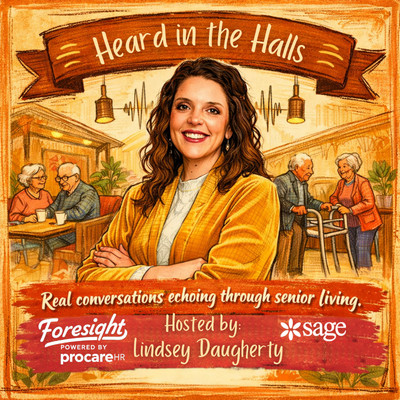
Heard In The Halls — The Series That Listens

By Rebecca Wiessmann
This article is the first in a new content creator series, Heard in the Halls, featuring Lindsey Daugherty of Sage. Listen to the first episode HERE.
Senior Living Foresight’s newest content creator, Lindsey Daugherty, doesn’t show up as a commentator who just discovered senior living last week. She shows up as someone who “grew up” in it — starting as a volunteer, then moving into caregiving, nursing, and leadership roles across the continuum.
Now, as Head of Community at Sage, she’s stepping into a different kind of role: supporting the industry at scale, while still keeping her feet planted in the realities of the floor.
What Sage Is — And Why It Matters To This Series
Sage describes itself as senior living technology built to keep up with care across the continuum. In the conversation, Lindsey puts it in plain terms: at its core, Sage is a nurse call system — but not the old “push button on the wall and hope for the best” version. Instead, she describes a mobile, app-based workflow tool that helps caregivers see who’s on shift, communicate in real time, and understand resident activity and insights.
That matters because this series isn’t just about “cool tech.” It’s about what happens when the people doing the work finally have visibility, context, and support — and what happens when they don’t.
The Premise: One Hallway, Many Truths
The title “Heard in the Halls” is not a metaphor Lindsey picked because it sounds good on a landing page. It’s a description of how senior living actually operates. In every community, the hallways are full of conversations — caregivers, nurses, physicians, executive directors, regional leaders, investors — all walking past the same residents, seeing different things, and caring about different outcomes.
And then Lindsey drops the real issue: those perspectives often aren’t connected.
The Priorities Of The Series
This series is built to surface what most people already feel but rarely say out loud:
1) Bring siloed perspectives into the same conversation.Lindsey describes senior living as “one human, many lanes” — different goals, different agendas, and not enough time at the same table.
2) Tell the truth from the floor up — not from the brochure down.The show aims for a realistic point of view that captures how care actually happens, including where communication breaks down.
3) Make room for the family voice.Families overhear fragments, get partial updates, and live with uncertainty — often without full context. The series wants families at the table, not waiting in the lobby of the story.
4) Move the industry toward proactive care and fewer “surprises.”When teams can understand what’s happening in real time, the goal shifts from reaction to prevention, better interventions, and more thoughtful care planning.
The Big Promise
“Heard in the Halls” is going to do something simple and disruptive: listen carefully, connect perspectives, and push senior living toward collaboration that feels more like a round table than a relay race.
And if it works, the payoff is bigger than operational improvement. It’s cultural. It’s trust. It’s the possibility that senior living starts telling the truth in a way that makes people lean in — instead of brace for impact.

Breaking the Silos — Introducing Heard in the Halls

A resident is one whole person. Senior living teams often approach that person from very different lanes. In this Heard in the Halls clip, Lindsey Daugherty talks about why silos happen — and what better collaboration could change.


Transcript:

So we can start poking the bear a little bit. Senior living is not just one thing.
How do you actually bring all of that together to create what’s best for residents?
Yeah — you put everyone at the same table, right? That’s exactly the issue. Everyone is telling the story from their own perspective instead of collaborating, because everyone is operating in their own lane.
There are always a lot of complaints about that in senior living, but no one really explains it. People say, ‘Everyone operates in silos,’ but then you think, how do you operate in silos if you’re taking care of the same human being?
It’s because everyone has different goals, like you said — different agendas, different things they’re trying to achieve — and they’re never really sitting at the same table talking about those things.”

Workforce Challenge

By Jack Cumming
As something of a senior housing industry junkie, I was watching the recent interview of Watermark’s Paul Boethal by Senior Housing News’s Tim Regan [Click here]. While the whole interview was interesting, Tim brought up staffing near the end. “What does staffing look like at Watermark? And generally, what are you seeing in terms of staffing conditions for senior living right now?”
Listening Beyond “Knowing”
Paul Boethal adroitly responded in very human terms, suggesting that it’s important to listen to employees, prospective employees, and leaving employees. His people sensitivity may have come from his time in military service. The military can be very people-intensive. In answer to the question, he quickly came up with something new. At least it was new to me, not as an idea, but as an idea that provided benefits that Boethal saw and I had missed.
His idea was that if you hired people who wanted to work less than the customary 40 hours a week, you might wind up with more people working fewer hours, but when there was a sudden, unexpected need, they could quickly jump up to the 40-hour mark to respond to the crisis. Responding to a sudden crisis can be time-urgent, requiring all hands on deck. Being able to pivot to answer the need is golden.
The Value of Time Management
In our emerging world of two-earner families and higher wages for workers, there are many people who are happy to work a shift for less than 40 hours a week. For the moment, we can set aside the fixed cost burdens of healthcare and other employee benefits. There are ways of managing that for those with the creativity to think beyond the norm. Minimizing those employment fixed costs allows us to consider the attractiveness of individualized shifts.
Going beyond what Boethal shared in his interview with Tim Regan, imagine that, instead of dividing the day into eight-hour shifts, we divided it instead into two-hour increments. Employees could bid on the shifts, and more difficult-to-fill shifts might come with premium compensation or other benefits to attract takers. That would bring the employment staffing model more into line with the independent contractor gig economy model.
Needs Responsive Compensation
Paul Boethal’s concept — of having more employees working shorter hours to better prepare for those times when a crisis requires existing employees to work longer — triggered Tim Regan to think of a similarly imaginative workforce idea. Tim said, “Frontier Senior Living CEO Greg Roderick talked [recently] about a community where, instead of paying higher wages, the operator switched to paying staff mileage reimbursement and solved some staffing issues.”
It turned out that the employing facility is in an area with high living costs, requiring most workers to commute a long distance to their jobs. Just increasing wages wasn’t working, and employees were leaving for jobs nearer to their homes. One employee suggested the mileage allowance, and that’s what did the trick. The takeaway: Sometimes just empathizing with employees’ challenges and responding in kind can be the medicine that cures the workforce malaise.
If meeting a mileage challenge can be that straightforward, how might the industry help young working families with childcare? For now, regulations may make that prohibitive, but regulations should serve the citizens, not inhibit the meeting of citizen needs. Effective advocacy organizations should be able to help create well-reasoned regulations instead of reactive regulations dreamt up by special interests or a defensive bureaucracy.
Just Thinking
This led me to consider a challenge that recently crossed my awareness. Responding to some resident needs requires around-the-clock presence of an RN (registered nurse). It can not only be costly to hire a nurse for the NOC (“nocturnal,” often 11 PM to 7 AM) shift, but it can also be difficult despite paying a shift bonus. For a small skilled nursing facility, such as one embedded in a life plan community (CCRC), that added cost can be prohibitive. What if, though, a NOC RN was offered a living unit on-site? No commute. That might be more attractive than merely trying to offer money.
Combine that with a more sensible approach to regulations. Proactive advocacy might allow that having an RN living on-site to oversee an experienced and well-trained LPN (Licensed Practical Nurse) to allow more residents to remain in their home, CCRC’s skilled nursing facility. If industry advocates were able to gain recognition that an on-call NOC RN was enough, then having an RN living onsite would be better.
Care Suites are an emerging alternative to skilled nursing for many common age-related conditions, but there can be reimbursement entanglements with Medicare. Also, moving a CCRC from an on-site skilled nursing unit to a care suite concept requires skillful, open interaction with residents from early in the consideration process. Too often, resident engagement is neglected, which can lead to unnecessary lawsuits.
Senior Living’s Challenge
What Paul Boethal and Tim Regan brought to light in this fascinating interview was the role that more imagination can play in improving the care delivered in senior living settings. One has to wonder why this reach for the creative solution isn’t the norm everywhere. What would it take to turn the industry from convention and follow-the-leader innovation toward the embrace of the American spirit of creative innovation? Let’s start now.

My Father Never Said I Was Right. Here’s Why That Was a Gift.

By Steve Moran
I grew up in a conservative religious family with a father who was critical of everything.
As the firstborn, I don’t ever remember him being proud of me. Not once. I grew up feeling guilty, afraid, and incompetent. I was oh so shy.
In my logical brain, I’ve worked through most of it. But on occasion, the emotions still surface and cause real suffering, even now, decades later.
For a long time, I thought my father gave me nothing but wounds.
I was wrong about that.
Continue reading on Practical Passionate Leadership (Substack) for free …

Why That “Funny” LinkedIn Post About Family Members Is Actually a Crisis

By Steve Moran
A couple of weeks ago, we published an article I wrote, and an industry friend sent me a sort of teasing email about my inability to stop ticking off (he used a slightly different term) the senior living industry.
I am going to do it again …
A few weeks ago I came across this post on LinkedIn that — as a family caregiver — really set me on fire.

The unofficial guide to family members of senior living residents.
(Written with complete love. Obviously.)
The Guardian. Has power of attorney and a laminated copy of it. Has visited twice this week. Has requested to speak with you three times. Has very specific opinions about the temperature in hallway C.
The Ghost. Has not visited since November. Calls every Friday at 4:57 PM to check in. Is always “just about to come see Mom.”
The Expert. Just read a WebMD article. Would like to discuss your clinical protocol. Has some thoughts about the medication schedule. Has never worked in healthcare. Is not deterred by this.
The Escalator. Goes directly from “I have a small concern” to “I am calling the state” without any stops in between.
The Apologizer. Starts every sentence with “I’m sorry to bother you but—” and then asks you to completely restructure your dining program.
The Resident Whisperer. Is certain their parent is unhappy. Their parent has told you multiple times they are very happy. This person knows better.
The One Who Gets It. Shows up quietly. Learns the staff names. Brings cookies for the night shift. Cries in the parking lot so their parent does not see it. Says thank you when they leave.
That last one? They are why the rest of us stay.
Which one did you meet this week?

What This Post Gets Completely Wrong
I want to be fair. The post is clever. Anyone working in senior living will recognize every single one of these characters, and yes, some of them are genuinely exhausting to deal with.
But clever isn’t the same as right. And this post … funny as it is … teaches your team something dangerous: that family members who push back are the problem.
They are not the problem. They are the opportunity you keep throwing away.
The Story I Can’t Get Past
Let me tell you about “The Escalator.”
The post describes someone who goes directly from “I have a small concern” to “I am calling the state” without any stops in between. The implication is clear; this person is an overreactor. A drama queen. An exhausting human being you just have to manage.
Here’s my experience as the caretaker of someone in senior living.
I discovered that my stepfather had gone nearly four weeks without a shower. Four weeks. I did not go straight to the state. I went to leadership first and gave them the chance to respond. They made excuses.
I didn’t call the state. Now I wish I had.
So when you roll your eyes at “The Escalator,” ask yourself an honest question: what happened before they escalated? Because in my experience, nobody starts at the state. They got there because someone like you dismissed them first.
The Real Story Behind Every “Type”
“The Guardian. Has power of attorney and a laminated copy of it …”
Maybe if you had taken the time to understand their role and what they need to accomplish, this person wouldn’t be nitpicking. Or maybe they might even have a point. Maybe they could become your biggest fan, sending you a steady stream of great new prospects.
“The Ghost. Has not visited since November …”
Maybe this person is caring for an abusive parent, doing the right thing, making sure Mom isn’t on the streets since no one else will. Maybe they’re a single parent working two jobs, barely making ends meet, so exhausted they simply don’t have the energy. Or maybe they have visited, and Mom’s dementia has progressed to the point where they don’t know what to say or how to act.
“The Expert. Just read a WebMD article …”
Maybe in doing their own research, they came across something that could actually make things better. Or maybe the hospice nurse prescribed a drug that will make things worse, because way too many hospice nurses solve every problem with another medication, and this family member is the only one paying close enough attention to notice.
“The Apologizer. Starts every sentence with ‘I’m sorry to bother you but …”
This one might actually tell you more about your culture than about them. When a family member feels they have to apologize before raising a concern, that’s a signal. It means they’ve learned from you, from your team, from the way they’ve been received before, that concerns are not welcome here. That’s worth sitting with.
“The Resident Whisperer. Is certain their parent is unhappy …”
We need honesty here. There are residents who put on a happy face with staff because they’re afraid that if they complain, they will be treated badly. It happens. So how about this: when the “Resident Whisperer” comes to you with concerns, you actually pay attention and see if you can make it better instead of using the resident’s own fear-based politeness as evidence against their family.
The Cookie Problem
Now let’s talk about “The One Who Gets It.”
Shows up quietly. Brings cookies for the night shift. Never makes a fuss. Says thank you when they leave.
They are why the rest of us stay.
Read that again. The post is telling your team and telling your industry that the ideal family member is the one who never complains. The one who shows gratitude. The one who brings treats.
The one who, in other words, makes your job easier.
That is a deeply dangerous message. Because what you’re actually training your team to value is compliance over accountability. You’re telling them that the family members who ask hard questions, who push back, who refuse to accept a non-answer are the problem. Something to be managed and mocked in LinkedIn posts.
Meanwhile, those are exactly the people most likely to catch something you missed. They are the ones who notice when a resident hasn’t had a shower in four weeks.
Your Complainers Are Your Best Asset
Every business in the world has people who complain. And the ones who can make you truly better are not the ones bringing cookies.
When people complain, you have two choices: see them as troublemakers making your life harder, or see them as people who want things to be better and believe you’re capable of it. The vast majority of complainers are in that second category.
They leave Google reviews. They talk to friends and acquaintances about your community. They shape how their entire network thinks about senior living as an industry. You can dismiss them, roll your eyes at them, give them clever nicknames on LinkedIn, and none of that will make a single thing better.
Your agitators want you to be better. 
And when you are better, they will become your biggest evangelists. They will make it possible to reduce your paid advertising to nothing. They will save you tens of thousands of dollars in referral agency fees. 

A Welcome Spam Message

By Jack Cumming
Like most of us, much of my daily email is spam. It’s annoying and often worse. Much of the time, what’s touted is clearly an attempt to sell an inferior product or service. Sometimes, it verges on fraud and, occasionally, it is attempted fraud.
But, not long ago, I got one of those spam messages for a product that really appeals to me. The spam came from Babylon Micro-farms in Richmond, VA. The spam email offered a one-click link to a YouTube tour of Babylon’s office. The tour is led by Sharon Rettinger, Babylon’s National Sales Director. There are many lessons in this simple example to help senior living better achieve its purposes.
Gaining Credibility
The video appears to be locally filmed without that superficially slick quality characteristic of most professional produced videos. Frankly, at least for me, that homemade feeling gives greater credibility to the message. Imagine, what senior living communities might do with a homemade video tour of the campus. Featuring resident testimonials could give it a credibility boost.
But, back to Babylon. The idea of a micro-garden or a micro-farm, created with a modern technology like hydroponics, is something that might appeal to many residents. Merely having such a project on the premises would immediately establish a senior community as hip and with it, embracing the latest science has to offer.
B2B or B2C?
Of course, I have no idea whether Babylon is the value leader or not. What they seem to offer, though, is a turnkey way to display micro-farm freshness and cleanliness, a key attraction for a Life Plan Community (CCRC). I can’t think of anything that would better dispel the impression of old people’s communities as musty, institutional, and dated. Those fresh greens – imagine an entire wall of them – herald a healthy lifestyle and fresh dining.
The one thing I would change would be to shift the Babylon pitch from a B2B appeal to providers to one directed toward residents. I understand, though, that the only drawback to that is that in many communities staff chooses and funds most of the decisions, even when a project like hydroponics might appeal to residents.
The more progressive approach is to give residents control of many decisions as citizens of their senior community, but that is not yet widespread enough for it to make sense for a vendor like Babylon. Most senior housing operators continue to provide institutional facilities with residents unable to spend corporate funds. An entrenched industry cannot be expected to suddenly shift the power balance toward residents and their families.
Learning From Others
Stepping back for a moment, or longer, from the Babylon example, there is much to be learned from a spam message like this that causes people to hesitate before hitting delete. To begin with, the visual is appealing, and the glimpse of fresh vegetables immediately catches one’s eye. Quick impressions are paramount when you are sending spam.
More important, though, is that that first positive instant impression. That is seldom the case with senior living, though there are often pictures of young oldsters enjoying a social moment together. Less appealing, are pictures of an institutional looking building entrance which shouts “facility” as much as the industry may decry that term.
That instant positive eye candy is enough to raise those Babylon click throughs, and the click immediately starts a video interaction with Sharon Rettinger who is clearly more interested in you than in her need to make a sale. That raises the question of how we might make an initial video more about the customer and less about the facility.
Alternatives to Convention
Perhaps, a short dramatic story — a mini-play — could create something people can relate to. Instead of making us teary-eyed about an old man struggling to stay fit, it might be better to show a drama that we would want to be part of. That old man may be the way you view your parents or your granny, but it’s not a situation that makes you think, “I wish that were me, and I could be doing what he’s doing.” How about a scene of a resident mentoring a young employee?
You may be thinking, “Hey, this is just common sense,” and it is. Why then isn’t it more common? I’ve always wondered why common sense is so uncommon. What do you think? For the linked video from Babylon micro-farms, click here.

They Can’t Follow a Vision They Can’t See

By Steve Moran
She had worked there for six years.
Six years of showing up, doing good work, caring about her residents. She knew their names. She remembered their families. She stayed late when it mattered.
She was a way-better-than-average team member. But she didn’t love her job. If anything, she was quietly resentful.
One day her immediate leader asked her a simple, even obvious question, just casually over coffee: “What do you think we’re really here to do?”
After a long, long pause.
“Take care of people?”
It wasn’t a terrible answer. But it wasn’t the answer. It was an aha moment for the leader; after six years of staff meetings and all-hands updates, countless staff trainings, and framed mission statements in the lobby, the best she could come up with was an answer that was more of a guess than a conviction.
I want to be clear here: This was not a team member failure. It was a leadership failure.
Here is the uncomfortable truth: your team cannot be guided by a vision they cannot articulate. And most of them can’t articulate it. Not really. Not in a way that would change how they make decisions on a Tuesday afternoon when you’re not in the room.
The good news is that there is an EASY FIX.
This works whether you lead an entire organization, a region, or a department of five. Just scale the vision to what you’re responsible for.
Continue Reading on Practical Passionate Leadership (Substack) …

The Virtual Clinic

By Jack Cumming
Imagine never having to leave your home to receive routine medical advice. For now, people regularly have to go to a doctor’s office in order to consult a physician about what’s concerning them. It may be life altering, or it may be nothing. For most non-emergency medical interactions, the physician’s office is a starting point.
The Congregate Advantage
That may soon change with the enormous advance unleashed by the rapidly expanding capabilities of neural network based artificial intelligence. Soon, if technological deployment follows its potential, we’ll be able to complete those initial interactions with a doctor by just picking up our smartphone and having at it.
The opportunities for senior living are enormous. If a person aging in a single-family home, can have easier, more productive medical access from there, think of how much more is possible for a cluster of older people, most of whom are intensive users of medical care. Picture a clinic suite set aside on the senior living campus.
As medical equipment is developing, it is becoming more intelligent and sufficiently automated that a bright person can quickly learn to operate it. For instance, looking at the retina can be like having a window into the vascular and other structures of the inner body.
Such an onsite clinic can be equipped with a digital retinography system. My most recent DRS exam was reviewed by a costly Ophthalmologist, but one has to believe that AI might do the review more systematically, with greater insight, and at lower cost. This is the kind of special application robotic solution, i.e., the DRS equipment, that is likely to be most effective with AI enhancement.
The Opportunity
The cost is more than an individual might buy but bring 200 or 300 residents together on a campus and an investment of roughly $15,000 in a critical device can make sense. It becomes a reason for people to move into congregate living, say a CCRC, rather than staying put in their own homes.
Checking for common afflictions of old age, e.g., hypertension, balance, incipient diabetes, etc. can be done more conveniently, at much lower cost, and with more empathy than in today’s impersonal medical system.
There is a money opportunity as well, as such onsite services can be integrated into the larger medical reimbursement system. Our national medical system is a mess, high cost without commensurate outcomes, so evolution is inevitable. Congregate living offers the opportunity to be on the cutting edge of that evolving reform.
How We Got Here
We’ll look at how we got here as a way of grasping fully the emerging opportunities ahead. Not all advances in medicine have been positive. At one time, we had a doctor who not only made house calls, but who also knew us and our health history because of the close relationship families had with their family doctor. Since then, medical practice has become much more complex but also rushed and, increasingly, impersonal.
One of the unforeseen developments, possibly related to the 1965 health insurance enactments, was the exponential growth in medical specialties and subspecialities. The relationship with a family doctor changed, just as ads began to appear advising us to “Ask your doctor.” We only saw our family physician briefly before being referred to a specialist.
High-Cost Specialists
As it now turns out, as our bodies age and our frailties increase, we acquire an entire bevy of specialists. Since many older people no longer drive, or are reluctant to drive, an unfortunate concomitant is that people spend inordinate time getting to and from doctors’ visits that are no more than routine.
Despite the commonsense solution of video visits, the complexities of that 1965 Great Society reimbursement structure, and its later amendments, have prevented such convenience from taking hold.
At least, though, through much of these transition decades, if we went to the hospital, there was a physician we knew there to help us through those dire moments. He was usually our family physician. He knew us. Not anymore.
Alone In the Hospital
Not only don’t physicians make house calls anymore, but they also don’t go to hospitals. Instead, in our moment of greatest anxiety, we are greeted by a stranger, a hospitalist, who takes over our care. He knows the hospital, but he doesn’t know us.
This depersonalization of the physician relationship is likely to help hasten the transition to a more empathetic AI virtual care interaction which will be more comprehensive than the most gifted specialists. We wrote about that in an earlier article. It appears that change should come soon to medical care. We’ll need fewer of those high-priced, super whizz specialists, and more nurse-type nurturers to bring care to medicine.
Sooner or Later?
How quickly, might these changes come about? That’s up to the marketplace. Already some senior living enterprises are embracing the potentiality by having inhouse Medicare Advantage with characteristics for middle income and more affluent people derived from successful PACE (Program of All-inclusive Care for the Elderly) concepts.
Change could come quickly. Just look at how quickly we absorbed smartphones into our daily lives. AI delivered medical information and recommendations can come into our lives just as rapidly as smartphones have over the past decade and a half. That means that by 2040, not so long from now, AI delivered medical care may be norm.
Once we experience better medicine, with greater convenience, at lower cost and get used to it as we got used to automated banking, we will love it just as we now love having smartphone information at our fingertips, all day, every day, everywhere.
This is part of a series considering how AI, robotics, and technology in general can take senior living from laggard to leader.  

Are You Defining Excellence Completely Wrong?

By Steve Moran
Conventional wisdom says high returns and high margins equal excellence. This is backward, short-term thinking. Need proof? Ask the shareholders of Blockbuster, Kodak, and Palm Pilot. Even today, companies like Intel and Boeing are struggling because of their focus on margins.
The problem is that when you focus on margins, your thinking is always short-term.
I have seen this so many times in senior living. A company opens a new property in a high-demand market, and it fills in a matter of weeks. It is easy to assume the company, the executive director, and the sales leader are brilliant.
Nope, they got very lucky.
I got to thinking about this after reading a piece from Admired Leadership that stopped me cold. The core idea is deceptively simple:
Excellence is not an outcome. It’s a standard for how you do the work.
Continue reading on Practical Passionate Leadership (Substack) for free.

A Chief Elder Officer’s Plan To Fix Home Care’s Broken Math

By Rebecca Wiessmann
In a Tech Tuesday conversation, Steve sits down with Neal K. Shah, the CEO of CareYaya, to explore a deceptively simple idea: technology should scale human connection, not replace it.
It’s an episode that starts with a headline-grabbing title — “America’s Chief Elder Officer” — and quickly turns into a serious discussion about workforce shortages, the economics of home care, and why “relational care” matters more than the checklist.
The “Chief Elder Officer” Idea Is A Marketing Hack — And A Movement
Neal doesn’t pretend the title is conventional. He calls it a marketing hack — a fast way to signal what he’s about. But he also frames it as aspirational: society is aging fast, the care workforce isn’t keeping up, and the issue deserves more policy attention and more innovation.
He argues that aging is one of the largest, most under-focused realities in the country — despite the size of the older population and the resources tied to it. In his view, the U.S. needs the equivalent of a national-level role that takes aging and caregiving seriously, not just as a social issue but as an economic and workforce challenge.
From Hedge Funds To Caregiving
Neal’s origin story isn’t “lifelong health care guy.” It’s finance.
He describes coming from a middle-class background, attending the University of Pennsylvania, and shifting from computer science to finance after the dot-com bubble burst. In his 20s and early 30s, he built a career in hedge funds — eventually launching his own fund and growing it substantially.
Then life hit.
He became deeply involved in caregiving for his grandfather through dementia and other serious health challenges and later became the primary caregiver for his wife through a multi-year cancer battle. Those experiences have reshaped how he thinks about time, impact, and what “work” is for.
He wound down his fund, stepped fully into caregiving, and then turned his attention to building something that could make care easier for other families.
The Broken Economics Of Home Care
Neal describes the home care market as massive — but structurally broken.
He points to a user experience that often feels like a bad deal for everyone: families pay premium rates, caregivers receive a fraction, and quality can be inconsistent. He argues that when a large portion of the hourly rate goes to the agency’s overhead and acquisition costs, the person doing the work isn’t rewarded — and the family still feels like they’re rolling the dice.
He also describes why so many families move to the “gray market”: hiring directly through personal networks or online listings, managing vetting and scheduling themselves, and hoping nothing goes sideways. That path can work, but it creates friction and risk — and families often end up becoming unpaid care coordinators on top of everything else they’re already doing.
Relational Care Over Task Completion
Steve brings the discussion home with his own reality as a family caregiver. His almost-93-year-old stepfather lives in a small, high-end community and needs more one-on-one socialization than the community can realistically provide. Steve describes paying someone directly — “gray market style” — not for medical care, but for companionship: conversation, outings, waffles, football talk, human presence.
Neal lights up at that example because it illustrates what he believes the industry underprices and under-measures: the relational aspect of care.
He references “Who Cares: The Hidden Crisis of Caregiving, and How We Solve It” by Emily Kenway, noting that caregiving is often defined as tasks completed rather than the lived experience of the person receiving care. In Neal’s framing, care isn’t just what got done — it’s how someone felt while it was happening.
Why Students Are The Secret Workforce
CareYaya’s core model is straightforward: connect older adults who need help and companionship with healthcare-track college students who want meaningful experience.
Neal’s argument is that this labor pool is overlooked because it doesn’t fit the traditional home care staffing model. Students generally can’t do 40 hours a week as a long-term career, but they can do flexible shifts — and they’re often highly motivated, mission-driven, and incentivized to show up and do a great job because they want recommendations for medical school, PA school, nursing programs, or other clinical paths.
He also emphasizes incentive alignment: students want experience; families want reliability and connection; and the model is designed to reduce friction through technology — scheduling, vetting, background checks, and ongoing matching — without the “half the money disappears before it reaches the caregiver” problem.
Senior Living As The Next Frontier
Neal says CareYaya currently operates primarily as a consumer platform — adult children booking support for parents at home — but he’s increasingly seeing demand from families with loved ones already living in senior living communities who want supplemental one-on-one engagement and support.
He signals that partnerships with operators are a major strategic priority for 2026 and makes a striking claim: in some markets, CareYaya has more student caregivers available than it has families booking hours, largely because the company’s growth is driven by organic awareness rather than heavy advertising.
He also discusses research-oriented collaborations, including work supported by National Institutes of Health funding.
Yaya Bear And The Idea Of Tech That Brings People Together
One of the most intriguing parts of the conversation is Yaya Bear, which Neal describes as a voice-AI-powered soft teddy bear designed to spark meaningful life-story conversations.
He frames it not as “AI replaces companionship,” but as “AI helps structure and unlock it.” A student can bring the bear into visits, engage alongside the older adult, and over time, the conversations help capture life stories that can be shaped into a narrated autobiography. The idea is less gadget and more catalyst — a tool that helps two humans talk better and go deeper.
A Moonshot: Build A Tech-Native Community
Near the end, Neal shares a big, spicy idea for senior living: don’t just sell tech into communities — build a community that is tech-native from the start.
He references General Catalyst and its approach to health care, arguing there’s a similar opportunity in senior living: buy or build one community and “run it backwards,” integrating technology as the operating philosophy rather than bolt-on tools.
To frame the mindset, he points to “Ask Your Developer” by Jeff Lawson and the essay “Software Is Eating the World” as influences — not as slogans, but as a call to redesign the experience from first principles.

S8 Episode 2 – Dementia Training, CDP Certification, and Better Senior Living

What happens when someone enters senior living with zero industry background — and discovers a mission worth staying for?
In this episode of Foresight Radio, we sit down with Rebecca Barker, VP of Business Development at the National Council of Certified Dementia Practitioners (NCCDP), to talk about her journey from HR software sales into the heart of dementia care education.
We explore:

Why senior living conferences feel like the “new kid in school” — and why that’s a good thing
The surprising passion that keeps professionals in aging services
The dangerous gap in dementia education for frontline caregivers
How live dementia training improves retention, confidence, and census
Why CDP (Certified Dementia Practitioner) certification builds pride and professionalism
The connection between training, family satisfaction, and occupancy growth
What it really means to set a national standard in dementia care

Rebecca shares how NCCDP’s live, instructor-led dementia certification differs from “click-through” compliance training — and why investing in education directly impacts staff retention, fall rates, deficiencies, and family trust.
If you’re a senior living operator, executive director, HR leader, or memory care professional, this conversation will challenge how you think about workforce development, dementia care standards, and long-term sustainability.

Are Staffing Ratios Intelligent?

By Jack Cumming
Staffing ratios have been much in the conversation about how care facilities should be regulated. The notion is that more care workers per patient is positive and that, therefore, care homes should be required to meet minimum staffing numbers.
Better would be a requirement that care providers meet quality, safety, and effectiveness standards. The mission for care is the well-being of those cared for. Mere staffing may not always be the best approach.
Mandated staffing ratios ignore the potential of emerging technologies. Let’s instead improve the quality, convenience, cost, and effectiveness of all we do, including caring for the frail and failing. This is a pressing opportunity for proactive advocacy by the trade associations that serve senior living. Aging people can benefit from progress, and trade associations are in the best position to help legislators and regulators better understand what’s possible.
Just One Example
Take something as common as the need of a resident (“patient” in medical parlance) for a two-person transfer. Transfers may be from a bed to a gurney, from a bed to a wheelchair, from a wheelchair to a chair, or from a wheelchair to a toilet.
The need for two people arises when the resident is too weak, unsteady, or otherwise unable to move safely or if the resident is overweight, unable to cooperate, act predictably, or bear weight on both legs. The purpose of requiring two people to assist with the transfer is to promote safety and prevent staff injury.
Obviously, such a transfer requirement directly affects the need for staffing, though automation can help alleviate such a need as well as help with bedsore wound avoidance. It’s not hard to imagine mechanisms or devices that might be devised to address these challenges. Japan, which has a much higher proportion of older people than the U.S., is already ahead in adapting to the need to assist older people with fewer staff.
Automation Barriers
We can ask why such automation is not more available in the U.S. After all, we pride ourselves on being technologically advanced. Several possible barriers come quickly to mind, though these are purely speculative. Here are a few such speculations:

An industry that prides itself on its personal touch approaches automation with skepticism.
Many eldercare functions are treated as medical, requiring expensive, delaying regulatory approvals.
Other markets for inventive creativity are more promising and lucrative than eldercare.
Mandated staffing ratios inhibit technological solutions that might provide better care at lower cost.

Obviously, the list could go on. The economic culture in the U.S. has long emphasized jobs as essential, though robotics and artificial intelligence may change that in the near future. The jobs culture is a byproduct of the industrial revolution, which is now giving way to the robotic revolution. Still, the mandating of staffing ratios may reflect the prevailing political belief that creating jobs is economically positive.
Change Takes Time
We’re only at the very beginning of a new age of labor transformation. We’ve already seen how it’s taken thirty years for society to absorb the benefits of the internet. Only now, for instance, is streaming replacing previous broadcast technologies. More and more productive efforts are now delivered remotely. Change takes time and is nearly always slower than anticipated.
In the meantime, the most constructive thing that might be done would be for the industry’s advocacy associations, LeadingAge and others, to proactively encourage automation. The emphasis should not be on staffing ratios or on merely opposing staffing ratios. The emphasis should be on improving the quality of life and care for those adversely impacted by age-related inabilities.
Realistically
We also need to be realistic. Automation can help free staff time to provide better personal interactions, but the telling impact will result in a reduction in staff. That will then free people for more meaningful work in other callings. A number of social programs have been proposed to help with the transition from jobs to meaning, but that challenge is beyond the scope of this article.
Robotics and artificial intelligence are likely to directly impact the affordability of providing care in institutional settings. They also seem likely to enable better care at a lower cost. Employment generally will probably be more meaningful for those staff members who adapt and remain. That’s been the case historically as technology has disrupted other industries.
Aside from technology’s ability to improve corporate caregiving, however, its bigger effect is likely to be in allowing aging people to stay longer in the general community without needing senior living as we now think of it. That is in evidence at the 2026 Consumer Electronics Show, where AARP is showcasing numerous initiatives to improve the consumer’s aging experience. Click for the agenda.
The overriding mission of the senior living industry, its regulators, and those it serves is to help older adults live with dignity, independence, health, meaning, security, and purpose in their communities. We do that best when we collaborate and innovate together to adapt emerging capabilities to those aims. As Dan Williams puts it in his recent Turnaround book, “Residents thrive. Families find peace. Teams discover purpose. Even when the odds say it shouldn’t be possible.” Isn’t that what we all would like?

50 Ways to Stay Out of Senior Living – An Ode to Paul Simon

By Steve Moran
I know I have a weird mind, and I spend way too much time going down rabbit holes, into strange cracks and crevices, wondering about all kinds of things.  I sometimes wonder if it is a bit like taking an acid trip without the acid. 
Driving Down The Highway …
I was recently driving down the highway listening to oldies when Paul Simon’s song “50 Ways to Leave Your Lover” blasted through the speakers. It sent me down one of those rabbit holes, and I found myself wondering if I could come up with a list of 50 ways to stay out of senior living (with a little help from AI, of course).
Just for fun … mostly … 
50 Ways to Stay Out of Senior Living
(To the tune of “50 Ways to Leave Your Lover”)
[Verse 1]
“The problem is all inside your head,” he said to me“The answer is as simple as a low-sodium teaI’d like to help you keep your house and live it fancy-freeThere must be fifty ways to stay out of senior living”
He said, “It’s really not my habit to intrudeBut if you’re eating pureed carrots, well, you’re in a sour moodI hope my meaning won’t be lost or misconstruedBut we’ve got fifty ways to stay out of senior living”Fifty ways to stay out of senior living
[Chorus]
You just hide the brochure, StanGet a master plan, FranDon’t act confused, LeeJust keep the front door keyHop on the treadmill, PhilHide every little pill, BillDon’t let ‘em see the cane, JaneAnd keep yourself free
(Repeat Chorus)
[Bridge] (Tempo slows, slightly ominous)
Now, the lawyer’s in the parlor and he’s looking at the booksHe’s got that “Medicaid-is-coming” kind of hungry, legal lookHe says, “You gave away the lake house back in 2022“That’s a five-year look-back penalty — now whatcha gonna do?”I said, “I’ll bury all the silver and I’ll hide the family van,Because a nursing home’s a prison for a self-respecting man.”
[Verse 2]
He said, “It grieves me so to see you in such fearOf a place with bingo night and lukewarm root beer”I said, “I appreciate that, but could you speak into my good ear?About the fifty ways”
He said, “Why don’t we both just sleep on it tonightAnd I believe in the morning you’ll see the light (As long as you can see the light without a nightlight)There are fifty ways …”
[The “Fast-Talk” Verse] (Match the rhythm of the rhyming names)
Hide the cane, JaneFake a sprint, ClintLose the walker, WalkerDitch the bifocals, localsDye the hair, BlairStand up straight, NatePass the test, BessKnow the date, KateRecall the name, BlaineDo the Wordle, MyrdlePost a reel, NeilUse the App, CapText with speed, ReedOrder Uber, HuberBuy a dog, LogHost a rave, DaveMow the lawn, DawnPaint the trim, JimStay out late, NateDon’t go to bed, RedJust don’t go, Joe …
[Outro]
You just hide the brochure, StanGet a master plan, FranDon’t act confused, LeeJust keep the front door key
(Fade out with: Fifty ways … just don’t let ’em catch you, Joe … stay out of the gulag …)
Now if only someone would perform this …
I have a few more lists coming. 

Battle of the Bots: Healthcare Denials

By Jack Cumming
Recently, I attended a webinar titled, The Winning Edge for Defeating Denials, put on by HealthLeaders and sponsored by Aspirion, whose “mission is to get providers paid accurately, quickly, and transparently.” You likely don’t need to be told that denials are an increasing barrier to prescribed treatments.
Complexity
One takeaway from the webinar is that there is an enormous number of payers as well as a huge number of providers. The providers deliver care, but they depend on revenues in the form of reimbursements from payers. Payers may be government, commercial insurers, self-funded programs, or even individuals.
Obviously, payers benefit by finding a pretext to deny or reduce payment, while providers depend on payments for their financial survival. The complexity of the potentially adversarial system was the topic for the webinar. The conversation was eye-opening.
Is It Really This Bad?
That this is a hot mess, to speak colloquially, was brought home to me by a post on LinkedIn by Trevor Daer of Granite Peak Analytics, LLC, who posted his 80/20 rule for advisers in the benefit space. He wrote, “20% are REALLY good at what they do AND operate with integrity…. 80% are not great as an advisor but pretty good at making money.”
We’ve been reading and hearing anecdotally about denials, which can sometimes be tragic. What we haven’t heard as much is that many payers, though not all, are deploying sophisticated artificial intelligence (AI) “reviewers” to systematically deny claims that don’t meet stringent standards for medical necessity, eligibility, and more.
The Battle Joined
Not surprisingly, many providers — especially hospitals — are beginning to use AI “appealers” to respond to the bot-generated denials. Thus, there can be a “battle of the bots” lacking any human intervention. Lost in this revenue-enhancing emphasis is the patient whose treatment may be delayed or denied altogether.
Patients ought not be harmed by conflicting payer/provider wishes. The provider is the licensed expert determining what treatment is appropriate in any given circumstance. Like any expert determination, that decision can be appropriately challenged. But — and this is a very big BUT — the patient should not be the one who is disadvantaged.
Common Sense
If a physician or other medical expert orders a medical response to a patient’s condition, that expert directive should be carried out as ordered. There may be a medical review, but it shouldn’t be at the hands of the party with merely a financial stake. If then the payer successfully sustains the denial, it’s the errant provider who should bear the burden, never the patient.
Ideally, the interests of the payer and the provider would be closely aligned, but the proliferation of payers and providers makes that problematic. A different system from today’s piecemeal fee-for-service concept can help, but our system has become politicized in a way that prevents optimization.
AI offers the potential to make affordable healthcare available to almost all Americans, but no one, other than those who are mercenary, benefits from deploying AI bots to battle heartlessly with each other. We need to rethink the system.
The Bright Potential
The senior living industry has expertise in the care of the elderly. Older people constitute the highest-cost demographic for medical interventions. Still, even senior living is not exempt from the equivalent of those decried denials that we so often read of.
If a senior living care provider implies lifetime responsiveness but is not fully licensed, equipped, or staffed to meet all needs falling within that care scope, then that is tantamount to a denial.
What’s To Be Done
If the size of the facility impedes the financial feasibility, say, for mandated staffing licensure or ratios, then there is a need to rethink the business model or the offering itself. Type A contracts, if sensibly administered, may offer one solution. Type A contracts assume reserving actuarially during the years of independent living for the time of care dependence. Thus, reserve releases can help support care finances.
It may be, too, that shortsighted regulation is misguided with unintended negative social consequences. Correcting such political misperceptions is the justification for industry trade associations. Whether regulation is proactively sensible or merely negatively reactive is a measure of how effective such associations are in carrying out their mission.
In terms of pure financial feasibility, emerging technologies, including robotics, can help make feasible what now may seem counterindicated. Let’s at least put these issues on the industry’s discussion/decision agenda. That, too, is an area in which trade associations might lead. Trade associations are at their best when they lead their industries into the future instead of defending the status quo and opposing regulation.
This is part of a series considering how AI, robotics, and technology in general can take senior living from laggard to leader.

Leadership Lessons From a Hot Dog Stand

By Steve Moran
I came across an Instagram post about Portillo’s, the Chicago-born hot dog chain with 90+ locations. They figured out the front-line staffing problem and are making serious profits. They have a very unique approach to paying frontline workers.
The Story
Here’s the short version: Portillo’s pays employees more for learning extra stations. Not for seniority. Not for years of service. For skills. The result? $8.5 million in revenue per location and the lowest employee turnover in fast casual dining.
If you run any kind of business where frontline workers are the engine — restaurants, retail, healthcare, hospitality, manufacturing, senior living, logistics — this should stop you cold.
Continue reading on Practical Passionate Leadership (Substack) for free.

Why Senior Living Advocacy Matters More Than Ever

By Rebecca Wiessmann
Steve sits down with Brian Perry, government affairs and advocacy leader, at Direct Supply’s Technology and Innovation Center. What follows is the first of a three-part series drawn from the interview.
Who is Direct Supply?
Before we dive into the interview, I want to introduce you to Direct Supply and their new creator channel, Directly Speaking.
Direct Supply is a Milwaukee-based company that has spent nearly four decades building itself into a “behind-the-scenes infrastructure partner” for senior living and post-acute care providers — supplying products, procurement, technology, and design/build support that help communities operate day to day. 
Today, Direct Supply positions itself as a single-source partner for operators — spanning equipment & furnishings, purchasing/procurement solutions, and building/operations-focused technology (the kind of tools that support life safety, maintenance, and facility workflows), plus design and project services that help communities plan and outfit spaces.
They also invest heavily in innovation through their Innovation & Technology Center (where Steve joined Brian for this interview) in the heart of the Milwaukee School of Engineering campus — a renovated historic building used to test, validate, and develop new approaches and tech tied to senior care.
And importantly for this series, Direct Supply has built a dedicated advocacy engine, including Direct Supply Senior Living Advocacy (organized as a 501(c)(4)), aimed at influencing policy and public narratives affecting senior care access, workforce, and reimbursement.
You can learn more about Direct Supply by visiting their website.
A Career Built Around The Messy Stuff
Brian Perry has spent two decades working in the part of senior living most people prefer to avoid — the political machinery that shapes reimbursement and regulation. He starts in public policy, learns the Medicaid/Medicare world at speed, and eventually lands at Direct Supply to focus on advocacy full-time.
He doesn’t romanticize it. Advocacy is where you fight battles you didn’t ask for, in arenas you don’t control, with rules that change depending on who won the last election.
The Big Issues Haven’t Changed — But The Stakes Have
When Steve asks what issues are biggest right now, Perry gives an answer that sounds like it could have been true 20 years ago: payment and regulation. On the skilled nursing side, he describes the long-running reality of being under-reimbursed and overregulated.
He also lays out the political pattern he’s seen repeatedly: Republicans often mean tougher fights for dollars and some easing of regulations; Democrats often mean more regulatory pressure and better odds on funding. Either way, it’s never calm. There’s always defense to play and always offense.
“Non-Regulatory” Is Really “Pre-Regulatory”
Steve breaks senior living into nursing homes, assisted living, and everything else — including what feels “non-regulated.” Perry pushes back hard on that framing. In his view, the less-regulated parts of the continuum aren’t protected — they’re next.
He calls it “pre-regulatory,” pointing to what he sees as regulatory creep, especially when one segment has already been squeezed, and advocates, attorneys, and policymakers start looking for the next target.
The Bad Operator Problem — And The Much Bigger Story Problem
Steve raises the industry’s hardest public challenge: cynicism, negative headlines, and the reality that some operators do harm.
Perry’s response is blunt: every field has bad actors. The larger question is whether the system can root out the truly bad players without building a regime that punishes everyone else.
Then he pivots to what he thinks is senior living’s most consistent failure: storytelling. For every ugly headline that grabs attention, there are tens of thousands of everyday “quiet wins” — care moments that don’t go viral — happening daily. Perry argues that advocacy isn’t just about rates and rules. It’s also about telling enough true stories that policymakers, voters, and media stop defaulting to the worst narrative.
The Guiding Star
Perry keeps returning to a simple principle: anything good for seniors is good for providers, and anything good for providers is good for the entire system. When advocacy is anchored there, it becomes harder for agendas and turf wars to hijack the mission.
Watch the full conversation with Steve and Brian Perry on YouTube.

What If Senior Living Leaders Led Like Lindsey Vonn Skied?

By Steve Moran
The Olympics are over, but I am still obsessed with Lindsey Vonn’s story. She continued to pursue her passion of being the best downhill women’s skier in spite of criticism, in spite of injuries, in spite of her age.
What It Took
She accomplished what she did only by being obsessed with being the very best. She spent time in the gym, she spent time on practice race courses, she submitted herself to coaches and experts who both told her what she was doing wrong and helped her find better ways.
Mostly, she was never content with where she was. She never once gave up on the idea that she could be better than she was — even when she was the best in the world.
Setbacks
She had so many setbacks … (here are just a few of them):

2007 — season-ending ACL sprain at the World Championships
2009 — sliced open her right thumb on a broken champagne bottle while celebrating a win, cutting a tendon and requiring surgery
2010 Olympics — came to Vancouver with a bruised shin so painful that putting on a ski boot was “excruciating”
2011 — concussion in a training crash one week before the World Championships; competed anyway
2018 — completely tore her LCL and suffered three tibial plateau fractures in her left leg in a training crash
2024 — underwent a robot-assisted partial knee replacement, using it as a springboard to return to competition

Not a single one of them caused her to quit.
The Lindsey Vonn Standard for Senior Living Leadership
What would it look like if senior living leaders were single-minded about being the best leaders in the world? Not “the best that you can be” — that phrase sounds more like an excuse than a standard.
I’m talking about leaders who, no matter how good they are or how successful they are, constantly strive to be better. Leaders who value their critics more than their fans. Leaders who are always learning, always self-evaluating. Leaders who take risks — and go for it.
The Gate at the Top of the Mountain
Being a senior living leader is a lot like standing in the starting gate of a downhill race. There are three choices:

Decide the risk is too great, walk away without competing, and find the easy way down the mountain — or ride the chairlift back down. It’s safe, but it has no value.
Start the race, but play it safe. Don’t go too fast. Just get down the hill without taking too many risks. This will get you to the finish line, and you probably won’t fall — but it’s not impressive. No one remembers those who finish in last place.
Go for it with everything you have. Understand there are risks. Over the course of your career, going for it will mean some falls and some injuries — but those falls and injuries become learning experiences. Lessons that make you better. Lessons that others will learn from too.

If senior living were full of Lindsey Vonn-style leaders, we would be transforming the world of aging. We would have people begging to work in senior living communities. We would have older adults scrambling for too few senior living units. We would have more brand-evangelist family members singing our praises than we can possibly imagine.
It’s up to you; you are at the gate every day. How are you going to run the course?

I Bet You Didn’t Know …

By Steve Moran
You spend so much time at work. The same is true with your team members. Two questions for you:

How much do you really know about them — who they are, what they do?
How much do they really know about each other?

Your first response could very well be that you don’t really care, or at least that it doesn’t matter. You should reconsider because when people are friends at work, they are much less likely to quit — and they are happier.

Beyond that, the people you lead are more than their job titles. They are the sum of everything that happened to them before they ever walked through your door. The childhood that shaped them. The struggle that tested them. The person who believed in them when it mattered most.
When you know that about someone, everything changes.
Try this powerful and simple exercise …
Continue Reading on Practical Passionate Leadership (Substack) …

Our Healthcare Opportunity

By Jack Cumming
Never before in the history of humankind have we had the healthcare-enhancing opportunity that we have now, in this moment.
AI Hopes; AI Fears
That opportunity exists within the technological miracle that we call “artificial intelligence.” AI can conduct a conversation with a layperson much like the conversation that occurs every time a physician hosts a “patient” in a clinical office.
At Davos, Bill Gates explained how this revolutionary capability can bring to the neglected peoples of the world the same access to healthcare information that wealthy Americans have with their access to the most knowledgeable physicians, specialists, and subspecialists.
Imagine a person concerned about possible malaise or abnormality able to instantly talk with a smartphone. The AI-empowered smartphone can quickly access the best information that all those physicians, specialists, and subspecialists have developed and mastered. The fear is that AI may make mistakes. Physicians, too, not only make mistakes, but they may also downplay that which later proves to have been urgent.
The Changing Role of Physicians
Most of the pundits have seen AI as helping primary care physicians serve more patients per day than has been the case in the past. That assumes that current structures remain. Click here for a Tedx Talk that reflects this thinking. The example given in the talk is doubling the patient load from about 30 patients a day to 60.
Personally, I trust AI more than a physician for whom I am just one of 60 in what must be an exhausting day. Even if a patient load of 30 per day is on the high side, it’s hard to imagine a physician who sees even 15 patients a day giving each the focus that best practice might demand.
The bigger opportunity, though, lies in improving the quality and relevance of that initial interaction while dramatically reducing the cost of healthcare delivery. Consider AI that does the whole job without high-cost human physician intervention at all. Is palpation of the abdomen called for? Ingenuity and medical engineering can deliver that. The same is true for most of what occurs during that initial visit.
Not only that, but it can also avoid the need for specialist and subspecialist referrals since AI, once trained, tested, and proven, can embody all of that knowledge. It can do it dispassionately, encapsulating intuition and gut feelings, and with more know-how than any human would be capable of mastering in a lifetime of study and clinical practice.
Pushback
It seems unbelievable. Skepticism is the reaction one gets when speaking of this possible future. That skepticism soon becomes fear. Fear is the engine for reactive regulation. That, too, is very human. As creatures, we are more emotional than rational.
Of course, there’s no assurance that such a future will materialize into reality. There are political and economic interests embedded in the status quo. Many ideas that are positive from an objective scientific and engineering perspective fall short due to negative political interventions driven by economics and catering to human fears of change. Still, the potential is there if we are able to realize it.
Senior Living
Senior living can be visualized as healthcare, or as hospitality, or as something else. Age-restricted housing, for instance, falls primarily into the “something else” category. It segregates older people from the wider community. It moves them out of sight, separated from most younger people who remain vigorous and vibrant. A corollary is that it offers hospitality and healthcare as attractions.
The fact is that older people are bigger users of healthcare than others, with the possible exception of newborns. Thus, the AI opportunity for extending and improving healthcare is particularly applicable to the senior living industry. Geriatric care is not well respected among most aspiring physicians, but AI virtual “physicians” are not impacted by such biases.
Improving Old Age
AI offers older people the chance to benefit from treatments that otherwise might be dismissed as “just a manifestation of old age.” Many of the afflictions of old age are widespread; think hypertension, fatigue, or medication interactions. AI can help with these routine aspects of aging, as well as targeting conditions like sepsis, pneumonia, cognitive loss, and more that are often dismissed as normal for old people. “After all, they’re going to die anyway.“
Opportunity Is Knocking
There is so much opportunity for senior services now. It seems inevitable that today’s conventional senior housing concepts will be challenged over the next few years. Obviously, there can be winners and losers whenever opportunity presents itself. For now, I, for one, and apparently Bill Gates, if you followed the link above, see a bright future. We’ll develop that appealing vision in articles over the next several months.
This is part of a series considering how AI, robotics, and technology in general can take senior living from laggard to leader.

These Three Words That Will Change How People See You

By Steve Moran
I keep getting asked the same question.
Two different conversations in the past two weeks. Two different people. The same question: If you could go back in time, what is one lesson would you teach your younger self?
The answer came flying out before I even thought about it.
Ask For Help
It’s still something I struggle with. But I am getting better.
Continue reading on Practical Passionate Leadership (Substack) for free.

What Nic Spring 2026 Really Means for Senior Living

By Steve Moran
There are conferences, and then there are conferences; some are better than others, some make a difference, and others don’t. 
Some simply reflect what’s happening in senior housing and care, and others, like NIC Spring 2026, help shape what is happening in senior living. 
The industry is heading to Nashville March 30–April 1, 2026, and NIC is already signaling momentum: it’s their first time in Nashville, and they’re positioning this conference as the place where the next act gets written: capital, care, and community in the same room.
This matters because right now, we are not in a “wait and see” season. We’re in the “What do we do next?” season. 
If you’re an operator, developer, investor, lender, vendor partner, or someone who just wants to understand where the puck is going, the NIC Spring Conference is the best place to be. 
What I’m Expecting To Dominate The Room
Lisa McKracken from NIC was recently on Foresight TV, and we spent some time talking about the spring conference and what leaders will be talking and thinking about.

Workforce, but With a TwistWorkforce will be one of the hot topics for sure. But the more interesting conversation is this: What kind of workforce conversation do we finally decide to have?I personally don’t think we have a staffing shortage as much as we have a culture shortage. I’m not pretending there aren’t labor constraints — but I am saying there are organizations that consistently attract applicants because they’ve built the kind of workplace people want to be part of.
And I’m watching closely for the sessions that aim right at this question: can senior living “win” in the workforce if we become the best place to work?
This is not a theoretical debate. That’s a survival and growth strategy.

Value-Based Care and the CMS SignalIf you want one “pay attention” indicator for where the industry is heading, this is it: NIC has a senior CMS leader showing up.Whether you love value-based care, hate it, or don’t even want to say the phrase out loud, it’s moving closer to our world. The smart move is to understand what it means before it becomes something that happens to you instead of with you.
Occupancy, Penetration, and What’s Actually Driving DemandWe talked about record-high occupancy, but here is the question that keeps nagging at me:
Is occupancy rising because consumers are newly enthusiastic about senior living … or is it simply demographics plus low new supply?
We can point to demographics and limited inventory growth, but measuring consumer enthusiasm is harder — and the real test may come when development accelerates again.
That’s exactly why I think this NIC Spring is so important. We’re in a window where data, capital, and operator execution are all interacting in real time — and the decisions people make in 2026 will show up in performance for years.
The Conversation I Want Everyone To Have in NashvilleHere’s the question I wish every leader would carry into NIC Spring:If you woke up tomorrow as the CEO of a well-funded senior living organization … what would you build?The answer shouldn’t just be “a bigger building.” It should be something closer to an ecosystem — a hub that influences health, connection, prevention, and community long before someone moves in.
That idea hits because it points to what I believe is still senior living’s most under-marketed superpower:
Human connection.
Not programming. Not dining. Not even care.
Connection. A village. A place where your world gets bigger instead of smaller as you age.
If Nashville becomes the place where more leaders start building toward that, we’ll look back on NIC Spring 2026 as a turning point.

Practical Notes if You’re Deciding Whether To Go
If you’re on the fence, a few quick realities:

NIC Spring runs March 30 – April 1, 2026 in Nashville.
Registration pricing moves in phases, and onsite registration is the most expensive tier. Register HERE.
Hotels can get tight fast around the venue — and yes, I waited too long too. (Don’t be me.)

I’ll Be There — Let’s Make It Useful
I’ll be in Nashville doing what I do: conversations, hallway interviews, trend-spotting, and trying to capture what’s really happening (not just what’s on the stage). If you see me, grab me. If you want to do a quick video interview, even better.
And if you want the longer, more nuanced version of all this — including Lisa’s best “signals” to watch — here’s the full livestream.

S8 Episode 1 – Stop Selling Buildings: How Storytelling Drives Occupancy, Retention & ROI

What if senior living stopped selling buildings … and started selling connection?
In this episode of Foresight Radio, we sit down with storytelling strategist and documentary filmmaker Peter Murphy Lewis to unpack why storytelling isn’t just a marketing buzzword — it’s a competitive advantage.
From the Peloton comeback strategy to frontline caregiver stories that drive recruitment and retention, Peter shares how senior living operators can:

Move from commodity marketing to emotional connection
Improve occupancy and retention through authentic storytelling
Empower frontline staff to become brand ambassadors
Replace polished corporate videos with vulnerable, human moments
Build long-term ROI by telling stories that stick

Peter is the creator of the documentary series “People Worth Caring About,” now streaming on major platforms, where he captures the real stories of caregivers and residents across senior living communities.
If you’re a CEO, marketer, operator, or frontline leader wondering how culture impacts revenue — this conversation will change how you think about storytelling forever.
📌Key Takeaways:

Why storytelling builds a “moat” around your brand
The simple 3-step framework to tell powerful stories
How frontline caregivers can drive recruitment marketing
Why senior living marketing is underutilizing emotion
How vulnerability builds trust in today’s digital landscape

Listen now and rethink how you market senior living.

Cultural Change from Them to Us

By Jack Cumming
Senior living is a people-heavy business. It’s also an industry that has been slow to make full use of the benefits of technology. When I moved into a CCRC in 2006, I thought residents could help shape the communities in which they lived. There were no “Life Plan Communities” in those days long ago.
Tech Shock
After moving in, I was surprised that residents couldn’t do something as basic as ordering a meal or repair using an “intranet.” That’s what a limited access internal internet was called then. I went to the executive director to suggest that we streamline things with such a capability. The response was that it would be too costly, and “There’s no money in the budget for that.” It was the first time, but not the last, that I heard that deterrent.
Since I knew better than that cost assessment, I reserved a domain name and built a simple resident-facing website. I offered to donate it to the provider at no charge. I thought that the demonstration would persuade those who feared such a project. The dining manager was interested and offered to share his menu spreadsheet with the project. That’s when I learned about the central office and executive control.
Unauthorized
The central office labeled the “pilot” as “unauthorized.” Employees were forbidden to cooperate. I stopped trying. That website, of course, still exists, dormant, and nothing has ever come of it, though one longtime employee did ask me to post corporate historical material on it. That, too, is still there. It was that employee’s dying wish that it remain. The executive who declared it “unauthorized” is also still in the same position.
My assessment is that cultural change, like moving from paper to computers, is slow and that there are many irrational inhibitions that arise along the way. An example outside of senior living can put into perspective how complicated a cultural change strategy is in practice.
Not Just Senior Living
The example is that of a car dealership. Don’t frown. There are similarities. Dealerships may have corporate branding, but they are also individual, just as senior living communities are individual. Today, as I write this, my car is due for its annual checkup. Usually, I go to Jiffy Lube to save time and hassle. Today, though, I had time, so I decided to go to the dealer.
Like senior living, my local car dealership is people-heavy. I had made an appointment on the dealer’s website, and I arrived right on time. Then I waited about five minutes in the driveway since the receiving bay was full. While waiting, I saw many people, evidently staff, standing around, chatting amiably as if on vacation.
Lots of “Workers”
As it turned out, the dealership is apparently very siloed. I had to wait for a “greeter.” The idle employees weren’t “greeters.” After my “greeting,” I was told that I would have to wait for a “service representative.” I waited. When the “rep” arrived, he had to enter all my information. He explained that he couldn’t access the system in which I had made the appointment.
Also, they had a “new” system, so he didn’t have the record from when I bought the car at that dealer. They didn’t even keep track of their customers. Finally, I got checked in, I went to the waiting room, and the car went off to a secret, unseen area. Quite a contrast from the simple, open experience at Jiffy Lube.
Valued Customers
Needless to say, perhaps, this was a huge change from what I had experienced in my childhood when my dad would get the family car serviced. Then, car dealers valued their customers’ time and tried to make it as simple and convenient as possible. On the other hand, then you had to change the oil every 1,000 miles, and now you can go a year.
Back then, though, Dad just phoned the dealer (there was no internet) to ask for service. The dealer sent a man on a three-wheeled motorcycle to our house. He attached the motorcycle to the back of the car and took the car off to be serviced. When the work was done, the car was returned to our home, and the dealer’s man drove back on the tricycle. The customer’s time was valuable.
Business vs. Customers
That’s changed. Now it’s the dealer’s time that’s valuable. Customers are expected to have time to spare. That, too, is true in senior living, where residents are thought to have time, and many do. My experience today at the dealer then improved. The car was serviced in less than an hour. There was no charge because the car was still under a purchase service deal. The service rep was very nice. I was a happy customer. Sorta.
As you can imagine, I thought back to those days long ago and wondered why car service had become so people-intensive. Shouldn’t we be progressing? That’s what gave rise to this article. There are lessons to be learned here. It’s not only technology but also organization that can make processes more cost-effective as we move into 2026.
Still, every human interaction that I had at that dealership was unnecessary. I haven’t mentioned visiting the cashier, asking for the car at a podium (another employee), and the fellow who fetched the car. All of it could have been easily handled online by text or old-fashioned email.
Back to the Future
Can we return to that earlier culture in which the customer was central, and the enterprise served that customer? As I think about it, it was a simple mindset, and I’m not sure why now it’s so often that we spend an hour or more on a phone line, listening to an automated menu that doesn’t relate to our need, waiting to speak to someone about our cable service. You can imagine the parallels in senior living. One has to believe that there is great opportunity in the old-fashioned notion that “the customer is always right.”

The One Voice Advocacy Concept

In the full conversation, Steve talks with Brian Perry (Direct Supply) about why senior living advocacy matters right now — especially as reimbursement pressure and regulatory creep collide. In this clip, Brian makes the case for “one-voice” advocacy across the continuum and why the industry needs to stop fighting each other over the small stuff. Watch the full interview HERE.

 
Transcript:

“Whether we’re talking about nursing homes or assisted living, the issues are largely the same. Too often, those segments act like they’re in competition. But we always say this: we agree on about 85% of the issues — and we should be screaming together about that 85%. It’s the same in hospitals and home care. This ‘one-voice’ advocacy concept we’ve been pushing is gaining traction, and that’s how we prevent things like trillion-dollar Medicaid cuts from happening again.”

Accidental Boss, Intentional Leader: The Fixes That Actually Stick

By Rebecca Wiessmann
Steve opens this episode from Las Vegas, on the ground at CES, where he’s stacking interviews and collecting the kind of leadership lessons that only show up when people are tired, busy, and trying to look competent on camera.
His guest is Joel Hilchey, whose career path sounds like a dare — engineer turned performer turned keynote speaker — and whose new book, The “6-and-a-Half Habits of Highly Defective Bosses,” is built around an uncomfortable truth: most bosses aren’t evil … they’re accidental.
They didn’t wake up dreaming of “leading people.” They got promoted because they were great at the work. They hit their numbers. They crushed sales. They were reliable in a crisis. And then one day someone tapped them on the shoulder and said, “Congrats — you’re in charge.” No training. No new operating system. Just a title and a team.
Joel’s big problem is the one every organization claims to care about (and then forgets to fund): losing key people. The A-players. The ones who quietly carry the place. He points out that “people don’t quit jobs, they quit bosses” is not just a meme — there’s research support behind it, and the reasons are painfully consistent: people don’t feel appreciated, challenged, recognized, or supported. Work satisfaction bleeds into life satisfaction. Leadership isn’t an HR issue; it’s a human issue.
And then Steve drops a story that makes the point in a way no slide deck ever could.
A CEO invites him to meet. Steve drives three hours. Waits. Texts. No response. The CEO finally shows up late, gives him almost no time, and moves on like it’s nothing. Steve’s conclusion is blunt and relatable: even if the company has a great product, he’ll pass. Because nobody wants to do business with jerks.
That moment ties to one of the episode’s core ideas: whether you’re selling a car, a tech solution, or asking someone to trust you with a loved one’s home, the “product” is often the people delivering the experience. You can be technically correct and still lose the relationship.
The Weirdly Perfect Leadership Lesson Hiding in Joggling
Somewhere in the middle of the conversation, Joel explains “joggling” — juggling while jogging (yes, this is a real thing; I looked it up) — and it becomes an unexpected leadership parable.
He talks about chasing a world record and discovering something that applies to careers and leadership alike: niche down far enough and the field gets smaller. You don’t have to be the best in the world at everything — you can become exceptional by leaning into what’s uniquely yours.
His punchline is absurd and memorable: he ends up setting a record for running backwards while juggling five balls. It’s ridiculous. It’s also the point. There’s power in finding your unfair advantage.
Steve immediately translates it into leadership terms: accidental leaders don’t just need competence; they need something that helps them connect — something distinctive that makes them real to their team. But Joel adds a crucial qualifier: uniqueness is great, but it doesn’t excuse being bad at the basics.
Why Leaders Stay Bad
Steve asks the question most people avoid because it’s a little too honest: why are there so many sucky leaders — and why do they stay that way?
Joel’s answer is more sympathetic than soft. Most bad bosses aren’t trying to be bad. They’re running old scripts. They lead the way they were led — by parents, teachers, authority figures — often without realizing it. So when someone misses a deadline, the default response becomes shame, lecturing, or “teaching a lesson,” even if they hated being treated that way themselves.
He shares a jaw-dropping stat from a conversation in the credit union world: it can be years between someone becoming a manager and receiving real management training. Even if that number is off, the point stands — one year is long enough to damage trust, morale, and careers.
And even when training exists, culture can sabotage it. If the organization rewards sucking up, hiding errors, and looking good instead of getting better, the wrong people rise — and stay.
The 2×2 That Explains What New Bosses Screw up First
Joel lays out a simple framework that immediately feels useful: a 2×2 matrix with time horizon (short-term vs. long-term) on one axis and focus (tasks vs. people) on the other.
New accidental bosses almost always overinvest in the quadrant that got them promoted: short-term + task-focused. Execution. Getting stuff done. Tightening screws. Making lists. Pushing harder.
Then the other quadrants show up — usually as unpleasant surprises:

Long-term + task-focused (strategy): Are we doing the right work, not just doing work right?
Short-term + people-focused (team dynamics): Conflict, awkward behavior, friction, performance drama—now it’s “your job.”
Long-term + people-focused (career development): People are thinking about their future whether you ask or not. If you never talk about it, you’ll feel “blindsided” when they leave.

Joel even tells on himself: he had an assistant for two years and never once asked what she wanted next — until she quit. It wasn’t betrayal. It was normal career gravity, happening without him.
The “Nice Boss” Trap and the Feedback Fumble
Steve gets personal (and practical). He admits he often wants to be liked, and that can weaken accountability. Joel names this problem with one of his book’s habits: feedback fumbling.
He describes three ways leaders botch feedback:

They don’t do it at all.
They do it badly (think “annual slap in the face”).
They demand feedback but won’t receive it.

Then he offers a simple move that changes the emotional temperature: keep conversations anchored in “what now?” rather than “who messed up.” When the focus is on repair and next steps, it feels like the same team solving the same problem.
He also connects feedback to another habit: credit stealing and finger-pointing. Teams watch closely for this. When things go well, do you share credit? When things go sideways, do you own your piece? Leaders who do both become more trusted — and ironically, more liked.
The Fastest Fix: Don’t Rely on Willpower — Build Systems
Steve asks the closing question every overwhelmed executive director is thinking: What’s the one thing to do first?
Joel’s answer is clarity before heroics: start with the self-assessment (the “Highly Defective Boss Assessment”) to identify where you’re most defective. Then — this is the real takeaway — stop trying to become a better boss through sheer intention.
Instead, build systems.
Block time for strategy and people development. Create triggers for recognition. Put “de-hassling” into the workflow so friction gets fixed before it becomes resentment. Decide what needs to be consistent and make it consistent on purpose.
Because, as Joel puts it, if you’re trying, people are surprisingly forgiving.
And that’s the best news in the whole conversation: you don’t have to become perfect. You just have to become intentional.
If you want to watch the full Foresight TV episode, here’s the link.

A Welcome Book for Executive Directors

By Jack Cumming
Many thanks to Andrew Christman, whose December 26th article in Senior Housing News, brought my attention to Dan D. Williams’s book, “The Turnaround Blueprint: Transforming Senior Living Communities from Struggling to Spectacular.” If you haven’t already, get yourself a copy. There’s much wisdom contained in its 300+ pages. Moreover, it’s practical and proven, written by a person who’s seen it all.
Executive Director Orientation
The need for such a book is evident from the start. Mr. Williams describes his first promotion to executive director. With about two hours “training,” he was on his own. “No guide. No mentor. No handbook. Just a stack of manuals I never opened and a community full of people counting on me to know what I was doing.”
Does that seem familiar? There’s not much out there to help aspiring executive directors, and Mr. Williams has gone an extra mile to fill that void. The only comparable resource I know of is the three volumes of material assembled by Amy Allen for the Certified Aging Services Professional (CASP) program that LeadingAge once endorsed. Unfortunately, that CASP material has never been made publicly available. I imagine that LeadingAge still has a copy somewhere. If they don’t, I do. It deserves publication.
Positive Possibilities
After reading Mr. Williams’s book, I’m not convinced that “turnaround” is the right word to describe the positive vision that Mr. Williams sets forth. There’s nothing wrong with senior living except that it falls short of its own potential. Mr. Williams sets forth a guidebook for how senior living, specifically senior housing, might thrive in the years ahead. His interest is in providing valuable information to the young people now rising in the industry who can deliver that promising future.
Front and center, Mr. Williams takes for granted the vital role of the executive director. The executive director he empowers is not a subordinate official, beholden to a hierarchical superstructure. Mr. Williams’s executive director is able to make key business decisions. In my imagination, I picture not a central office filled with executives but a council of executive directors coming together for mutual support.
The book seems to see those higher-ups as necessary, often inevitable, but something to be managed. He counsels, “Be honest. If the reason is ‘corporate says we have to,’ own that. Then explain what you can control.” There’s no significant mention of a central office or a council of peers in the book.
Mr. Williams wisely counsels caution: “Keep corporate or ownership updated.” That reminds me of Jack Ma’s advice about the Beijing government. “Love the government,” he counseled, “Don’t marry them.”
Don’t Forget the Residents
Although he also doesn’t mention those hidden gems of competency among the residents, it’s obvious that he respects the residents in a way that can seem obscure to those who have little real contact with residents. My sense is that it’s common to think of most residents as being like those poor souls ending their lives in skilled nursing or high acuity assisted living. Mr. Williams takes it for granted that that’s not most residents.
On page 263, Mr. Williams makes a point that really resonated with me as a resident. He writes, “If you’re serious about growth, stability, and standing out, technology isn’t a sideline. It’s the main event.” Residents expect cutting-edge technology. They may not be comfortable with using it fully themselves, though more and more residents seem more tech-savvy than many who have IT in their corporate titles. Still, residents expect to have the same benefits from automation as those that benefit everyone else.
Doing More with What’s There
That brings me to the takeaways that I gleaned from this important contribution to the industry’s literature shelf. Mr. Williams takes it for granted that executive directors are the key fulcrum that makes a senior community either succeed or fail. That said, he’s not advocating visionary change in this book. He’s just suggesting that the industry turn its attention toward doing more with what’s obvious.
To better understand the industry in which you work, settle down this weekend for a good read with Dan Williams, “Turnaround,” and then start on Monday to put it to good use. In addition to the book, there’s a wealth of helpful resources at https://dandwilliams.com. I confess that when I first saw that URL, all I could think was “Dandy Williams.” This book is a “dandy,” though for some it may be a “doozy.”

The Leap Nobody Talks About

By Steve Moran
Narcissism. Humility. And the distance between good leadership and great leadership.
If you are a true narcissist, someone who has to be right all the time, no matter what; if the people you lead exist primarily to confirm how great, how right you are; if you are constantly amazing at how stupid and incompetent others are …
This article is not for you!
Seriously. Stop reading.
I don’t want you to read this because I’m afraid you will try to use the rest of the content to manipulate and hurt your team. Though maybe I shouldn’t be that afraid, because IT WON’T WORK!
Continue reading on Practical Passionate Leadership (Substack) for free.

Why Boomers Won’t Move to Your Building

By Rebecca Wiessmann
This article is based on a conversation with Bill Pettit, co-founder of Black Dog Capital Advisors.
Bill Pettit has built senior living communities for three decades, and he says the biggest mistake the industry is making is simple: “We keep building in places nobody wants to live.”
The Age-in-Place Reality
“Boomers want to age where they live, not in some age-segregated development forty minutes from everything they know, but in the actual communities they’ve been part of for decades. They’re not looking to relocate to a campus, no matter how nice the amenities are,” Pettit explains.
This preference fundamentally challenges how the industry has done business. Historically, operators built large campuses in suburban or exurban locations where land is cheap. They offered amenities and services and assumed that would compensate for removing seniors from their neighborhoods, shopping areas, cultural institutions, and social networks they’d spent decades building.
Turns out? It doesn’t compute, at least not for boomers.
Urban Integration, Not Isolation
The implication is clear: senior living must become more urban, more integrated into existing neighborhoods, and more connected to the broader community. This raises land costs and creates development challenges, but it aligns with what boomers actually want — and are willing to pay for.
For developers and operators, this means completely rethinking site selection, building scale, and community programming. Rather than creating self-contained worlds, successful developments will serve as anchors within multigenerational neighborhoods where seniors can maintain connections across age groups and continue participating in the civic life they’ve always known.
This isn’t just about convenience — it’s about identity. Boomers built their lives in these communities. They know the shopkeepers, they volunteer at the library, they have their favorite coffee shop. “We’re asking them to give all that up to move somewhere ‘more appropriate’? Good luck with that,” says Pettit.
The Transition Period
Pettit doesn’t sugarcoat the challenge: the industry faces a difficult period ahead. New supply is restricted by inflation, high interest rates, and elevated construction costs. He estimates a challenging 24-36 month window before market conditions stabilize.
During this transition, opportunities will emerge for those positioned to capitalize. Distressed properties struggling with post-COVID challenges will need strategic repositioning. Financing pressures will create acquisition opportunities. And operators willing to experiment with new models will gain first-mover advantages as the boomer wave intensifies.
But the larger question is whether the industry will embrace change quickly enough. Boomers won’t wait for operators to figure it out. They’ll either force the industry to adapt or create alternative solutions outside traditional senior living altogether.
What Success Looks Like
Through Black Dog Capital Advisors, Pettit is raising capital for active adult developments that embody these principles. They’re community-focused, choice-driven, technology-enabled, and above all, accessible to middle-income seniors who represent the vast majority of the market.
But whether his specific model succeeds isn’t the point, Pettit argues. “The point is that baby boomers will transform senior living just as they’ve transformed every other institution they’ve encountered. The only question is whether we’ll transform with them or be transformed by them.”
The communities that thrive will be those that recognize boomers don’t see themselves as old, don’t want to be segregated by age, expect hospitality-focused environments without medicalization, demand choice and flexibility, and insist on affordability that makes senior living accessible to middle-income Americans.
Why He’s Still Optimistic
Despite everything he’s said about how hard this transition will be, Pettit remains deeply optimistic about senior living’s future. America is aging, and the need for housing and community solutions for seniors will only intensify. The demographic wave is undeniable.
“There’s going to be more money and more profitable returns to capital in the next five to ten years than we’ve seen to date. But capturing this opportunity requires humility and willingness to question long-held assumptions,” he says.
It means recognizing that what worked for the Silent Generation won’t work for boomers. It means building in the places people actually want to live, even when it’s harder and more expensive. It means solving for affordability rather than accepting the industry can only serve the affluent.
“For operators, developers, and investors willing to embrace change, the opportunity is immense. For those clinging to outdated models, the next decade will be unforgiving,” Pettit warns.
“The greatest returns don’t come from perfecting yesterday’s solutions. They come from having the courage to reimagine what’s possible tomorrow. And tomorrow is going to look a lot different than today — whether we’re ready or not.”

Affiliating With the Village Movement

By Jack Cumming
Senior living communities generally give as much attention to marketing as they do to how best to support their residents. The emerging village movement offers a way to boost both marketing and the resident experience. It starts with a story, which you can access by clicking here.
Villages Are Popular
Imagine benefiting from a rapidly growing movement to improve your occupancy and your reputation for resident empowerment. By providing an overlap between those of your residents who might join a village and those in your surrounding community who may be future residents, it becomes natural for people to move from village activities to residential living as they age and their needs change.
For now, many life plan community (CCRC) operators see villages as an emerging competitor that encourages people to age in place without moving to a care community. That may be true for a younger subset of those eligible for residence, but it’s reminiscent of a time in the 1950s when the movie industry saw television as an emerging threat. More currently, conventional cable and television content providers see streaming as a threat.
Turning Threat into Opportunity
The truth is that television was a threat to the preexisting movie industry, streaming is a threat to conventional television, and villages are a threat to communal residences’ appeal to younger eligibles. It’s not uncommon for established interests to feel threatened by innovation when the wiser course is to see innovation as opportunity.
A threat is best when embraced and dealt with, rather than when the change is denied, leading toward obsolescence. Some people still go to the movies, but many now enjoy watching a movie in their home theater setting. That analogy applies to senior living as well. The village movement need not be a threat to senior living.
How might embracing the village as opportunity work in practice? First is to realize that emerging villages present more opportunities than they do threats. Then, a CCRC strategy might be to adopt a local grassroots village and to nurture it into a plus for the CCRC. Villages have many needs — automating administration, providing meeting places, events, and activities — which can readily fall within the purview of an open CCRC community.
Making Transitions Seamless
A better way to think of villages is as an adjunct to a waiting list. You may already have an empowered membership waiting list. For instance, you may offer future residents membership benefits. Those on the waiting list who want affiliation benefits pay a fee and receive many of the benefits generally associated with a closely affiliated continuing care at home program.
Having a sponsored village brings you into association with those grassroots members who are hoping to age permanently in their long-term home. In short, you can support the prevailing wish among younger oldsters to age where they live, while also offering an option for when that dream is no longer feasible. If handled with delicacy and without paternalism or control, it can be a win-win both for the community and the senior housing enterprise.
Relinquish Control to Co-Governance
This last is a key observation. Obviously, many members in a grassroots organization, like most villages, choose that alternative not only for the benefits but also to avoid the loss of agency that can come with institutionalization. This has proved a stumbling block for the CCRC industry as a whole, and it is even more pronounced among those oldsters who choose a village experience.
While the need for old-age services will logically correlate closely with the needs of the boomer generation, the delivery of those services may shift from central control toward a more participatory model. What that might look like has been a particular interest of mine, and I will continue to write about that in other articles. In the meantime, forward-looking senior living industry leaders will be watching closely the growing village movement and thinking of how they can embrace that trend.

Learned the Hard Way

By Steve Moran
We have all had the experience of doing something that seemed like a good idea at the time and turned out to be a total disaster. An experience that Mark Twain describes like this: “There are some lessons you can learn carrying a cat by the tail that you can’t learn any other way.”
You are reading and recalling right …
Something in your past, maybe your first real job, maybe a project that blew up spectacularly, maybe a moment you still cringe about at 2 am. And yet, while it may have taken some time, you learned some important lessons from it … taking years off your learning curve. Something nobody taught you in a classroom.
And here’s the thing that bothers me about most teams: that knowledge is just sitting there. Locked inside individual people. Going nowhere.
Teams get stuck. Not because they lack talent. Not because they lack resources. They get stuck because they keep bumping into the same walls that everyone around them already figured out how to get over — they just never said so out loud.
This exercise will help unlock that wisdom for the entire team.
Continue Reading on Practical Passionate Leadership (Substack) …

Why We Matter

By Jack Cumming
An article on Medium made me cry. It also made me want to celebrate all those who are there for us as our lives draw to a close. The article was written by Carole Olsen and titled “My Sister Has Opted to Go into Hospice.”

Carole explains, “The rehab that she is in says she is not ready for hospice. What qualifies a person for it? Thank heavens she is not in pain. She can’t eat and is not hungry. She doesn’t want a feeding tube to prolong her life. Her only form of nourishment is sipping thickened juices with a spoon.”

There’s anxiety, reality, and caring in that short statement. Logically, we know that the dying person’s choices are sensible. Emotionally, we want her to recover and stay with us forever. Realistically, rehab may not care. Death and dying are too common. “She is not ready for hospice.” We want to shout, “For heaven’s sake, have a heart.”
Reality, though, is not realistic. We’re born, we thrive, we love, we live, and then we fade. Individually, we are small, but together we are more. We are humankind, the resilient spirit that has made this planet our home.
Carole’s sister is not in pain. What a blessing that can be. Anything we can do to relieve human suffering is a worthy cause. Service in senior living, whether as a med minder, caregiver, or mogul, is worthy. You are making a better world.
Carole’s sister’s transition is not what we hope for. My friend, John Uhlig, hoped to make it to 100. And he almost did. He was a pastor, comforting others right up to his final days. As the end drew near, John was in skilled nursing with his son sitting by his side. On the night in which he perished, something awakened the son, and he felt his father’s pulse.
The pulse was there. The son’s hopes rose. Then, slowly, as if the time had come, John’s son felt his pulse slow until it was gone. With that, his father’s spirit passed into the hereafter.

John Donne saw truth and wrote, “And therefore never send to know for whom the bell tolls; It tolls for thee.”

May your life be filled with love, and may the comfort and joy that you bring to others stay and abide with you in your time of need and transition.

Companies Don’t Have Visions, Leaders Do

By Steve Moran
This article started with a single idea borrowed from Jon Gordon’s book “The Energy Bus“:

If you don’t clearly communicate your vision for your team, for your organization, no one will want to travel with you.

Simple sentence. Huge implication. But it didn’t quite click. After a bunch of false starts, this is where I landed:
Companies don’t have visions, leaders do.
You might be thinking, “Wait a minute, my organization has a mission statement and maybe even a vision statement.”
My response: “So what?”
Continue reading on Practical Passionate Leadership (Substack) for free.

Urgency, Emotion, and One Bad Click: A Practical Cyber Safety Talk

By Rebecca Wiessmann
In this Tech Tuesday livestream, Steve’s chair is temporarily filled by guest host Kent Mulkey, who opens with a simple reality: senior living leaders are losing sleep over scams, and for good reason.
Kent is filling in while Steve travels to CES in Las Vegas, and he uses the time wisely — bringing in Macaulee Cassaday, Program Director at Cyber-Seniors, to talk about what’s changed, what hasn’t, and what communities can do that’s practical, human, and repeatable.
Cyber-Seniors, Macaulee explains, started as a high school community service project in Toronto: two sisters teaching older adults how to use technology. It grew into a documentary, then a nonprofit, and now an international effort built around an intergenerational model — young people and older adults learning together to bridge the digital divide. But the conversation quickly shifts from “How do I use this device?” to the tougher question: How do we stay safe once we’re connected?
The Scam Landscape Is Getting Smarter
Back in 2010, in the early “computer lab” era, the gap looked different. Many older adults didn’t have laptops. Smartphones weren’t the everyday tool they are now. Teaching was about basics: email, Skype, and simple social media.
Scams existed then, but they were often blunt instruments — big promises, clumsy grammar, obvious red flags. The “Nigerian prince” email is practically a punchline.
Now, Macaulee says, the landscape is more convincing and more dangerous. Phishing attempts are polished. Language is cleaner. Grammar isn’t the giveaway anymore — because scammers can use tools (including AI language models) to produce messages that look legitimate. And the impersonation is more serious: banks, government agencies, PayPal, social platforms — institutions people are trained to trust.
The result is a shift senior living teams feel every day: residents are more connected, which is a good thing … and also exactly what makes them reachable.
How Scams Actually Work: Patterns Beat “Scam Stories”
Macaulee breaks down the big categories without turning it into a cybersecurity lecture:

Viruses/malware: the “you have to download it” threat — unsafe websites, untrusted downloads, sketchy attachments. Sometimes it steals data, sometimes it locks files, sometimes it just gums up the device and ruins your day.
Password attacks: weak passwords that are easy to guess or leaked passwords from a hacked company. The real danger accelerates when people reuse the same password everywhere.
Phishing (the biggest day-to-day threat): emails, texts, and calls that impersonate a trusted source and try to get you to hand over information.

But the most useful part of Macaulee’s explanation isn’t the list — it’s the emphasis on the pattern.
Yes, knowing common scams helps (“package delivery,” “grandparent,” “bank alert,” “social media lockout”). But if teams only memorize scam types, they’ll always be playing catch-up. The better defense is learning what stays consistent across almost every fraud attempt:

Urgency (“Act now or your account will be shut down.”)
Emotion (fear, excitement, pressure, embarrassment)
A convenient link (that is not actually the real website)

Macaulee’s example is painfully familiar: a “PayPal” email warning of suspicious activity, a link to “log in immediately,” and a fake site designed to look like the real one. The victim doesn’t “get hacked” by magic. They’re nudged — emotionally — into handing over credentials.
The scams aren’t always dramatic, either. Sometimes the ask feels mundane: date of birth, home address, email, “just confirm this.” But paired with other details scavenged online, those small data points become the ingredients for identity theft, account takeovers, or highly believable impersonations.
Why Older Adults Get Targeted: Perception, Trust, and Money
Kent asks the question everyone asks: Why seniors?
Macaulee offers three big drivers:

The perception of lower tech fluency (even as that’s changing).
A tendency to be more trusting (scammers believe they can exploit that).
Accumulated wealth — the assumption that older adults may have retirement savings and accessible funds.

It’s not flattering, but it’s the logic criminals use. And it’s why senior living can’t treat this as an occasional inconvenience. It’s a persistent threat vector aimed directly at the people communities serve.
What Staff Can Notice Without “Spying” on Residents
The most actionable section of the conversation is about what senior living staff can do — without turning into device police.
Macaulee points first to education and normalization: communities should be talking about platforms residents use (email, texts, social media), because different platforms come with different risks. She suggests simple, preventive moves that fit daily life:

Encourage residents to save contacts and be cautious with unknown numbers/emails
Help residents lock down privacy settings on social platforms
Discourage accepting friend requests from people they don’t know
Make security “part of setup,” not an afterthought (strong passwords, privacy defaults)

Then she shifts to behavioral indicators that might suggest someone is already in the middle of something:

Increasing isolation (both a risk factor and a symptom)
Stress, depression, or withdrawal
Sudden secrecy around devices or communications
A new “relationship” that becomes consuming, especially in romance scams

She’s careful about autonomy — residents should live their lives. But communities can create a culture where staff casually ask the kinds of questions that keep doors open: What do you like doing online? Who are you talking with? What apps have you been enjoying? When done with warmth, those questions aren’t interrogation. They’re relationship.
Oversharing: The “It Seems Harmless” Trap
Kent presses on social media oversharing, and Macaulee makes it concrete: the issue isn’t “don’t post.” It’s “don’t post publicly what you wouldn’t share with a stranger.”
The sneaky part is how harmless details can become dangerous. Security questions often involve personal history — where you met your spouse, names of family members, hometown streets. If those details are posted openly, they’re essentially answers to password-reset prompts.
Tagging full names of family members, sharing grandkids’ names, posting lots of identifiable details — those can feed “grandparent scam” impersonations and targeted fraud attempts.
Her best advice is both simple and surprisingly hard to enforce: make profiles secure first (privacy settings), and then share with people you actually know and trust.
Don’t Act Like It’s “A Senior Problem”
Kent notes that families often hesitate to bring this up because it can sound infantilizing. Macaulee’s counter is refreshing: start with empathy and a shared reality.
Everyone gets scam texts. Everyone gets trick emails. Even Macaulee — someone who lives in this space — has to pause, google a link, and verify whether a message is real.
And then she drops the line that flips the emotional dynamic: young people may be more likely to fall for online scams than older adults. That’s not a dig at younger folks — it’s a reminder that “digital native” doesn’t mean “digitally literate.”
The goal is a peer-to-peer conversation: We’re all being targeted. Let’s compare notes. What are you seeing? What do you do when you’re not sure?
What Communities Often Overlook: Confidence and Agency
When asked what senior living is missing, Macaulee doesn’t say “more software” or “more controls.” She says confidence.
If communities only “do it for residents” — set everything up, manage everything, handle all the tech — residents don’t build the muscle to protect themselves. Safety improves when older adults keep their agency and learn the how and why behind the steps.
Her model is coaching, not rescuing: sit beside them, guide them, but let them do the work — set the password, adjust privacy settings, learn the patterns.
And her final advice is quietly profound: alongside education, stay connected in real life. Fraud thrives in isolation. People who have trusted humans to call — before they click, before they send money, before they respond — are safer. Offline community is still one of the strongest anti-scam defenses available.

Valuable Interfacing

By Jack Cumming
Not long ago, I attended the Interface Seniors Housing West Conference, produced by France Media. With one exception, the format is a series of five- or six-person panels on topics primarily related to the financing and development of senior housing projects. Between each panel, there is a networking break, and the producer ensures that attendees are well fed and tended as they engage with each other.
ValuePLUS Roundtables
The one exception alluded to above is what Interface calls ValuePLUS Roundtables. This can be the most engaging part of the event. For this conference, there were eleven tables with topics ranging from marketing to strategy to capital raising to workforce issues. I started at a table labeled “Third Party Management” but quickly moved to an adjacent table, “Lifestyle That’s Attractive to Next Generation of Seniors” with an architectural focus. That proved to be a learning experience.
The “facilitator/architect” allowed the discussion to evolve naturally. It began with everyone introducing themselves and explaining why they were at the conference. That started as a selling round, but that didn’t last. Soon, and this was significant, it became a focus group on what the attendees would want for their parents now and for themselves when the time comes “for that.”
What Do People Want?
It’s not surprising that people working in the industry, especially those now approaching their own retirement, are thinking about the old-age residential experience to which their careers have been dedicated. Each person had very specific individual things that matter to them. For one person, that means healthy living, with healthy eating, top-flight fitness, engaging intellectual fare, and the like.
As a person who has spent many years aging in a CCRC, I couldn’t help but think that the good health emphasis may be more aspirational than realistic. Unexpected, but inevitable, health issues can detract from that vision of an energetic, vigorous dedication to longevity and health span. Still, marketing might benefit from a health zone with spa dining and much more. Usually, operators ask sales staff to sell without asking them what might be changed to make the product more attractive.
The Peter Pan Effect
The lyrics to a song in the Peter Pan musical famously declare, “If growing up means it would be beneath my dignity to climb a tree, I’ll never grow up, never grow up, never grow up. Not me!” That applies as well to people on the threshold of old age. “I’ll never grow frail, never grow frail, never grow frail. Not me!”
Although people may say they are moving in to be treated with respect and care as they age, most people at move-in are still hoping that they will beat the aging realities. The hope is that they can live healthy, vital lives for as long as they can imagine. That perception is particularly important for new communities during initial fill-up.
If you want to attract younger, active people, what they want is different from what they will be happy with later as old age overtakes them. For instance, where I live, at one time we had a SwimEx and a sauna. The sauna is now a storage room, and the SwimEx is no longer in operation.
When I moved in nearly twenty years ago, early fill-up residents all spoke of how those amenities differentiated the community from others. Almost all of those early residents have now gone to green pastures, and we have a lively set of new residents. The new residents don’t miss what they never had.
How Do Visiting Family Feel?
At the Interface Conference, an interesting insight was shared by a daughter whose parents had recently decided to move into an assisted living community. Her father is in decline, but he loves now to sit in the lobby watching the world pass by. The community was chosen primarily for its proximity to the home they gave up. What sealed the deal was that they could have a view apartment and the living space they felt they needed: two bedrooms, and a bit more.
One clear takeaway is that everyone, after thinking about it, agreed with me that the age restriction that defines the “senior” in senior housing is a net negative. The daughter told of staying in the guest room at her parents’ new home and feeling out of place in a way she never had in the guest room in their former home.
Ultimate Retirement or A Home to Love
Since I was the old man at the table and a resident, my tablemates were deferential but saw themselves as decidedly different from a person born, as I was, in 1936. Remember that the initial focus was architecture. I brought up the desirability of having shared office space, perhaps for a fee, for the increasing number of prospective residents who plan to continue working.
My impression is that, for now, both the existing residents and those who market to them, view senior housing as the ultimate retirement. You’ll hear people say, “I don’t have to lift a finger. Everything is done for me.” Moreover, most residents don’t want to be active in governance. They came there to “retire,” and they are determined to do just that. Marketing and management cater to that perception.
It’s Not for Dynamic People
What’s likely, and what I’ve experienced with several friends who were thinking of senior housing, is that those who expect to work or stay active in other ways sense that lethargic life and decide that it’s not for them. That was clear at our roundtable. Most loved the idea of mutual congregate living if it were designed for people like them.
The enthusiasm for thinking of what they themselves would want was so animated and so lively that one could scarcely get a word in. Listening to the eager conversation at our table made me realize how disconnected the industry is from its potential.
The opportunity may be more in general-market multi-family housing with age-supportive characteristics than it is in betting on a generation of baby boomers who are now entering their 80s and who will be gone in a matter of decades, leaving a housing glut and a dearth of prospects behind. Change is coming, but it’s unlikely to be what most insiders expect.

The Weirdness of Getting Old

By Steve Moran
If you are lucky, one day you too will grow old. I know it’s obvious I am telling you something you already know … but no one told me, and no one talks about how weird it is.
The World Sees You Differently (and rightly so, mostly)
Some examples …

Recently at CES in Las Vegas, I rode the conference bus from one venue to another. I was the last one on the bus that was “standing room only.” Immediately after boarding, several younger folks jumped out of their seats to allow the old guy to sit.
Leaving Las Vegas, when I got to my departure gate, there was a guy sitting in the designated handicapped seats, and he immediately jumped up, offering me his (no judgment about him sitting there since there were lots of empty seats). It was a very kind gesture.
As I walked the show, I was not as interesting to people because of my age, even in the age-tech area. Not exactly discrimination — it was simply that I looked different from them, different than the people they primarily interact with.
And embarrassingly, I am not immune to this thinking. I did an interview with a guy who has some really interesting technology and who is older than I am (I think, since I didn’t ask). I realized that my first impression reaction carried its own set of prejudices.

The Differences are Real
It is easy to pretend that older people are just like younger people, but in aging bodies. Something many anti-ageism crusaders want you to believe. It is simply not true. As we age, we change; we are different, and not in trivial ways:

I once loved sitting on the floor; no more. I had lunch at CES. There was no place to sit except on the floor. I made it work, but it was uncomfortable. Getting up was awkward and ugly.
There are things I once loved doing that I am blasé about, amusement park rides being a good example.
I listen to conversations about relationships, families, and kids, and think, “Been there, done that.” I was once there, but no more.
I used to cringe with embarrassment at how older people spend so much time talking about frailties, medical conditions, treatments, and doctors’ appointments. Now I find myself doing that exact thing with my friends.
With the sale of Foresight to ProCareHR, I have some insight and input about growth plans and find myself thinking … I would love to tackle that, or I want to get involved.  I then realize my time is coming to an end. One day, not that far in the future, I will attend my last conference, write my last blog, contribute one last idea. (That sounds more maudlin than I intend it to be. I still have some big future plans and dreams, and I still have a few more years.) But the reality is that I will not be a part of Procare or Foresight in 5 or 10 years. 

The Gift of Perspective
I am not offended or upset. I don’t feel discriminated against or picked on. I am profoundly grateful that I am in good health and that I am still contributing and making a difference. The alternatives are much worse.
Each day I wake up excited about the possibilities. I have a much healthier outlook on life. My life is as complex as it has ever been, but it is a complexity that is mostly of my own making. Much of the complexity comes from decisions I made, and I own it all.
The Last Day
And one day … I will take my last breath, and when that happens, I will know …

In at least a small way, I made the world better.
I loved and was loved.

The last words I want to breathe are these:
To my family: “I love you with my entire heart.”
To the world: “What an amazing ride.”

Senior Housing “Is a Consumer Business”

By Jack Cumming
Kathryn Burton Gray is one of the brightest, most experienced minds in senior housing. She was on a “capital markets update” panel at the recent Interface Seniors Housing West Conference in Los Angeles. Something she said resonated with me as hitting on an industry blind spot that I’ve long felt.
“It’s the Consumer, Stupid”
Ms. Gray is much more tactful than James Carville was when he advised Bill Clinton’s 1992 campaign, “It’s the economy, stupid.” His message, though, was to the point and one that the senior living industry needs to heed.
She said, very simply and very directly, “This is a consumer business.” She went on to say that most of the top consumer behemoths are taking a close look at senior living. They may not be in the capital markets as lenders, but you’ll find them at conferences, and some are beginning to make strategic investments. At least, that’s what I understood her to be saying. I would have loved to have explored this more with her.
Unfortunately, there’s no recording of the Interface Conference, but I did find a video podcast from a few years ago where she said something similar to what impressed me. Here’s an excerpt, lightly paraphrased for clarity, from the transcript of that podcast.
“What I think is really interesting is that active adult has found its way within the multifamily sector. There are active adult communities and lifestyle branding to create a hybrid of seniors [oriented] multifamily. I think we need a new lens in how we build products.
“I don’t want to age myself, but to just put it candidly, I’m on the end of the baby boom, where I’m really Gen X. I think we’re still building for the Silent Generation. I want our industry to step back and look at other consumer companies, whether it’s Amazon, whether it’s Disney, whether it’s Google, something that understands people.
“We don’t ask what people want. We just assume that it’s been done this way before. We’re going to develop it the same way, i.e, the spokes-and-hub design. Is that what we want? I think my generation will be thinking as we get older: do I really want to keep up my house? do I want to keep up my landscaping? do I want all the maintenance responsibility?
“Then, they’ll hesitate thinking, ‘I don’t want to go in a nursing home … because everything becomes … a nursing home.’ We won’t want that. So, what I love about active adult is it’s a transition between middle age and getting older. A story I was involved with recently was an interview with the developer of Jimmy Buffett’s Margaritaville.
“That’s a really good brand in terms of where I think we’re headed. It’s an example of the importance of consumer-focused development, lifestyle branding. I’m not saying everybody wants to get drunk at 3:00 in the afternoon, but a lot of them may want to, so they have that option.
“I think my generation are going to look for experiences. It’s going to be an attractive and differentiating theme. It’s going to be a happy place.”
It’s Not as Novel as It Appears
At this point, I should disclose that generational thinkers have consigned me and my contemporaries to that Silent Generation. What we would have liked to have had is not what Ms. Gray defines as “for the Silent Generation.” When we were her age, we would have loved what she is dreaming of for those of her era. It’s what a younger person imagines an older person wants.
Hey, I was in high school when generations were first spoken of in a Time Magazine article about a so-called “Silent Generation.” Before that, the social scientific era of generational categorization had not yet begun. Businesses innovated to meet human needs in general as they perceived them and as they, the businesses, saw economic opportunity.
Bankers, Developers, and Operators
The Interface Conference is about the business of senior housing. That’s different from how the industry started. Then, it was a condescending, needy oldsters notion. That idea of old age got the industry on a “charitable” nonprofit track. The notion was that old people were cute, needy, and subject to the “distress” of aging. The IRS bestowed tax exemption on “homes for the aged.” The Interface Conference is decidedly “for-profit.”
There are leaders who realize that the opportunity is in improving the lives of people generally while cushioning the transitions of old age. Others imagine that they are clever and have found an “asset class” with above-average returns.
In the long run, the prize will go to those who heed people like Kathryn Burton Gray, who are able to respond to what people want and to follow them to give them what they want as they age. That won’t be a spokes-and-hub model, to use Ms. Gray’s term for the centrality of public areas.
An optimized model will be differentiated to address the changing needs of people as they progress through the stages of aging. As people live longer and longer, there are several stages of aging among residents. The industry has yet to adapt its value model to address those progressions smoothly.

The Only Thing That Counts

By Steve Moran
In your mind, you may be the greatest leader who ever walked the face of the earth. In your mind, you have lofty goals for your organization. You care about your customers, your team members, and the people who depend on you.
You feel bad when they struggle. You even have joy in your heart when good things happen. You probably post on your resume and LinkedIn profile that you are a “servant leader.”
That’s all worthless.
It’s This
The only thing that counts is your behavior. And if that’s not hard enough to swallow, here’s the real gut punch: The only behaviors that really count are the ones that happen when you’re dealing with jerks. Those people you don’t particularly like, trust, or know — the complainers, the underminers, the energy vampires who make your life hell.
It’s easy to be nice to people you like. That’s not leadership — that’s just being human.
The hard part? Going the extra mile for people who clearly don’t deserve it (at least in your own mind).
Continue reading on Practical Passionate Leadership (Substack) for free.

Not a Robot, Not a Replacement: AI Companions in Memory Care

By Rebecca Wiessmann
Steve is on the road — calling in from a cold Minneapolis hotel room — when he sits down with Dr. Christian “Chris” Mason, CEO of Senior Housing Managers and Integration Engineers, for a Tech Tuesday that lands squarely in the “exciting … and a little bit unsettling” category.
Chris has spent 35 years in senior living, led operations, chaired the NCAL side of the house, built a company (Vigilant) that was sold to RealPage, and now he’s focused on a big question: Can AI make life better for people living with dementia — without replacing the human touch?
His answer is immediate: it’s not about replacement. It’s about augmentation — making care easier for staff, more connected for families, and less lonely for residents.
An AI Companion That Isn’t a Robot
Chris draws a bright line between what people imagine and what they’re actually deploying. This is not a robot roaming hallways.
It’s a conversational avatar on a tablet — currently characters like “Kathy” (and now “Ken” as well) — built with a tech partner called Cloudmind. The avatar can:

hold conversation
tell stories and reminisce
sing hymns or engage faith themes
respond to emotional tone
help residents feel accompanied, especially when staff and family can’t be present

Under the hood, the system also learns from interactions, producing what Chris calls an “emotional vital sign.” In plain English: it tracks mood and sentiment over time in a way that might help staff spot trouble early — before it becomes a full-blown behavior event.
The Three Pain Points They’re Attacking
Chris frames the work around three problems that every operator recognizes instantly:

Mood and loneliness (especially in memory care)
Behaviors and PRN medication use — including the industry’s ongoing struggle to avoid overreliance on antipsychotics
Staff bandwidth and burnout — because memory care is labor-intensive and the staffing math isn’t getting easier

Steve connects this personally, using his stepfather, Gary, as the real-world example: someone who wants constant companionship, while Steve — like every caregiver — can’t always be there.
And that sets up a critical point: you don’t just “hand someone a tablet” and call it care.
Proving It’s Not Just Another Shiny Toy
Chris is candid that they’re still learning. Their first pilot asks a basic question: Is this even feasible with memory care residents? Would it be disruptive? Confusing? Rejected?
Instead, it turns out to be “digestible” and usable — enough to move into a second pilot focused on staff support and workflow impact.
In pilot two, the avatar program runs across six memory care communities with residents living with a mix of dementia types (Alzheimer’s, vascular, Lewy body, mixed dementias) and plenty of complicating medical conditions.
Staff are encouraged but not forced to use the avatars during high-friction times: sundowning windows, after meals, waiting periods, moments of anxiety.
To evaluate what’s happening, they track five main data streams:

Baseline clinical/behavioral profiles and existing behavior plans
Daily mood/sentiment from avatar conversations (positive/neutral/negative indicators)
PRN logs (including antipsychotics and other meds)
Usage data (frequency, minutes per session, total minutes)
Narrative notes generated from interactions to help complete the picture

Chris calls it “millions of data points,” and he’s careful not to oversell. But he says the early results are encouraging.
One Story That Sticks: Barbara and the Call Light
Chris shares an anecdote that makes the concept feel less theoretical.
Barbara — once a choir leader, church secretary, and bookkeeper — develops pronounced dementia-related depression and anger. She hits the call light 30–35 times a day, lashes out at neighbors, and is on multiple PRNs. The care team works hard to avoid administering them when possible.
Barbara is introduced to Kathy. Over time, Kathy becomes her “best friend.” Barbara sings hymns in the morning, reminisces, and spends long stretches engaged — “whole meals,” not just “snack time.”
And then the headline: the call light behavior drops dramatically, and she becomes calmer and kinder — not because the staff disappeared, but because companionship became consistently available.
Chris is explicit: it won’t happen in every case. But it’s the kind of signal operators can’t ignore.
The Ethics Question: Can You Create a “Steve Avatar” for Family?
Steve pushes into the uncomfortable but inevitable future: if companionship matters, could you create an avatar of a family member — so a resident believes they’re talking to their son, spouse, or caregiver?
Chris doesn’t dodge it. He says the ethical considerations are real and many, but he frames it around intent and outcome: if it meaningfully improves quality of life for someone with dementia, there may be situations where it’s appropriate. The larger point is clear: the technology is moving faster than our comfort level — and that means operators need to lead the ethics conversation, not wait for it to be forced on them.

“Is This Just an iPad Babysitter?”
Steve raises another tough comparison: what parents worry about with kids and screens — does tech become a lazy substitute for human presence?
Chris says no: residents choose to engage or not. And more importantly, the goal isn’t avoidance. It’s awareness. If emotional vital signs flag a resident slipping, that’s a cue to investigate root causes — pain, constipation, UTI — rather than defaulting to “they need a med.”
In that framing, the avatar isn’t a replacement. It’s a detection and companionship tool that can help staff act earlier and smarter.
Families Like It. Staff Don’t Revolt. Some Residents Opt Out.
Chris says families are responding positively, including access to a portal that shows sentiment trends and interaction summaries. Staff acceptance improves because the rollout message is clear: this doesn’t replace you; it gives you leverage.
Not every resident wants it — and Chris treats that as a feature, not a failure. Person-centered care means that choice still matters.
Availability, Cost, and the Five-Year View
The tech is already being piloted more broadly, and Chris says it’s available now through Cloudmind, with pricing that varies by deployment model (single resident vs. multi-resident, operator-paid vs. pass-through billing). He also mentions ongoing exploration of reimbursement pathways, including possibilities tied to CMS-related coding.
Steve closes with a prediction: within three to five years, avatar companions (and other AI-enabled tools) will become common in memory care — and likely spill into other parts of senior care.
Chris’s view is even broader: the next decade is about equipping staff with better tools so turnover drops, burnout eases, and person-centered care becomes more achievable — not less.
Want the full conversation? Watch it HERE.

Proactive Medicine

By Jack Cumming
In an earlier article, I introduced a therapeutic app, https://www.talktoash.com, which seems to be unusually well conceived and executed, though still in development. The founders view it as “AI for mental health,” but its natural conversational approach can lend it to many other human relationship situations.
Cost and Inconvenience of Office Visits
We know anecdotally that the time and transportation challenges of frequent physician office visits are a major component of the aging experience in the United States. This is an area in which the senior living industry might engineer a social breakthrough. The result could be a paradigm for how to bring American healthcare expenditures in line with other countries and to improve the care for our oldest citizens.
In this article, we take a dive into that office visit conundrum to see what can be done about it. Today’s office visit culture doesn’t work well for anyone. Doctors don’t like the feeling of being rushed. Consumers, called “patients” by the medical culture, like the rushed feeling even less. Moreover, doctors who are highly trained can get jaded with a procession of routine medical complaints. Often, the outcome is a prescription that might have been handled by a clinical pharmacologist.
The Geriatric Challenge
The visit dynamic becomes particularly daunting with advancing old age. My friend, who is well over 100-years-old has a “concierge” doctor for whom she pays a handsome surcharge. Although she is mentally as sharp as an 85-year-old, she is physically frail. Her meals and more are delivered to her in her living unit. Still, she has to be bundled into a wheelchair and taken to her concierge doctor, who doesn’t make home calls.
An aspect of senior living that is seldom spoken of is the constant challenge to transport frail and failing older residents to their many medical appointments. Transportation has become a major, neglected part of the prevailing medical office visit culture. Primary care physicians don’t even follow their patients to hospitals. Instead, they rely on “hospitalists” to pick up the care at the hospital door.
An Emergent Opportunity
The senior living industry has a clear opportunity to improve the system. Some senior living enterprises are already doing so with PACE (Program of All-Inclusive Care for the Elderly) undertakings like that at St. Paul’s San Diego. Others, like Juniper Communities, offer geriatrically tailored Medicare Advantage services on campus.
Recent telehealth and artificial intelligence advancements make on-site services like this practical virtually everywhere. That has the potential to greatly improve geriatric medicine and to reduce the cost of health care in the process. The primary barriers are special interest pushbacks, regulatory equivocation, and political posturing. Despite these barriers, improved geriatric medicine delivered onsite in senior living communities is becoming increasingly feasible.
A Better Medical Visit
That brings us back to our conversational app, https://www.talktoash.com. Imagine if, instead of just limiting the app to therapy, it were developed to emulate the conversation you have with a physician during one of those inconvenient medical office visits.

AI-enhanced telehealth can be trained to be more probative than most physicians.
AI-enhanced telehealth can be on hand casually, whenever a medical concern arises, for instance, a sudden sharp chest pain that passes as quickly as it struck.
AI-enhanced telehealth can analyze far more quickly than even the most highly trained physicians can.
AI-enhanced telehealth can allow a reduced number of physicians to better maintain the health of a much larger number of “patients.”
AI-enhanced telehealth can bring the specialized knowledge of physician specialists directly into the context of the initial conversation with a worried consumer.

Thus, a simple application of emerging technology can improve convenience, lower cost, and bring the effectiveness of routine healthcare within the reach of all socioeconomic strata. Senior living has a huge advantage since there are also on-hand staff who can facilitate remote telemedicine, for example, by using a lens device to allow a distant physician to examine retinal health. But this article just touches the surface of a major opportunity.
This is part of a series considering how AI, robotics, and technology in general can take senior living from laggard to leader.  

The Only Meeting Format You’ll Ever Need

By Steve Moran
Two weeks ago, I asked you to track your meetings. Some of you did it. But most of you didn’t. That’s okay, this will still work, just not as well. Or better yet, go back and do part one. This article will still be here. Here is the link.
When leaders have done the first exercise, here are some things they have said:

“78% status updates. I wanted to throw my laptop across the room.”
“I run six recurring meetings every week. Four of them accomplish nothing.”
“Someone else just sent me a screenshot of their spreadsheet with one word: ‘Ouch.'”

You saw the numbers. You felt it in your gut. That sick realization that you’ve been wasting your team’s time. Not on purpose. Not because you’re a bad leader. But because you’ve been running meetings the way everyone runs meetings.
Which is badly.
Here’s what happened next for most of you: nothing. You looked at the data, felt uncomfortable, then went right back to your regular meeting schedule. Because knowing you have a problem and knowing how to fix it are two different things.
So let me tell you how to fix it.
It’s simpler than you think: Meetings are only for solving problems.
Not for updates. Not for coordination. Not for information sharing. Only for problems that require the group’s collective thinking.
Everything else goes in Slack or email.
I know what you’re thinking: “But my team needs to know what everyone’s working on.” Maybe. But they don’t need a meeting for that. What they need is for you to stop wasting their time listening to information they could read in 30 seconds.
Here’s how to make it happen.
Continue Reading on Practical Passionate Leadership (Substack) …

Empathetic Artificial Intelligence

By Jack Cumming
All close, trusting relationships start with someone who listens to you and understands you. That’s both universal and specific to great therapy. In truth, there can be nothing better than the therapeutic insights you get from a trusted friend. A friend can help you to accept a need for you to change without hurting your feelings or causing you consternation.
Therapists Are Nice
These therapeutic insights underlie everything I ever learned about relationships generally, including doctor/patient relationships. The therapist is paid to connect with the patient. It’s a medical model. Still, the truth is that if therapy hadn’t started with physicians — Sigmund Freud, Carl Gustav Jung, Karen Horney, and a host of others — it might have just emerged as the natural philosophy (science if you insist) of human relationships. This article continues a reflection that began with a suggestion of how medical practice might become more proactive.
Dale Carnegie’s book, “How to Win Friends and Influence People,” comes to mind. The premise is that nice people aren’t just born that way. Niceness and human understanding are capabilities that can be learned. If that seems cynical or manipulative, perhaps it is a bit, but if it makes people nicer, isn’t that a good thing? We all want to be understood and appreciated. There’s nothing wrong with pursuing that as a universal objective.
A Promising App
I’m not sure that relationship understanding should be considered medical, but a little relationship help could improve those medical interactions considerably. Let me explain.
There’s a startup that has a product that has intrigued me. I wish I could invest in it. I think that it has that much potential. Still, I can see a huge upside beyond the narrow scope of what the founders now seem to envision. The enterprise is https://www.talktoash.com, and it proclaims itself to be “AI designed for mental health; 24/7 emotional support that learns, grows & adapts.”
Here’s how it works. You install an app on your smartphone. I have an iPhone 16 Pro Max. There’s no charge for the app … for now. You enable your microphone, and you can start talking to Ash, as in Ashley, for example, about just about anything. What’s remarkable is the conversational responsiveness. It lacks the artificiality that we ordinarily associate with AI applications. Instead, it interacts much as a friend might.
From what I’ve been able to learn, the founders are using their venture capital funding to allow a very wide beta test without cost to users to bring the therapeutic interactions up to a point of excellence that it would be difficult for latecomers to match. They recognize that weekly therapy visits can be very costly, so they plan to provide a parallel service for no more than an annual cost equal to the cost of a single therapist session.
Challenging Pushbacks
Unfortunately, that comes with challenges. A therapeutically oriented device can be seen as inherently medical, requiring an expensive and time-consuming approval process. Moreover, would a device like “Ash” be as safe as a human therapist if a user has, say, suicidal ideation or other sociopathic thinking?
My offhand thinking is that it might be better than a human, but that’s unlikely to be the position, say, of the American Psychological Association, which represents the interests of its 172,000 members: researchers, educators, clinicians, consultants, and students. Then, there is the American Psychiatric Association with 39,200 members in psychiatric practice, research, and academia. Additionally, in the United States, there is the U.S. Food and Drug Administration, which approves medical devices. There are considerable hurdles and objections to overcome.
Avoiding Impediments
If the Ash App provided career coaching, for example, I don’t think it would require such stringent approvals, nor would there likely be the same intensity of concerted pushback from organizations seeking to protect the livelihoods of their members. I tested it to see how it might respond to such a request, and superficially, in a short conversation, it seemed to require no special tweaking for such a purpose.
In fact, its advice was very helpful. It also occurred to me that any relationship, career coaching, pastoring, or even simple friendship might progress toward the kinds of ideation risks that could bring the app into the regulatory gauntlet. It would be a shame to see such a promising advance snuffed out by retrograde interests and excessive regulation.
I see many applications for the conversational breakthrough that this talented team of innovators has achieved. Perhaps its biggest application could be in improving health care and reducing health care costs in the United States, particularly for older people. That will be the subject of the next article in this series.

Are You the One Killing Your Culture?

By Steve Moran
“People will forget what you said, people will forget what you did, but people will never forget how you made them feel.” — Maya Angelou
I hope this shocks you. It should!
70% of team engagement is dependent on how managers make their team members feel. (Gallup’s 2025 State of the Global Workplace Report)
50% of people in the US have quit in order to get away from a bad leader at least once in their career. (The same Gallup report)
Google took a look at more than 180 teams and found that team composition — along with seniority, education, and even skill — was less important than psychological safety. Teams with high safety exceeded their targets by 17%.
The Big Question
How do you make team members feel?
Continue reading on Practical Passionate Leadership (Substack) for free.

Aging Well Isn’t One Thing — It’s a Thousand Small Acts of Bold

By Rebecca Wiessmann
In a recent Foresight TV episode, Steve talks with two guests who are trying to poke a stick at one of society’s most stubborn blind spots — ageism.
His guests were Paula Ledbetter and Angela Lyonsmith from Mather, an 84-year-old nonprofit with a long-term vision that’s both simple and ambitious: change the way society views aging.
The Campaign That Refuses To Whisper
Mather’s “Older Is Bolder” isn’t a brochure. It isn’t a “10 steps to thriving after 70” listicle. It’s a public statement — literally.
Lyonsmith described the origin story as an image-first idea: enormous portraits of older adults placed where they can’t be ignored — moving through Chicago on CTA buses and trains and displayed at major rail stations. The goal was to interrupt the default mental picture people carry when they hear the words “older adult.”
The execution is big-city bold: a mobile art installation across Chicago featuring 10 “Boldmakers” — real people with real stories — paired with a QR code that takes commuters to short videos where each person tells their story in their own words.
That “in their own words” part matters to Lyonsmith. She argues that storytelling changes people faster than statistics do. And she wanted the kind of imagery that forces a second look — because invisibility is one of the quietest forms of ageism.
Aging Well: Not “The Way,” but “Ways”
Steve has been thinking about aging differently lately. He turned 70 in 2025, and he joked that once your age starts appearing on car-rental contracts, it gets harder to pretend you’re not in the club.
He also admitted something many people won’t: even older adults carry ageist reflexes. He described playing golf behind “two old guys,” only to realize later they might have been his peers.
That set up one of the most important themes of the conversation: aging well isn’t a universal formula.
Ledbetter put it plainly — at Mather, they talk about wellness as personal. It looks different to everyone. That’s why the campaign intentionally focuses on “ways to age well,” not “the way.” The Boldmakers don’t represent a single ideal. They represent possibilities: purpose, heart, service, love, community impact — expressed in wildly different forms.
For a marketing professional, Steve notes, that’s almost heresy. Marketing loves a single promise: Do this one thing and your life changes. But the point here is the opposite: the options are endless, because people are endlessly different.
Is Older-Adult Invisibility Imposed … or Chosen?
Steve pressed Lyonsmith with a provocative question: Do older adults become invisible because society erases them — or because they choose to disappear?
Lyonsmith doesn’t offer a tidy answer, and that was the right move. She emphasizes there’s no monolithic “older adult experience.” Culture matters. Developmental stage matters. Personal history matters. She recalls a conversation at a senior living community where someone raised an important nuance: what “bold” means at 65 might look nothing like what “bold” means at 80. Sometimes boldness is outward — activism, leadership, movement. Sometimes it’s inward — reflection, meaning-making, generativity.
In other words, “bold” can be loud … or quietly defiant.
A Story About Joy, Service, and a Pocket Full of Viagra
Then Steve did something that makes his interviews feel like real life instead of a panel discussion: he told two stories that complicated the whole idea of “aging well.”
First: a friend in her late 70s/early 80s — a retired principal with a big heart, already volunteering in multiple ways — told him she wanted to give back even more, but didn’t know what to do next.
Second: a talkative 79-year-old seatmate on a flight who described a life of traveling to see girlfriends, pulling a Viagra out of his pocket mid-conversation to prove a point. The man sounded happy. He also didn’t sound like he was making the world better — at least not in the ways Steve values.
His tension was the question underneath both stories:
Is living well about feeling good … or about mattering?
Lyonsmith didn’t moralize, but she made Mather’s point of view clear through examples: the campaign amplifies people whose lives spill outward — service, coaching, mentorship, artistry, community-building. One Boldmaker she mentions is a Senior Olympian, but what makes him “bold” isn’t just athletic achievement — it’s using that platform to coach youth and open doors that change the trajectory of their lives.
Measuring Success Like Grown-Ups
This wasn’t just a creative project. It’s also research-backed.
Ledbetter explained that Mather chose high-traffic placements (like Roosevelt station) to maximize intergenerational exposure and impressions. And they’re measuring whether it’s working by surveying commuters — before, during, and after the campaign — to see whether attitudes about aging shift.
That’s notable in a world where “awareness campaigns” often stop at vibes and billboards. Mather is trying to find out whether the needle actually moves.
What Senior Living Can Steal (In the Best Way)
Late in the conversation, Steve turns the lens toward senior living operators watching from the sidelines, thinking, “This is cool… but what do I do with it?”
Lyonsmith’s answer wasn’t a packaged program — it was an invitation: start with storytelling, because humans have always used it to build meaning and connection.
She suggested that senior living communities could adapt the “Older Is Bolder” frame in dozens of ways: spoken-word nights (“I’m 89 years bold, and here’s my story”), podcasts, exhibitions, photography projects, bookmaking, performance art, creative engagement programming — anything that elevates identity over age and replaces “decline narratives” with real human stories.
Steve adds his own dream: senior living as a place where older adults don’t just “move in”… they gather strength and purpose — and then change the world for the generations behind them.

Where To See the Boldmakers
If there was one consistent call to action, it was this: go listen to the Boldmakers themselves.
The campaign’s home lives online — stories, videos, and an invitation for others to share their own “bold” word and bold age.
And the deeper invitation — especially for senior living leaders — is to stop treating aging as a problem to manage and start treating it as a story worth rewriting in public.
Watch the full Foresight TV livestream “Older Is Bolder: Rewriting the Story of Aging” HERE.

Is Your Pricing Fair? Do You Deliver Value?

By Jack Cumming
Just the other day, I went to buy a book, Neal Gabler’s “Walt Disney: The Triumph of the American Imagination.” It was recommended by Jamie Siminoff, the founder of Ring doorbells. The price for the book was right, but the pricing led me not to buy the book.
The Kindle edition, with no marginal cost to produce another copy, was priced at $11.99, while the hardcover edition sold for $7.55. That’s not fair. It costs much more to manufacture a hardcover book. I passed on buying the book and figured I might have to get it from a library or just not read it.
Pricing Wisdom
That pricing wisdom applies as well to senior living. After all, I can think of no other business that requires as much trust from the buyer of the seller than is the case with senior living. If the pricing isn’t fair, can a resident ever trust the seller to deliver well-being for the rest of one’s life? The answer is clear. If providers are so money-driven that the pricing is unfair, then it’s hardly a business with the integrity to become a lifelong companion.
The elephant in the room is the coming of “dynamic pricing” to the CCRC and senior living worlds. Senior Housing News describes dynamic pricing as “… a strategy basing prices for products or services on changing market factors including supply and demand, competition, and existing inventory.”
In short, it means pricing from moment to moment based on whatever the market will bear. One resident might be advantaged while another has a lifelong disadvantage due to the “demand, competition, and … inventory” existing at the time of contracting. That may make sense in a profit-maximization context, but is it consistent with good faith and fair dealing?
A Matter of Trust
The larger question becomes whether the senior living industry, and especially the not-for-profit entrance-fee continuing care retirement community sector of it, can be trusted by consumers. A close legal examination raises many red flags to suggest that consumers should beware, and, unless they are very wealthy with a permanent trusted advocate, they should seriously consider other alternatives.
One thing seems evident. In an era in which a commitment to equity and fairness seems to be taking a back seat to dreams of corporate enrichment, it’s refreshing to find any entity committed to putting fair treatment of consumers first. That can be more meaningful than any short-term, unearned profit to be gained through questionable pricing practices.
The Captive Resident Example
One simple example, common among entrance fee CCRCs, can make the point. Let’s say that, after many years, a long-term resident decides that he or she no longer needs one of the larger apartments. Their unit was perfect for two healthy oldsters, but now only one of them survives, and that large apartment feels ill-suited.
At move-in, the entrance fee for the large apartment was $115,000, but now inflation and the market indicate a current entrance fee for the same unit of $365,000. There is a small one-bedroom unit, closer to the public areas, that carried an entrance fee of $35,000 years ago but that now commands a $125,000 entrance fee. Those are the givens.
Our protagonist, we’ll call him or her Logan Riley. If Logan moves to that smaller unit, the operator can resell the larger unit to a couple on the waiting list for $365,000. It’s in the operator’s best interests to encourage the move. The executive director tells Logan that it will require an entrance fee difference of $10,000 = ($125,000 less $115,000). Logan sees that as unfair and fails to make the move, instead buying a mobility scooter.
It Makes No Sense
Not only does this make no sense and eliminate the financial gain to the operator from the move, but it also damages the provider’s reputation for fair dealing and resident equity. Yet, this is a common CCRC practice. Now the industry is beginning to go a step further with opportunistic pricing for the provider’s benefit, but to the detriment of the residents’ trust.
Obviously, if Logan had taken the deal as the operator proposed, the owner-operator would have had an unearned windfall equal to the difference between the $365,000 current value and the $115,000 allowance paid to Logan, less the cost of turning the apartment. Still, that may not be as obvious as it seems.
Substance vs. Words
Many working in the industry think that the industry’s challenge is semantics and nomenclature, as an example, avoiding words like “care,” “facility,” and “retirement,” while doing nothing to change the substance. Still, semantic ignorance should not justify exploitation.
Examples of questionably equitable decisions abound in an industry that often claims the moral platform of not-for-profit values. That’s concerning and is a direct outgrowth of the divide between providers and residents. Until that artificial divide is bridged, bringing people with equal humanity into community with each other, the industry will continue to struggle with equitable injustice.
Clever, or? …
Often, maybe always, being clever or legalistic is not intelligence. Some think that cleverness is business acumen. It’s not. Trustworthy is business acumen. It pays to be a good neighbor, helping everyone to feel safe and fulfilled.
It takes courage to be trustworthy. There will be some on your board, or with you in the C-suite, who think clever is tops. But there is no corporate asset more precious than customer trust and public belief in your good faith and fair dealing.
In the long term, it pays to do what is right. You’ll know you’ve got it right, if anyone ever does, when the market buzz — that of residents, prospects, and everyone — becomes the promoters of your aging model. For now, that pall of skepticism hangs darkly over the industry.

Senior Living Truth – Our Biggest Lie

By Steve Moran
The entire senior living industry talks about how great senior living is:

How it makes the lives of older people better
How it gives older people a new lease on life
How we give older people purpose
How we create great experiences for older people
How we solve the loneliness problem

The list goes on and on.
And Yet …
I’ve been thinking about this for months and talking to people in senior living about it for the same period of time.
Senior living leaders are doing everything they can to ensure they NEVER have to live 
in senior living — at least not until they have no other choice.
There. I said it. The thing I’ve been afraid to put out there in print. I would love to have you prove me wrong!
Put Your Money Where Your Mouth Is
If you need more proof, I want you to give me a list of retired senior living executives (or even executives who are not retired but over age 60) who have moved into senior living as a lifestyle choice.
I can name a few, but that number is fewer than the number of fingers I have on one hand— not counting my thumb.
It’s likely worse than that.
I’ve talked to dozens of people who work in senior living who have moved loved ones into senior living communities, where the experience has been mediocre to terrible. This, of course, is not universally true. I’ve had a series of events with my own family — some being terrible, some being mediocre, and some, including my stepfather’s current setting, really good. I can also name a handful of other leaders who have had really good experiences, mostly in communities they own.
But the exceptions prove the rule.
Rethinking Everything
I’ve spent a ton of time soul-searching about this, at times wondering if I’m a big fat hypocrite for being part of a business sector where I don’t want to be a customer.
Here’s what I’ve come up with (some of which is contradictory):

I believe that much like the death business (funeral homes, cemeteries), much of senior living is about necessity rather than lifestyle, and we simply need to be more honest about this reality. Even today, my stepfather is in senior living because it keeps him safer, and we simply couldn’t shoulder the burden of caring for him at home.
The reality is that for some people, senior living does represent living their very best life. This is true in spite of senior living executives mostly not believing in their own product.
Senior living needs to think more about the most important thing human beings need in order to thrive. The data is clear: it’s human connection. There’s a ton of research to back this up. (Watch for a future article on this topic.)
Senior living will never be home. (Watch for a future article on this topic.)
Senior living can be better than home, though rarely is. (Future article coming.)
We desperately need to be willing to rethink what we are today.

The Fundamental Question
We say that senior living is best for older people. But none of us believes it.
What does that tell you about what we’re selling?
What would you add to this list?

Myopia and Happy Talk

By Jack Cumming
What kind of resident would you be if you were 87 years old and living in an entrance-fee Life Plan Community (CCRC)? Would your CCRC be new and shiny, middle-aged and a bit careworn, or very old and shabby but filled with love? Would you be a resident at all?
These were questions that coursed through my mind as I listened to a recent LeadingAge “conversation about capital market and finance trends to watch for 2026.” LeadingAge’s focus was on capital markets and the strategic outlook for the senior housing industry’s business and profit interests.
A discussion on resident experience, services, living conditions, empowerment, life enrichment, or care models might have placed residents at the center. This conversation was about money. Implied is that demographics will bring sufficient paying residents.
Not-for-profit Experts
The panel consisted of Stuart Jackson, executive vice president (Greystone,) Rich Scanlon, senior managing director (Ziegler), Katelyn McCauley, VP of senior living research (Ziegler), and Dana Anders, senior living & care segment leader (CliftonLarsonAllen). I listened in as a financially-expert resident, though there was no resident expert on the panel of experts. The only mention of residents was of the potential bonanza from the baby boomer demographic surge.
It’s common in not-for-profit CCRCs for resident entrance fees to anchor the equity funding. In the for-profit world, providing equity funding comes with ownership and usually a democratic voice in governance. Moreover, specifically for CCRCs, investor equity funding in for-profit enterprises cushions residents from financial risk. Not-for-profits lack that cushion.
The privileges that come with equity investing in for-profits are reserved for the state in the case of not-for-profits. Generally, that means that the executives exercise ownership with little oversight. Regulatory oversight varies widely from state to state, but is nowhere near as robust as the comparable state oversight of the insurance industry.
Money and Taxes
The financial experts on the panel are in business to advise and assist the executives, primarily of not-for-profits. Resident interests are represented only to the extent that executives are concerned with them. Advising is a lucrative business.

The advising experts are also financial mainstay supporters of LeadingAge. LeadingAge and Ziegler have a long-standing, 20+ year partnership to produce the LeadingAge Ziegler 200 ranking of nonprofit senior living organizations. Greystone is recognized as a “Gold Partner” of LeadingAge, and they collaborate on events such as the Ziegler Greystone Executive Symposium.
LeadingAge is a large 501(c)(3) organization representing over 5,000 members with revenue streams from dues, conferences, and various products. Although trade associations are recognized by the IRC under 501(c)(6), LeadingAge maintains the more favorable 501(c)(3) qualification, presumably as an educational organization. Donors to 501(c)(3) organizations may deduct contributions from their federal income taxes, while 501(c)(6) donors cannot.
Comrades In A Cause
Among the panelists and the LeadingAge facilitator, there was jollity, camaraderie, and commiseration. The jollity related to next fall’s Philadelphia conference. Rich Scanlon agreed to play the kazoo at the event. The camaraderie came from years of working together profitably in the not-for-profit, tax-exempt senior housing space. The commiseration was in response to a McKnight’s article that appeared on the day of the session. McKnight’s reported:

“Bankruptcy filings in the senior living and care sector increased 18% year over year in 2025, making the sector the only one in healthcare other than hospitals to see an increase, according to a new report from healthcare restructuring advisory firm Gibbins Advisors.”

Reaction
Since the panelists all profit from the industry just as it is, they see no reason for change. Primarily, they advocate growth to meet anticipated demographic demand. It’s not surprising that they saw the McKnight’s report as flawed. National Investment Center (NIC) data were cited as evidence for a prosperous future.
After complaints about data categorization in the McKnight’s story, one panelist remarked, “I would also maybe talk just about the absolute numbers on that, because it’s, like, bankruptcies are up 60%, it’s, you know. It’s a terrible thing, but it also says that it went from 5 to 8, so… the thresholds… still pretty small there.” Actually, the 5 to 8 figure was for hospitals; there were 13 “Senior Care filings.” For resident entrance fee investors in those thirteen communities, that’s concerning. Since entrance fees are the primary source of equity, we have to conclude that those residents’ entrance fee investments are gone… lost.
Happy Talk Only
The discussion was kumbaya, and then time ran out, so there was no time for discussion of anything that might have been more substantive. Moreover, there is no LeadingAge forum to facilitate such discussion.
That absence of the grassroots voice deserves some thought. Might LeadingAge better serve its mission, “to be the trusted voice for aging,” by collaborating with those served as well as those serving? If LeadingAge does extend its advocacy to residents, it should be robust and not tokenistic.
In a free society, trust and loyalty are two-way. Opportunity is knocking, and some residents are asking to be admitted, while others don’t think it possible. Still others are followers by nature and love a structured culture in which executives act unilaterally. Inclusion governance is messy, but LeadingAge and other organizations can be stronger when they are inclusive. I hope it doesn’t take a crisis to bring residents into the conversation.

Your Life Is a Quiet Disaster

By Steve Moran
Most days, I’m pretty impressed with myself.
I built Foresight from nothing, grew it, sold it — and along the way we remained obsessed with our mission: improving the lives of the people who live and work in senior living. It’s meaningful work. Work that matters. 
Work people actually thank me for.
And they do. People tell me I’m doing something important. Sometimes I believe them.
But here’s the part nobody claps for:
My life is a quiet disaster too.
Not the dramatic kind, just a very ordinary disaster life that plagues both successful and not so successful people. Too many things I do just because I have always done them, and think I need to do them. The urgent stuff that too often is not all that important. 

Here is the scariest part:
From the outside, it still looks like a pretty good life.
Continue reading on Practical Passionate Leadership (Substack) for free.

Hospitality Over Healthcare: The Only Way Forward for Senior Living

By Rebecca Wiessmann
This article is based on a conversation with Bill Pettit, Co-founder of Black Dog Capital Advisors. Watch the full episode HERE.
The senior living industry loves to debate whether we should be healthcare or hospitality. Bill Pettit has spent thirty years thinking about this question, and in his mind the answer is easy: hospitality wins. Not because healthcare isn’t important, but because the economics and reality of what seniors really need point in only one direction.
The Economic Reality Nobody Talks About
“Here’s what I learned building Merrill Gardens: hospitality is what you can do at scale. Healthcare, when done right, becomes prohibitively expensive for everyone except the most affluent seniors.”
This isn’t philosophy — it’s math. The regulatory requirements, staffing ratios, and liability considerations that come with positioning senior living as healthcare drive costs through the roof. Meanwhile, most seniors entering communities don’t need intensive medical care. They need help with activities of daily living and a supportive environment that allows them to maintain independence as long as possible.
“Our focus should be on delivering not just a place to live, but community and services that people actually value and want to engage in,” says Pettit. “We should provide places people enjoy living in, not places they’re afraid they’re going to end up in.”
What Hospitality Actually Means
A hospitality-first approach doesn’t mean ignoring health needs. It means creating environments where wellness is supported through community engagement, proper nutrition, safe physical spaces, and care coordination—without transforming independent and assisted living into medical facilities.
Think about it this way: when you check into a great hotel, they anticipate your needs without making you feel like a patient. That’s the model. Make people feel cared for without making them feel cared-for-because-they’re-declining.
Unbundling the Old Model
Boomers spent their entire lives making consumer choices. Now we hand them a bundled service package with everything thrown in at one monthly fee and expect them to be grateful?
“We need to provide more opportunities for choices in aging. Unbundle the services. Let residents construct their own living arrangements à la carte,” argues Pettit. “If they want the full package, great. If they want to handle their own housekeeping but need help with meals, that should be an option too.”
This is how active adult communities work—and it’s why Pettit is betting on them through Black Dog Capital Advisors. Residents maintain full independence, with community-building programs and services available as desired rather than mandatory. The development creates physical and social infrastructure for connection while respecting residents’ autonomy to engage on their own terms.
The Affordability Crisis We’re Ignoring
Perhaps no challenge troubles Pettit more than the industry’s drift toward serving only affluent seniors.
“Over thirty years at Merrill Gardens, I watched as what started as accessible to middle-income seniors increasingly became squeezed to where it only served the affluent. Buildings got more expensive. We needed to pay team members well. But the economic equation shifted, and we ended up with a great business that was essentially locked to wealthy seniors only,” he recalls.
That’s not sustainable—not for the industry, not for society. The vast majority of American seniors simply cannot afford traditional senior living communities, which often cost $4,000-7,000 per month or more. As the boomer generation ages, this affordability gap will only widen.
Pettit’s solution is creating not a full-service solution, but one that provides the most valuable elements of senior housing in an accessible form. Active adult communities focused on building community primarily for single seniors, while welcoming couples, can hit price points that are genuinely affordable for middle-income Americans.


Technology as Enabler, Not Monitor
Increased investment in technology can simultaneously improve service quality and reduce costs—but only if communities approach it as an enabler of independence rather than a monitoring system. Boomers don’t want Big Brother watching. They want tools that let them maintain autonomy longer.
Where We Go From Here
The industry faces a difficult 24-36 month transition period. High interest rates, inflation, and elevated construction costs are restricting new supply. But opportunities will emerge for operators willing to experiment with new models.
The communities that thrive will prioritize hospitality over healthcare for independent and assisted living, unbundle services and embrace technology, and solve for affordability rather than accept that they can only serve the wealthy.
“I’m deeply optimistic about senior living’s future. The demographic wave is undeniable, and I forecast more money and profitable returns in the next five to ten years than we’ve seen to date,” says Pettit. “But capturing that opportunity requires questioning everything we think we know. It means recognizing that hospitality isn’t the soft option—it’s the only economically viable path forward that serves the vast majority of seniors who will need our communities in the decades ahead.”

Vaccination Wisdom and Our Racial History

By Jack Cumming
From our earliest days as a nation dominated by European settlers on the North American continent, racism, even enslavement, has been part of our cultural history. That has prevented us from a full understanding of something as basic as the origins of the health-preserving benefits of vaccination.
Out of Africa
The year was 1716. The European was Cotton Mather, a strait-laced Boston preacher. He purchased, yes, purchased an African man whom he called “Onesimus,” referring to the New Testament story in the Book of Philemon. His “slave” could have resented his indenture, but instead, he shared African wisdom with his “master.”
That wisdom changed our world. In the master’s words:

“Enquiring of my Negro man, Onesimus, who is a pretty intelligent fellow, whether he had ever had smallpox, he answered, both yes and no; and then told me that he had undergone an operation, which had given him something of smallpox and would forever preserve him from it; adding that it was often used among the Guramantese and whoever had the courage to use it was forever free of the fear of contagion. He described the operation to me and showed me in his arm the scar which it had left upon him, and his description of it made it the same that afterward I found related unto you by your Timonius.”[Source]

Who knew? Obviously, the African origin of this valuable science has been culturally suppressed all these years, decades, and centuries. Dr. Edward Jenner, an English physician, is credited with inventing the first modern vaccine in 1796 by using cowpox to protect against smallpox. This breakthrough established the science of vaccination and led to the eradication of smallpox [Source].
3-or-more
We have an example of that in senior living today. Mary Elizabeth Harmon is a remarkable thinker who grew up in Kenya. She is now the entrepreneur behind the Village Company 360 concept for eldercare. You can read her story by clicking here.
Her basic insight, derived from her African experiences of neighborliness, is that as few as three people can form a village as a caring community for mutual support. Her ideas would dovetail perfectly with the village movement, and there has been some interest shown in her project.
Let’s Collaborate
Senior living is characterized as much by divides as by collaborations. Much like the divide of Cotton Mather from Onesimus, resident ideas are listened to but seldom credited. When Kirk Mason says, “… it’s our residents that make the Manor a special place, it’s not just talk; it’s the truth,” that’s exceptional, though it should be the norm.
Likewise, one has to wonder why “villages” are considered competition for senior living instead of being an integral part of the experience. Why aren’t more CCRCs and other senior living homes sponsoring “villages” comprised of those residents who opt in and others who aren’t residents yet? Why aren’t ideas like Mary Elizabeth Harmon’s 3-or-more concept intrinsic within senior housing? It’s out of Africa.
Beyond Bias
That brings us to our long national struggle with a racial divide. Why are Black churches so much more communal than the typical pastoral model elsewhere? Is it the African tradition that Mary Elizabeth Harmon espouses and that Onesimo brought to colonial Boston? Are we still too prissy to fully embrace the humanity that defines our commonality?
When our unconscious biases blind us to the merits of others, we all suffer. Yet, we are all guilty of those blind spots. How can we not be when they are “unconscious triggers”? The only way to move past bias is through experience curated by education.
It’s A Puzzlement
Kent Mulkey wrote recently of the concentrated responsibility that executive directors are expected to shoulder 24/7/365 with little recognition for their primary importance within the hierarchical structures of corporate senior living. We take it for granted that people of dark complexion are more prominent among the menials working in senior living, while pasty-faced people are common among managers, executives, and, yes, residents.
Why, we have to wonder, are there so few rigorous programs to qualify the top-achieving, most capable people as executive directors? At one time, what’s now LeadingAge sponsored the Certified Aging Services Professional program with a learning and examination program facilitated by Amy Allen. That was transferred to the University of North Texas and eventually shut down, replaced by the Larry Minnix Leadership Academy.
Anyone could qualify through the CASP program, while the Leadership Academy is closed to outsiders. The CASP program allowed college students, perhaps those mastering human nature by studies in the humanities, to demonstrate interest and competency for entry-level leadership jobs in senior living. Might we be able to lift the overall quality of the industry by reinstituting and promoting certificate learning programs like CASP? It could be a way to ensure merit-based selection for key senior living opportunities.
There is no industry better positioned than senior living to put merit first before appearance, contacts, and bias.

Top 2026 Senior Living Conferences

National and regional, massive and niche — there’s a senior living conference for just about every objective (and every personality type). But let’s be honest: not every event deserves your time, travel budget, and two days of your life in a windowless ballroom.
At Foresight, one of the questions we hear nonstop is: “What’s the best senior living conference to attend?”Our answer: It depends. (Helpful, we know.)
A conference can deliver a strong ROI — but only if you treat it like a strategy, not a field trip. The first move is to narrow the list to the events that match what you actually need right now.
Skip down to view the top living conferences in the U.S.
Step 1: Set your goals
Before you register anyone, get specific. Ask: What would make this event a win? Is your goal to…

Generate leads (or strengthen existing relationships)?

Evaluate new technology and solutions?

Schedule face-to-face meetings with key people?

Learn strategies, playbooks, and best practices you can apply immediately?

Get a pulse on what’s next in senior living?

Step 2: Prep like you mean it
Once you’ve chosen the right event for your goals:

Pick the right attendees. Send the people most likely to accomplish the goals you set in Step 1 (not just whoever “needs to get out of the building”).

Plan your week before you arrive. Review the agenda, shortlist sessions, map the exhibit floor (if applicable), and identify the people you want to meet. Then reach out early to book time—conference calendars fill fast. The more intentional you are, the more value you’ll extract.

Step 3: Learn — then turn it into value
After the event, two final moves separate “we went to a conference” from “we got ROI”:

Debrief and share. Have attendees report back to the team with takeaways, ideas to test, and key contacts. (Pro tip: give them a few debrief questions before they go so they capture the right information.)

Track ROI. Log leads, follow-ups, meetings, and deals that tie back to the event. Over time, you’ll build a simple “which conferences pay off” history that makes next year’s choices easier—and smarter.

Top Senior Living Conferences of 2026
And now, here is our comprehensive list of the top regional and national senior living industry conferences in 2026.
National Conferences — Spring

Conference
Description
Venue/Dates

ASHA Annual Meeting (American Seniors Housing Association)
Focuses on finance, development, and operation of a full spectrum of senior housing and services. Only ASHA members are invited to participate.
January 26-28
Phoenix, AZ

Senior Living 100
Targeted to senior living operators, with sessions on leadership, strategy, and innovation.
March 8-10
Coronado, CA

HIMSS24 (Healthcare Information and Management Systems)
Geared towards health care professionals, including CIOs and senior executives.
March 9-12
Las Vegas, NV

Environments for Aging Conference + Expo
Focused on senior living architects, facility managers, senior housing developers, and contractors.
March 16-18
Phoenix, AZ

NIC Spring Conference (National Investment Center for Seniors Housing & Care)
Geared towards leaders in senior housing, skilled nursing, health care, and support services. The focus is on providing the latest data and trends.
March 30-April 1
Nashville, TN

Synergy Senior Dining & Hospitality Conference, from Senior Dining Association
Focuses on the needs and challenges of the senior dining industry.
April 14-16
Charlotte, NC

LeadingAge Leadership Summit
Focused on C-suite executives in aging services. Separate from LeadingAge’s larger annual meeting, which happens in the fall.
April 20-22
Washington, DC

Senior Living Executive Conference & Expo, formerly Argentum
Serving for-profit owners and operators of senior living communities.
May 18-20
Nashville, TN

Senior Living Innovation Forum: Spring (SLIF)
Connecting senior living leaders to discuss trends with the goal of reshaping the future of senior living.
May 31-June 2
Carlsbad, CA

Regional Conferences — Spring
There are many regional events. Check industry associations such as Argentum, LeadingAge, American Seniors Housing Association and AHCA/NCAL to find ones near you. Here are some examples.

Conference
Description
Venue/Dates

Annual TALA Conference and Industry Expo (Texas Assisted Living Association)
Geared towards owners/operators of assisted living communities throughout Texas.
April 8-10Round Rock, TX

PALA Spring Conference (Pennsylvania Assisted Living Association)
Brings together leaders in assisted living, nursing homes, and personal care.
April 29-May 1Hershey, PA

LeadingAge California BOLD Annual Conference & Expo
Bills itself as one of the largest premier annual conferences on the West Coast supporting the continuum of care for older adults.
May 19-22Palm Desert, CA

National Conferences — Fall

Conference
Description
Venue/Dates

RETHINK Conference, from Skilled Nursing News
Focused on long-term care executives and professionals; looks at trends, issues, and the future of skilled nursing.
September 28-30Philadelphia, PA

SMASH Senior Care Marketing & Sales Summit
Focused on providing marketing and sales solutions and insights for operators of senior living communities.
October 5-7Las Vegas, NV

AHCA/NCAL Convention & Expo (American Health Care Association / National Center for Assisted Living)
Focused on post-acute and long-term care providers, vendors, and affiliates.
October 11-14Las Vegas, NV

NIC Fall Conference (National Investment Center for Seniors Housing & Care)
Geared towards leaders in senior housing, skilled nursing, health care, and support services. The focus is on providing the latest data and trends.
October 21-23Chicago, IL

LeadingAge Annual Meeting
Focused on not-for-profit aging services providers across the spectrum of care.
October 25-28Philadelphia, PA

Senior Living Innovation Forum (SLIF): Fall
Connecting senior living leaders to discuss trends with the goal of reshaping the future of senior living.
November 1-3Amelia Island, FL

ICAA Conference and Expo (International Council on Active Aging)
Focused on retirement, assisted living, rehabilitation, wellness, fitness, and recreation fields for the 50+ demographic. 
November 17-19Orlando, FL

CFI Conference, from Pioneer Network and The Green House Project
For providers. Examines changes in regulations, advancements in person-directed care practices, and innovative staff development opportunities about culture change.
TBA (at time of this article’s publication)


Regional Conferences — FallThere are many regional events. Check industry associations such as Argentum, LeadingAge, American Seniors Housing Association and AHCA/NCAL to find ones near you. Here are some examples.

Conference
Description
Venue/Dates

Elevate: CALA’s Conference & Trade Show: Fall (California Assisted Living Association)
Attracts owners and operators of California-based residential care facilities that encompass assisted living, memory care, and continuing care retirement communities. Provides access to the latest tools, resources, and policy updates to help maximize quality of care. 
November 2-4Palm Springs, CA

PALA Fall Conference (Pennsylvania Assisted Living Association)
Brings together leaders in assisted living, nursing homes, and personal care.
TBA (at time of this article’s publication)


The Meeting Audit That Will Make You Uncomfortable

By Steve Moran
A few Thursdays ago (I have to be careful not to disclose too much here), I sat in a conference room for fifty-three minutes. I know because I checked my watch. Twice … well, actually more like a dozen times …
Seven people around a table. Good people. Smart people.
Sarah gave us an update on … well, I can’t actually tell you because I don’t really remember.
Then … Mike talked about something else, and after that Jennifer talked about something with some vendor contract … At least I remembered that.
Then the meeting was over, I grabbed my backpack, went back to what I was doing, and couldn’t remember a single thing that was decided.
Because we hadn’t decided anything, we’d just … talked. We’d spent an hour listening to information we could’ve read in an email. Every single person in that room had work waiting for them. Real work. Problems that needed solving. And we’d just burned an hour telling each other what we already knew.
I was exhausted. We all were. And nothing had changed.
Continue Reading on Practical Passionate Leadership (Substack) …

Having Pneumonia Is So Great — What I Learned in a Hospital Hallway

By Steve Moran
I want to tell you about the best worst weekend I’ve had in a long time.
Two weeks ago, I was playing my little nine-hole par-three golf course after work. The kind of course where nobody’s keeping score, and everybody’s telling lies about their game. I felt good. Strong. The kind of good where you forget you’re getting older.
That lasted through Thursday evening.
Friday morning, I woke up with a fever. Not a bad one. Just enough to make everything feel wrong. I pushed through my workday anyway because that’s what we do, isn’t it? We push through. 
Saturday morning, I taught my kids at church, still feeling like warm garbage.
Saturday afternoon, my wife and I headed out of town for a long weekend. That’s when the fever decided to get serious. And the coughing started. The kind of coughing that makes you wonder if your lungs are trying to explode or escape.
My wife spent the weekend watching me sleep, cough, and apologize for ruining everything. She’s patient like that. More patient than I deserve.
When Pushing Through Isn’t Enough
I went to the doctor. Got more meds. The fever went down, but the coughing got worse. And now there was wheezing, which is never a good sign.
I hate being sick, and I hate being stupid even more.
So Saturday morning, instead of teaching my kids at church, I drove myself to the emergency room. They took one look at me and got serious in a way that made me realize I should have come sooner.
They drew blood from both arms — and friend, they drew a lot of it. Then came the long walk to a hallway bed. I’d been dreading that. The hallway bed. The place where they put you when there’s no room, when you’re not quite sick enough for privacy but too sick to send home.
Turns out, that hallway bed was the best seat in the house.
My Front Row Seat
A young paramedic student came over, nervous energy radiating off him like heat. He asked if he could start my IV. I could see he needed the practice. I could see he was scared of screwing up. I know that feeling, so I said yes.
He took his time. Found the vein. Lined up the needle. I didn’t watch — I never can, though I don’t know why.
He nailed it. Almost no pain.
I told him about my arm hair situation and the taping challenges it presents. He appreciated the heads-up.
Then came the IV steroids, the antibiotics, the breathing treatment, and the chest x-ray. Four hours of being worked on by people who do this every single day, for people like me who only show up when things get bad.
But here’s what I want to tell you about.
What I Saw
From my hallway bed at the intersection, facing the nursing station, I could see everything. Hear everything.
An older woman down the hall kept crying out. “I need help.” Then, “I gotta pee.” Over and over. I know they were helping her. I know she wasn’t being ignored. But she was suffering in a way I wasn’t. Her misery was bigger than mine.
Across from me, a young woman was getting her blood drawn. She had perfect pink nails. The kind you get done for special occasions. I heard her tell the phlebotomist she was supposed to be a bridesmaid in a wedding that afternoon. She’d come in from out of town for this wedding. I hope she made it, but I don’t think she did.
The PA system kept announcing stroke alerts. Cardiac events. Somewhere in this building, people were fighting for their lives while I was just fighting to breathe easier.
Another woman was on a hallway bed nearby. I could only see her feet. She’d taken a fall and couldn’t remember what happened. Her voice sounded confused and scared.
And I’m lying there thinking, “I’m the lucky one.”
The Gratitude List
I should have been in Arizona that week. Should have been at ASHA, having dinner with my teammate Jada Clint and the ProCareHR sales team. Should have been seeing old friends I haven’t seen in years.
But I’m not. I’m home in my easy chair, writing this.
And I’m thinking about history. About how pneumonia used to be a death sentence. How people would spend weeks or months in bed, if they survived at all. How my great-grandfather probably knew someone who died from what I’m recovering from in my living room.
I’m thinking about my insurance card and how this whole thing will cost me $90 plus $11 for medications, how I can pay for it online without thinking twice.
I’m thinking about how I’m well enough to sit here and write. To do my livestreams this week. To make phone calls, send emails, and be present for the people who matter.
I’m thinking about my wife, who watched me ruin a weekend and didn’t complain once.
I’m thinking about that paramedic student who got his IV placement right and probably felt like a champion for the rest of his shift.
I’m thinking about that woman with the pink nails and hoping she made it to that wedding.
Mostly, I’m thinking about how being sick enough to need help makes you realize how much worse it could be. How much worse it is for other people. How much better I have it than I usually admit.
The hallway bed taught me that.
You don’t get to choose when life knocks you down. But you do get to choose what you see while you’re down there.
And friend, if you look close enough, you’ll find the great hiding right there in the middle of the awful.
Where have you found it?

The Life You’re Leading Today Is Exactly Where You’re Meant to Be

By Steve Moran
Most of us won’t admit it, but nearly everyone is unhappy with the life they are living, having this sense that it could be better, that it should be better.
This is partly because we’re human.
It’s partly because of social media.
It’s partly because there are so many amazing thought leaders like Gary Vee, Simon Sinek, Tony Robbins, Brené Brown, and Adam Grant who are telling you every day, “All you have to do is _________ (fill in the blank), and your life will be so much better.”
They might be right. But they might be wrong because they don’t know you.
Continue reading on Practical Passionate Leadership (Substack) for free.

The NVIDIA Secret Senior Living Refuses to Steal (But Should)

By Steve Moran
One of the things NVIDIA does is ask themselves what a social media influencer would say about their products. They go even further by doing two things:

They write real reviews of their own products. Honest reviews, not puff pieces. If the reviews aren’t glowing, they ask themselves what they need to do to make them great.
They write the reviews they want to see about their products, then go out and build those products.

This approach to creating and marketing products is why they are the most valuable publicly traded company IN THE WORLD.
The Senior Living Problem
As I was reading about this approach and thinking about senior living, I got to wondering what this might look like in our industry. There are some challenges …
There are plenty of consumers who are passionate about technology. We have very few consumers who are passionate about what we do.
In senior living we don’t really have anyone who actually does consumer reviews about either individual communities or companies. Many years ago I would go visit communities and write about them. Honestly, only about 25% of those reviews were super positive.
The universe of AI chips and graphic chips is relatively small compared to senior living communities and organizations, making the task more manageable.
The Google Review Scam
The closest we come to consumer reviews are Google reviews, and senior living organizations have gotten really good at gaming that system. Over and over again I come across not-very-good communities that have great Google scores.
A Way Forward — Four Ideas

A great business opportunity — this could be an amazing business opportunity for someone. Create a company that goes in and reviews communities for a price. It would end up being mostly good organizations and companies that would use the service because they really want to get it right and would value a critical look. And when they finally got it right, they would use that consumer review as the centerpiece of their marketing strategy.
Write the review you want — this is something you could do right now. Write the review you would love to see published about your organization and about your community. Be honest, because no honest review is ever 100% positive. Write it, and then take an honest, hard look at how you stack up.
Do it yourself — internally, have a strong/critical team member stay in your community for a week. Have them eat the food and participate in the activities. Then let them write the review or simply make a list of the things that are wrong. I spend a lot of time staying in hotels, some high-end and some more modest. I know what a great stay looks like — and a not-so-great stay. It mostly comes down to the little stuff.
I have also spent a few dozen nights in a number of senior living guest suites, and never, not once, have they ever gotten it as right as even a mid-tier hotel, which demonstrates that it is really hard to get it all right. Top-tier hotels have a checklist with well over 100 items for each room. Embrace the problems as an opportunity to make it better and get it right.
Write the Google review you want — this is maybe the easiest place to start. Simply sit down and write the Google review you want. Or even better, write a series of them. Different team members will focus on different areas, and collectively you will come up with something amazing. Once they are written, score yourself on how close you are to making those reviews a reality.

If you do any of these, I would love to hear about it.

What’s Your Decision Style?

By Jack Cumming
Anyone in a leadership position knows that direct reports and others regularly come to you with ideas. They want your approval or, perhaps, they want your permission. If you give the go-ahead, then the responsibility for success or failure passes to you. If you demur, the idea likely dies aborning. It takes pragmatic courage to stay current with innovation.
Ideas Are Easy
How you respond in those spontaneous moments tells a lot about who you are and what your leadership can achieve. The truth, though, is that ideas are easy. Bringing them to reality and reaping the rewards are the hard parts.
I thought of this minor truth recently when reading Jamie Siminoff’s book, “DingDong”. If you’ve forgotten, Jamie Siminoff invented the Ring Doorbell. He went on Shark Tank without success, but he later sold his business to Amazon for over $1 billion. Who needs Shark Tank when Amazon comes knocking? Or should we say, when Amazon rings your bell and appears on your Ring feed?
Christmas Crisis
Siminoff writes of a crisis he faced on the penultimate day before Christmas 2013. He was brainstorming in a restaurant with associates. He writes that, despite the urgent crisis he faced,

“The waitstaff seemed in a good mood. Why not? December 23rd may be even more fun than Christmas Eve and Christmas itself, because it’s 100% anticipation, not yet the actual execution of the holiday.”

That’s like the joy of youth when all possibilities still stand open before you. It’s different in old age when the responsibility for the choices of your life is behind you. Time and mortality are real.
Decision Wisdom
A wise friend once shared with me a truth about decision-making. He was talking of a local clergyman’s inability to act decisively, even though the clergyman was intelligent and a very good listener and learner.

“Some people feel most comfortable making a decision quickly and then redirecting the outcome to make things work out for the best,” he said, “while others revel in the anticipation when all potential outcomes still seem possible.”

The result he explained is that some leaders love the process of analysis and contemplation but hate the eliminating of possibilities that a decision entails. They tend to spend endless hours in meetings and studies without reaching decisions. Others quickly consider the choices, focus on the one that makes the most sense, and decide, knowing that they can usually shift direction afterwards if needed. They are people of action.
Decision paralysis is not limited to business. For many, many years, I knew I had no marriage and that my wife thought it was the man’s role to do the ending. Still, I would have worked it out and that hope, that one day my then-wife would realize that I was a keeper, kept me from acting. Well, that was part of it. I also didn’t want to lose my children. We lived in New York, and my then-wife dreamed of Hawaii. It’s a long, complicated story. We weren’t matched. It took twenty years of misery before we separated.
Thinkers and Doers
This dynamic between the lure of action and that of deliberation has been a major interest of mine from early in my career. While I was working my way up through the corporate bureaucracy of a major New York City life insurance company, I also secretly pursued graduate studies in history in night school at NYU.
My aim was to understand the human dynamic in business. Actuarial studies provided the scientifically analytical approach, what we now call “data directed.” Things are what they are because that’s what the numbers show they must be. History studies provided the human dynamic. Things are what they are because that was the direction set by those who made the early decisions.
To clarify, we can apply this to the senior living industry. The data and actuarial reasoning show that old age is inevitable. Moreover, old age is accompanied by loss of capacity and increasing dependence. That creates an opportunity for people to help others, which is the basis for any business. Without a customer, there can be no business.
That brings us into the human side, for which history is, perhaps, the best path toward understanding. The industry is largely tax-exempt because clergy played a major role in its infancy, and they are accustomed to tax exemption and hope that the practical side of things would work out for the best. As it turns out, not-for-profit organization and tax exemption allow management freedom of action and less accountability than is available in the general world of human endeavor. This has a lot to do with the senior living industry’s decision dynamic.
Historical Precedents
My history interest led me to focus on the lives of interesting historical figures who can help anyone to be a more effective leader. John Law was a thinker and doer whose thinking got ahead of the practical, leading to the debacle of the Mississippi Company. Charles Maurice de Talleyrand-Périgord was a diplomat so skilled in the art of human persuasion that he won France a seat at the table when the victors in the Napoleonic Wars decided what to do with the French losing nation.
Walther Rathenau was a dilettante philosopher who published widely on social issues even as he built the German General Electric Company. He went on to help Germany overcome its raw materials shortages during World War I and, later as a diplomat, to negotiate the Rapallo Treaty, allowing defeated Germany to begin to rearm after its WWI defeat.
These thinkers who were also doers are fascinating people to get to know. They are also rare, and there are precious few in any generation, but they have the potential to change the world for the better in their time.
Learning From Others
Takeaway: It’s better to act and regret it than to endlessly dillydally with little to show for it. When someone comes to you with an idea, ponder quickly — on the spot — whether the idea has merit. If it does, just say, “Go for it!” Don’t take it under advisement. That’s stultifying. Don’t immediately find all the flaws in the subordinate’s idea. That’s just letting fear be your guide.
You may have read of Jeff Bezos’s innovation at Amazon, where people with ideas were encouraged to submit short (6-page max) elaborations of the merits of their idea for senior management consideration. That simple “Go for it!” concept took Amazon in unexpected directions and helped make it the behemoth it is today. Learning from others is always preferable to the alternative of learning from hubris.
Rule #1: Let the thinker act on the idea. If it fails, the practical thinker should be the first to see it. If it succeeds, it might upend the industry. It’s better to be a motivator than a discourager. Rule #2: If the thinker-doer, who might be you, is not obsessive about leading and about learning by critiquing your own best thoughts, you’d best stick to administration. Your remuneration can still be outsized, but the business you oversee likely won’t be an industry leader.
Beyond Copycat Convention
As Jamie Siminoff put it, after persuading a venture capital firm to let him “Go for it!” with his doorbell innovation:
“Conventional-thinking non-weirdos make bad venture capitalists, generally, and do well only when the tides rise so fast that everyone makes it, despite themselves.”
Are you an everyone or a leader?

The Brutal Paradox

By Steve Moran
I recently came across this concept in David Brooks’ book “How to Know a Person” — one of the best books I’ve read in a long time.
If you really want to know me, you can’t simply see me as an older white guy (maybe even an old white guy) because if you do, you completely miss who I am.
At the same time …
If you work to simply see me as an individual without putting me in the context of my age, gender, and skin color, you also miss who I am.
Why the Anti-Ageism Movement Misses the Point
This is why I’m so unenamored with the Ashton Applewhite version of ageism. My age is real, and it’s a big part of who I am. So much of the anti-ageism movement seems to want to pretend that older people are just like younger people, except their appearance has changed. It couldn’t be further from the truth:

There are things I can’t do anymore that I used to do
I spend a lot more time and money on all things medical
There are things I’m not interested in doing anymore
I have many friends and relatives who have died
I can look to the future and, in more than a theoretical way, realize that I won’t always be here

The Gifts That Come With Age
At the same time:

I’m as happy as I’ve ever been
I know more things than I’ve ever known
I give better advice
I’m better at knowing when to keep my mouth shut (this one is still very much a work in progress)
I’m continuing to make the world a better place
I don’t worry nearly as much about money
I have grandkids who are the love of my life

Embracing Life’s Stages
The right truth is that the best thing we can do is see life as a series of stages and enjoy each stage for what it is, for the joy it brings. We get to choose to see what’s wrong or see what’s right. While I suppose it’s true that we need crusaders who are outraged by wrongs, even they can choose to see the good, the joyful. It’s not an either-or.
Dick Van Dyke Shows Us How To Do It
“The Times” recently published an article about Dick Van Dyke, who is turned 100 in December 2025. It’s a good look at growing old well. He openly talks about the negatives of aging (which are real) along with the positives and how he keeps “dancing his way through life.” Just a couple of quotes:
Referencing the roles he played, portraying an old man:

“Mostly, it’s the physical deterioration that feels accurate. Like my old characters, I am now a stooper, a shuffler and a teeterer. I have feet problems and I go supine as often as is politely possible.”
“I’ve made it to 99 in no small part because I have stubbornly refused to give into the bad stuff in life: failures and defeats, personal losses, loneliness and bitterness, the physical and emotional pains of ageing. That stuff is real but I have not let it define me. Instead, for the vast majority of my years, I have been in what I can only describe as a full-on bear hug with the experience of living.”
“Boiled down, the things that have kept my life joyful and fulfilling are pretty simple: romance, doing what I love and a whole lot of laughing. Let me show you what that looks like on the ground, as they say. To pull the ‘grumpy old man’ away from the TV, Arlene will dance along to the pharmaceutical ads. This gets me out of bed, following her to the kitchen. Invariably, one of us will start singing and the other will join in. And if it’s a good day, which it almost always is in our house, we’ll break into a little swaying and soft-shoe right there.”

You can find the entire article here: Dick Van Dyke at 100: my rules for a long, healthy, happy life

Striving For Perfection in Communal Aging

Submitted by Jack Cumming but, mostly, written by Artificial Intelligence
Congruent minds think alike. This article was ready to submit, when I found that Steve Moran had had a similar idea. There are similarities, and there are differences. What’s needed is an entity like, say, Acts Retirement Communities, which is in the process of a leadership change to give this “new thinking” life.
Not long ago, I went to artificial intelligence with a question that has confounded me for many years. The question was:

“What would be the senior living industry that an aging person might hope for if the industry were dedicated to the welfare of those who are fit of body and mind as they approach old age and who are looking for empowerment and independence for as long as they are able?”

As is often the case, the response was far more thoughtful and cogent than I might have expected. AI, in this case DeepSeek, never ceases to amaze me. Here’s the answer to the question of what an idealized senior living industry might look like. We can note at the outset that such an industry would be one that its servants, those who build their careers in the industry, might welcome for their own later years. DeepSeek replied:
Based on your vision, this would be an industry fundamentally reimagined around the principles of active aging, empowerment, and lifelong purpose. It would shift from a model of “care and decline” to one of “engagement and possibility.”
This ideal industry would be called something like:The Empowerment & Active Longevity Community Network
Its core pillars would include:

Philosophy & Culture:

“Aging in Community, Not in Place”: Moving beyond just physical safety (“aging in place”) to fostering a dynamic, intergenerational community that provides social fuel and relevance.
Strength-Based Model: Focus on what people can do and want to learn, not on their limitations. Residents are seen as contributors, mentors, and co-creators.
Autonomy as Default: Every service and design choice assumes capability. Support is available but invisible and non-intrusive, activated by choice.

Physical Environment & Housing:

Universal Design that Inspires: Beautiful, accessible homes and communities that feel like modern, vibrant neighborhoods, not institutions. Features like step-free entries, lever handles, and smart home tech are integrated seamlessly. [JBC: Such homes can be units in a communal structure as single-family houses give way to more ecologically responsible living norms.]
Multi-Generational Hubs: Communities intentionally blended with childcare centers, artist studios, small business incubators, and colleges to ensure cross-pollination of ideas and energy.
Advanced Wellness Infrastructure: On-site fitness centers with trainers specializing in longevity science, swimming pools, physical therapy, and preventive health clinics.
Agrihoods & Green Spaces: Integration of community gardens, walking trails, and access to nature for physical and mental well-being.

Services & Empowerment Offerings:

Lifelong Learning & Innovation Labs: Partnerships with universities for continued education, along with maker-spaces, tech workshops (e.g., coding, AI, VR), and creative arts studios.
Purpose & Encore Career Counseling: Dedicated advisors to help residents launch social enterprises, consult, mentor, volunteer, or turn passions into projects.
Advanced Mobility & Freedom: On-site car-sharing of accessible vehicles, community EVs, and partnerships with autonomous vehicle services when ready. Easy access to public transit and adventure travel planning.
Healthspan Optimization: Proactive health coaching, nutritionists, on-site medical care focused on prevention (cognitive health screenings, fitness metrics, metabolic health), and seamless integration with high-quality external healthcare systems when needed.
Peer-Led Governance & Co-Creation: Residents have significant say in community operations, activities, and even new developments through councils and committees.

Technology as an Empowerment Tool:

Discreet Health & Safety Monitoring: Wearables and ambient sensors that provide data to the user for self-optimization, with emergency alert fallbacks. Privacy is paramount.
Digital Connection Platforms: Curated platforms to manage community engagements, form interest groups, and connect with family and the wider world.
Robotics for Tedious Tasks: Adoption of assistive robots for housecleaning, lawn mowing, or heavy lifting to preserve energy for meaningful activities.

Financial & Social Models:

Flexible, Tiered Membership Models: Options ranging from ownership (co-housing, condos) to rental, with à la carte service packages. The goal is to avoid a massive, lump-sum buy-in that locks away capital.
Intergenerational Equity Partnerships: Models that allow younger generations to invest in or share community resources, breaking age-based segregation.
Strong Social Capital: The community itself is designed to be the primary “safety net” — a network of friends, neighbors, and peers who naturally look out for one another, reducing the need for formalized care.

In essence, this industry would not be a “senior living industry” at all. It would be a Human Potential in Later Life Industry.
The person you describe wouldn’t be looking for a “retirement home.” They would be seeking a Launchpad for Their Next Chapter — a vibrant, supportive, and resource-rich community designed to maximize their freedom, growth, and contribution for as long as possible. The industry’s success would be measured not in occupancy rates, but in residents’ reported sense of purpose, autonomy, and joy.
End of AI generated response. My question is whether creating this kind of experience could be the key to the future of aging and whether it would be as profitable as today’s industry norms have been. Since DeepSeek, the AI platform that created this dream, is based in China, one wonders if China will evolve such a vision before the United States does, or vice versa. What do you think? Let us know below.

What If You’re the Problem?

By Steve Moran
Let’s have the conversation nobody wants to have.
What if it’s not the constraints?
What if it’s not the organization?
What if it’s not your boss, your budget, your staff, or your circumstances?
What if it’s you?
Not your intentions. Not your desire. Not your effort.
Your actual leadership.
The way you show up. The choices you make. The habits you’ve developed. The blind spots you’ve been carrying for years.
What if you’re the reason your team isn’t performing? What if you’re the reason good people keep leaving? What if you’re the reason the culture feels toxic?
I know you don’t want to hear this.
I know you’ve been nodding along for two weeks while I talked about constraints and finding your six inches of ground and being relentless about what you can control.
But here’s the thing: Sometimes the thing you can control is yourself. And sometimes that’s the exact thing you’re refusing to look at.
Continue reading on Practical Passionate Leadership (Substack) for free.

Stop Testing, Start Connecting: A Revolutionary Approach to Dementia Engagement

By Rebecca Wiessmann
Steve Moran recently sat down with Sharon Johnson, brand experience manager for Connect, to explore how technology can transform dementia care by focusing on meaningful engagement rather than mere entertainment. Watch the interview here.
The Problem with Traditional Engagement
Steve opened up about his own struggles visiting his stepfather, Gary, who lives in a memory care community. “He’s got two or three questions he asks me over and over again.” After answering these repetitive questions, he finds himself running out of things to talk about. It’s a challenge many family caregivers and professional staff face daily.
Sharon agrees, noting that the typical approach often feels like a quiz show. “What did you have for lunch? Did you see the game last night?” These questions can feel like tests to someone with short-term memory deficits, creating anxiety rather than connection.
The OPA Framework: A Game-Changing Approach
Sharon shares what she calls the OPA framework — asking for someone’s Opinion, Preference, or Advice. This skills-based approach focuses on what people with dementia can still do rather than what they’ve lost.
“These are questions that people with dementia can answer and enjoy answering,” Sharon explains. “It’s a form of self-actualization.” The approach allows people living with dementia to be experts and maintain their sense of identity.
Steve tested this approach with his stepfather using the Connect tablet. He selected an activity about mountain climbing and asked Gary if he’d ever done it. Gary launched into a story — whether factually accurate or not didn’t matter. “It was very engaging, and it was almost shocking how good it was,” Steve admitted.
Beyond Entertainment to Cognitive Wellness
The conversation touched on a critical distinction in dementia care: the difference between entertainment and meaningful engagement. Sharon points out that during the COVID pandemic, isolation’s impact on cognitive wellness became dramatically evident, reinforcing the essential human need for meaningful social connection.
Steve drew a perfect analogy from his Las Vegas location: people come to Vegas to be entertained, but they leave exhausted. The same principle applies to dementia care — entertainment alone creates a hollow existence. His own stepfather retired three times because leisure activities alone weren’t fulfilling. The fundamental human need to be valued, to contribute, doesn’t disappear with dementia.
Building Trust Through Connection
An important theme emerged around staff engagement in memory care communities. Steve observes that, even in excellent facilities, caregivers need guidance on having meaningful mini-conversations with residents. Sharon confirmed that Connect helps with exactly this challenge by teaching engagement techniques through use.
“If you don’t have a trusting relationship with a person with dementia, you’re not going to get anywhere,” Sharon explains. Caregivers who find something to talk about beyond care tasks build the trust that makes their work more effective and residents’ lives better.
Practical Applications
The Connect platform offers remarkable flexibility. It works on tablets, laptops, or large-screen TVs. It can be used remotely — allowing family caregivers to engage with loved ones from anywhere. The app includes curated activities adapted for early-, mid-, and late-stage dementia, meeting people where they are in their journey.
One of the most touching moments came when Steve described an art therapy session where his stepfather created an amazing drawing. “I had no idea he had even the ability,” Steve marveled. Johnson expands on this, saying that dementia sometimes removes filters, opening people to experiences they would have rejected before diagnosis. Steve adds, “Every time I walk into his room and see that picture, it just makes me smile.”
Looking Forward
Hopeful Aging continues to innovate. Johnson revealed they’re in clinical trials for AI capability that will learn user preferences and personalize content. This led to a discussion about the possibility of AI companions for people with dementia. Steve admits his thinking has evolved: “AI has infinite patience. It’s never going to run out of questions to ask.”
What sets Connect apart is its foundation in decades of research and its mission-driven approach. Sharon emphasizes that Hopeful Aging’s primary goal is getting these tools into the hands of people who can benefit from them.
Steve closed the conversation with renewed commitment to using the tablet more consistently with his stepfather, inspired by the framework and possibilities Sharon shared. Connect’s platform illuminates a path forward for dementia care that honors dignity, builds connection, and creates purpose — moving beyond the entertainment model to something that truly enhances quality of life.

Hospitality vs. Care … Can Senior Living Have Both??

In senior living, we often act like we have to choose: hospitality or care. In this clip, Bill Pettit challenges that assumption — and makes the case that hospitality isn’t “extra,” it’s a delivery system that can elevate care.
Watch the full interview to hear the full interview between Steve and Bill, where they unpack Bill’s mission to focus on giving seniors what they want so they can thrive the way that works for them.

Transcript
Steve: One of the other things you’ve talked about—today and in the past—that keeps rattling around in my head is the question of hospitality versus care.
Bill: I’m looking forward to our debate on that, because I don’t believe there’s anything about a hospitality structure that’s incompatible with delivering quality care. I think we can talk through it. And I’m looking forward to convincing you that it doesn’t have to be care or hospitality.

The Money Trail: Sources and Uses of Funds

By Jack Cumming
The first time a person attends the Annual LeadingAge Conference can seem overwhelming. It’s huge. There are so many events. Music is playing. People are milling everywhere. And then, there’s the exhibit hall.
Overwhelming
Walking from the corridors, teeming with attendees, into the massive space and innumerable booths of the exhibit hall gives one a quick glimpse of how huge the senior living industry is. There are so many vendors there, seeking notice and patronage. If the first impression of the conference was overwhelming, walking into the exhibit hall takes it up a notch.
Right at the front, the most noticeable booths are those of the investment bankers specializing in senior living and their development colleagues. The investment bankers raise the money, and the developers put it to work expanding existing communities or developing new ones. Senior housing is capital-intensive, meaning it takes a lot of money, and this is where the money is to be found and put to use.
The Big Money Questions
This open evidence of money everywhere leads one to think about the money ethics of the industry.

Is it ethical to claim tax exemption for organizations that require proof of wealth before resident beneficiaries can move in?
Is it ethical to use contractually required entrance fees as at-risk equity capital?
Is it ethical to promise lifetime benefits without holding full reserves specifically to meet those deferred late-life obligations, including residence?
Is it acceptable that most of those who structure and govern senior living communities choose not to live in them when they, themselves, become eligible?
Is it ethical to market “continuing care” or “life plan” without licensure and the capability to provide all stages of care implicit in those terms?
How would the industry stand up to an intensive and well-publicized inquiry into its practices and beliefs?

A distraction into an alternative universe can give us a glimpse into how such a public event might play out. Here’s how.
An Alternative Money Universe
Financial concentration is not new. We can examine its universality and temptations in the form of an alternative universe. No one now living exists in that alternative universe. We’re not thinking here of science fiction but of history with real events, real players, and real outcomes. The takeaway: with concentrated wealth comes opportunity, but also the possibility for clever transactions. Clever can be rationalized, while opportunity is the path of wisdom.
A quick story can explain this more clearly. It’s the story of how I came to realize the wisdom of avoiding clever subterfuge. As a young man, I was studying for actuarial exams. After work every evening, I would go to the library on the 14th floor of the New York Life building on Madison Avenue, find a small table in an alcove, and settle in to study.
A Distraction
As is often the case when one concentrates on a difficult task, distractions would present themselves. Most often, it was the books on the shelves of that isolated alcove. That’s where I discovered the transcripts of the “Joint Committee of the Senate and Assembly of this State of New York appointed to investigate the affairs of life insurance companies transmitted to the legislature, February 22, 1906.”
The investigation was called the Armstrong Investigation, for short, after the chair of the committee, and the hearings were held in the Aldermanic Chambers of New York City to ensure easy attendance by witnesses and maximum coverage by the media of the time. The daily proceedings created the leading news stories day after day as the hearings took place.
Since I was building a career in life insurance, naturally, I read that avidly when I should have been immersed in mathematics. Math can never have the fascination that the maneuverings of people have. The great Charles Evans Hughes was the counsel for the committee. History thus gives us this completed example of what can occur in an alternative universe that is a mirror of our own.
Scandal or Mere Lack of Understanding?
It turned out that there had been scurrilous abuses of authority by some of the leading businesspeople of the age. It caused great scandal, and it took the life insurance industry twenty years to recover from the mistrust aroused.
New York Life, my employer, was a mutual company, owned by its customers and run assiduously for their benefit. I resolved then and there to adhere to that premise of customer service as a lodestar and to be ready if ever needed to stand to account as Charles Evans Hughes long ago called those self-absorbed men (they were virtually all men) to account.
The money names from that faraway past are still with us today. J. P. Morgan is now part of Chase Bank, but Equitable Life, New York Life, and Goldman Sachs still do business under those names. Kuhn, Loeb eventually merged into Lehman Brothers, and its remnants were absorbed into American Express.
Personalities
Consider, though, the fascinating players in the 1905 drama. George Walbridge Perkins was simultaneously vice president of New York Life and a partner of J. P. Morgan. Let that sink in for a minute. Imagine Morgan lending securities to New York Life overnight on the last day of the year in order to dress up New York Life’s balance sheet.
It would be as if Dan Herman of Ziegler and Mark Andrews of Greystone were the same person. Of course, then it was about the ties between the source of funds and their facilitation. Now, it is more about the links between facilitating finances and their use. Money is all about sources and uses.
For those who may not have time to delve deeply into the transcript, the examination of George Walbridge Perkins is indicative both of naïveté and self-dealing in that alternative universe of long ago. For that purpose, I recommend starting on page 856 of Volume I of the transcript referenced earlier. We get to know Mr. Perkins very quickly. It would be an understatement to say that he is self-assured.
Think of the contrast between a man who deals in millions and a clerk, Milton Monroe Mattison, who is paid $10 a week. I was struck by Mr. Mattison’s proud statement at one point about a transaction that netted many hundreds of thousands of dollars: “We … made a very handsome profit …” We can only imagine what this modest servant thought when testifying on behalf of Mr. Perkins and his Midas touch.
It’s Still Relevant
As I was rereading this testimony recently, I couldn’t help but think that people like Dan Hermann, who are still active in financial dealings today, would find the reading as fascinating as I did then, so many years ago. Frankly, I learned more that was of value to my career from this reading distraction than I did from what I should have been studying.
The thinking of those who then confronted similar ethical and equitable challenges to those of today is best learned from their own utterance. Charles Evans Hughes’s probing of their convictions and why they held them raises that thinking to a much higher level.
Lessons Learned
What will you learn if you take time to obtain and peruse this fascinating set of tomes? First, I learned early in my career to be open in all that I do. I decided then that I would conduct my life so that I would be no more than embarrassed if everything I had done were to come to light. Yes, there are things of which I am ashamed. For instance, I made a fearful mistake in marrying unwisely at a young age. That’s an embarrassment, but I’ve been very blessed in my marriage with my second wife, Valerie.
Second, it reinforced a bit of wry wisdom that I had from my father. My father used to give joking advice. “Don’t marry for money,” he adjured, “but go where the money is.” That’s still true today. If you aspire to wealth, then go where wealth is to be found. Wealth is found in the money concentration that facilitates the sourcing of money to be used for constructive purposes.
My son once worked as a paralegal for a prominent Wall Street law firm. That was nearly fifty years ago. As a young man, my son was discussing money with a law partner. The partner advised him, “If you want money, go to investment banking. I draw about $800,000 a year (think 1983), while my counterpart at Goldman Sachs receives $5 Million.” The impression left by that massive exhibit hall at the LeadingAge Annual Conference is one of money.
Beyond Money
In case you’re curious, I can share that my son never did get rich. Instead, most of his career was as an attorney in service to the California Supreme Court and, for a stint, the D.C. Circuit Court of Appeals. I’m very proud of his accomplishments.
To conclude, it’s not true that money doesn’t matter. Money represents the quantification of human endeavor and achievement. It matters. Integrity, though, matters more and is the more difficult to pursue. Integrity requires that we know what is ethical and equitable in any given situation, and that is not always clear.
The only way to end this is to quote Goethe from his masterwork, Faust, which deals with these matters. Goethe concludes by having God declare, “Wer immer strebend sich bemüht, den können wir erlösen,“ which translates as, “Salvation comes to those who strive as best they can.”
Nancy Reagan famously counseled Ronald Reagan to answer pointed accusatory questions simply with, “We’re doing the best we can.” That’s all that is asked and all that is needed. Click here for a paper describing the Armstrong investigation and its impact. Imagine how such a thorough investigation of today’s senior housing might play out.

Do This, and You Will Understand Your Team 1,000% Better

You think you know how your team is doing; that you have a solid finger on the pulse of your organization. You have one-on-ones, you read the room in meetings, you have a real open-door policy.
Then something explodes, or a team member quits, or morale crashes for no apparent reason.
Or maybe none of that is true, and you have …
Team dynamics that are not working, and even though you have tried, you can’t quite figure out what is wrong or how to fix it.
Or maybe you know things are not working, you have tried to figure out how to fix it, and are at a complete loss to the point that you have more or less given up.
The Problem
The problem is that you are only seeing what people feel safe telling you directly. The real patterns, the slow leaks of energy, the quiet resentments, the things that are draining everyone, including your stars, live below the surface because people don’t really want to speak up.
What If…
What if you could see the real truth about your team’s week in 15 minutes? Not filtered through individual performance anxiety or the pressure of a formal meeting, but the raw, honest snapshot of what’s actually happening?
This simple exercise gives you that X-ray vision. And unlike surveys or feedback forms that disappear into the void, this one creates immediate action while your team is still in the room.
Continue Reading on Practical Passionate Leadership (Substack) …

Crisis Comes to Resteasy Village

By Jack Cumming
Tales of Sam Veltheim, Resident Director
Author’s Note: This is Part 7 in a fictional account of how one CCRC might have evolved with a different cultural focus. The series is unashamedly written from a resident’s perspective.
The story so far: When we last caught up with the folks at Resteasy Village, a generous donation of land from Coach Koch had allowed the nonprofit CCRC to transform itself into an expanded CCRC plus a town center for the surrounding city.
A multi-use commercial-residential development gave the previously amorphous city a new center, new meaning, and new vibrancy. The residents of the CCRC benefitted from the adjacent vitality while enjoying the serenity and security of their haven of retreat, nestled in a corner of the larger development.
As our story opens once more, age has taken a toll on Sam Veltheim. He no longer feels that he has the energy or the will to continue as CEO of the two corporations — one for-profit and one not-for-profit — that make up the commercial and CCRC aspects of Resteasy Village. The name, Resteasy Village, now applies not only to the CCRC but also to the larger center of relaxation and activity that comprises the new town center.
Conventional Search Approach
At the next board meeting after his decision, Sam notified them that he would be retiring and gave them three months’ notice to find a successor. The board immediately named a search committee consisting of the development contractor, the financial advisor, and Jim Kingsley, the resident who had been a Wall Street financial leader and who was also on the board. The three soon contracted with a leading executive search firm. The search firm then met with the search committee to define criteria for Sam Veltheim’s successor.
The criteria they decided on included experience managing a commercial shopping venue, a strong background in business leadership, and an awareness of the sensitivities of stewardship for the well-being of CCRC residents. The full board was asked to weigh in, and they added additional qualifications, including a reputation for integrity, a commitment to community involvement, and people sensitivity. The resulting search reviewed over 100 potential candidates, from among whom seven were chosen for interviews, leading to three finalists, and ending when Bill Yeager was selected.
Enter Bill Yeager
Bill Yeager brought outstanding credentials. After graduating in business from the University of North Texas at Denton, Yeager became a Marine Corps fighter pilot, leaving service after twelve years as a Lt. Col. He then joined a REIT and led an effort to reposition the portfolio from strip center/small market malls with moderate performance and sales to a high-productivity portfolio of larger market malls and lifestyle retail. He had direct performance accountability for a small portfolio of senior housing properties within the REIT.
Bill Yeager took over from Sam Veltheim and hit the ground running. His focus was on improving profitability by increasing the number of high-end fashion outlets in the commercial part of Resteasy Village and on improving the bond ratings for the not-for-profit CCRC by increasing resident fees. He also introduced fee-for-service pricing and admitted new residents who were more likely to use services, thereby increasing revenue per resident.
Pursuing Profit
For the commercial operations, he renamed what had become the town center as Resteasy Village with the name The Shoppes at Deauville. In his presentations to the board, the new CEO emphasized what he was doing to maximize profit. The financials began to show improving profit margins.
While that might seem positive for some, the community reaction was not. Merchants complained that they were being squeezed out to make way for high-end merchants. Residents in the CCRC became frightened that they might outlive their assets, and several residents were forced to seek charity care since they no longer had the funds to pay the escalating fees. And the public began to go elsewhere to find life and activity.
While the contractor on the board was delighted, other directors were disturbed by the negative reputation that their enterprise was acquiring. A board crisis ensued, and the board chair called the board into an emergency weekend meeting to consider what to do.
A Divided Board
For the first time in its long history, the board was divided. The more commercially minded members of the board applauded the new allegiance to profit. Others, though, argued that customer service should be primary and that if the people were properly served, then there would be sufficient profitability for all. An added factor was an analysis by the financial advisor on the board, which showed that commercial revenues were beginning to drop as the surrounding residents began to avoid what was now The Shoppes at Deauville.
The board discussion was contentious. In the end, though, it was decided that they could not continue with Bill Yeager and that a more people-minded leader was needed. The board turned to the financial advisor, who agreed to assume the CEO post on an interim basis immediately.
How Did That Work Out?
Yeager was let go with a handsome severance package. Under the wise leadership of Jim Kingsley, this time the board knew better than to go the search route. Cindy Baker had been Sam Veltheim’s right hand, and she had applied herself assiduously to try to make Bill Yeager a success. Still, she never wavered from giving people understanding her top priority.
The transition with an interim ED was short. Cindy took hold seamlessly. She knew what was needed, and she was not afraid to act decisively. The name of the center was changed back to Resteasy Village. Gradually, the human dimension returned to both the CCRC and to the now restored family-friendly community center.
Surprisingly, total dollar profit continued to grow even as profit margins narrowed, but Resteasy Village became so popular that sales volume in the shopping operations was high, and occupancy in the CCRC persisted at over 98%.
Disclaimer: In this story, and in other related tales of Resteasy Village, all names, characters, and incidents are fictitious. No identification with actual persons (living or deceased), places, buildings, businesses, or circumstances should be inferred.

What Great Leadership Actually Looks Like — When Everything Seems to Be Impossible

By Steve Moran
Last week I told you that settling for mediocrity was a choice, not an inevitability.
Some of you thought to yourself, “Steve is full of crap.”
I get it … but … let me prove I’m not.
Because the gap between “you’re choosing mediocrity” and “here’s what choosing excellence actually looks like” is where most leadership advice dies. Lots of people will tell you to be better. Almost nobody shows you how.
So here’s how …
Continue reading on Practical Passionate Leadership (Substack) for free.

Tours Are Theater. Families Still See The Truth.

A look ahead to 2026 — and what the next decade will demand
By Matt Thornhill
On January 1, a milestone arrived for senior living: the first baby boomers turn 80.
It’s the start of a 19-year demographic run that the sector has long been anticipating. For nearly twenty years, one thing has felt inevitable: when boomers reach “old age,” senior living demand will surge. That belief is now hardening into confidence.
And yet, as we head into 2026, I believe the industry is misreading the moment.
Not because the demographics are wrong, but because the assumptions beneath them are.
Demographics Are Not Destiny
Senior living is increasingly treating population math as a guarantee. The logic goes something like this: boomers will need support, senior living provides support, therefore boomers will choose senior living.
It’s a comforting belief. It’s also naïve.
Boomers are not the Silent Generation. And the conditions shaping their decisions about aging are fundamentally different from those that shaped prior cohorts.
For years, the industry has framed maintaining “independence” as the core aspiration of older adults. But for boomers, the priority is more precise: control.
This is a generation that redefined every life stage — work, parenting, marriage, retirement. They expect to remain the pilot of their own lives, not a passenger in someone else’s system. The fourth quarter of life, in their view, is not a surrender of agency; it’s another chapter they intend to control and direct.
Why Home Still Wins
Home is where that control is preserved.
It’s where daily life follows personal rhythms, not institutional schedules. It’s where habits, identity, and continuity are maintained. People don’t stay home because it’s easy. They stay because it’s theirs.
Traditional senior living — even when beautifully designed and compassionately delivered — still asks residents to adapt to the community rather than the community adapting to them. Dining times, activity calendars, staffing patterns, and workflows create necessary structure. But they also require a shift: from being in charge of one’s day to living inside a system designed for efficiency.
For many boomers, that’s a trade they’ll resist. And for the first time, it’s one they may not need to make.
Senior Living’s Real Competitor Isn’t Another Community
A rapidly expanding ecosystem is making aging at home viable at scale.
Health systems are delivering hospital-level care in living rooms. Remote monitoring and telehealth are routine. Retail pharmacies are becoming health hubs. Care coordination platforms, transportation networks, home-modification financing, medication management, meal services, and social connection tools are proliferating.
Billions of dollars are flowing into this infrastructure — and most of it is coming from outside the senior living sector.
Going forward, senior living will not primarily compete with other providers. It will compete with the growing viability of staying at home.
Why Today’s Strength Masks Tomorrow’s Risk
At this year’s LeadingAge national conference in Boston, the mood was optimistic. Occupancy is strong. Construction is lagging behind demand. The demographic wave feels imminent.
But full buildings in a supply-constrained market do not prove long-term relevance. They simply reflect scarcity.
Scarcity has a way of masking complacency.
We’ve seen this dynamic play out before. Taxis assumed riders would always hail a cab — until Uber put control in the user’s hands. Hotels relied on brand loyalty — until Airbnb offered choice and personalization. Retailers believed location guaranteed traffic — until Amazon gave consumers frictionless control over selection and delivery.
None of those industries collapsed because demand disappeared. They faltered because consumer preferences moved.
Senior living is not immune.
A Fragmented Sector, A Familiar Mistake
Senior living remains highly fragmented, dominated by regional and community-based nonprofit providers. Talk to a local operator, and many will point to their waiting list as proof of future security.
But waiting lists reflect today’s scarcity, not tomorrow’s choice.
Blockbuster store managers once said the same thing. Their stores were busy — until consumers discovered they didn’t need to surrender control over how and when they watched a movie. Their buildings didn’t empty because demand declined. They emptied because demand moved.
The Question That Can’t Be Avoided
So here’s the question the sector must confront as it looks toward 2026 and beyond:
What happens when aging in place becomes not just preferable but possible?
Boomers will unquestionably need support as they grow older. But what they choose, and where they choose to receive it, is no longer predetermined.
This is especially consequential for nonprofit providers. Their strengths are mission, trust, and deep community roots. That can create a bias toward stability and incremental improvement, which seems prudent. But in a market shifting toward control and choice, staying the course is the riskier move.
What Must Change
The strategic challenge ahead isn’t better marketing or more amenities. It’s alignment.
If senior living wants to attract boomers, it must deliver control. Not as a slogan, but as a design principle. That means environments where daily rhythms remain personal, not institutional. Communities that feel more like neighborhoods than facilities. Support that adapts to individuals rather than requiring individuals to adapt.
Some organizations are experimenting with smaller-scale, resident-directed models that reflect these values. They offer a glimpse of what’s possible. But they remain the exception, not the norm — and the window for reinvention will not stay open indefinitely.
A Look Ahead
Demographics will drive need. Maintaining control will drive choice.
The boomers are coming. The question is whether senior living will offer something they will choose.
Full buildings today are not proof of security. They are a warning disguised as success.

Our Fantasy Enters a New Phase

By Jack Cumming
Tales of Sam Veltheim, Resident Director
Author’s Note: This is Part 6 in a fictional account of how one CCRC might have evolved with a different cultural focus. The series is unashamedly written from a resident’s perspective.
The story so far: We last left the residents of Resteasy Village, led by Executive Director Sam Veltheim, himself a resident, contemplating the development of a 320-acre property given to them by the city’s beloved Coach Koch.
Enthusiasm for the new unified town plaza concept grew among the residents as they discussed it and looked at the architectural renderings. They had provided input from the earliest conceptualization and were impressed with the mixed classicism provided by renowned collegiate architect, Gregorios Triandis. Most residents felt they had ownership, so they were among the most enthusiastic supporters of the project.
Financing Challenges
Sam Veltheim was working closely with a partner, Latisha Simpson, from Adler Hirsch, a leading New York investment banking firm, to bring the ambitious project to fruition. Market studies had shown that the growth of the city, and the aging population in the surrounding municipalities, brought with it high demand for quality communal services, both for a growing senior population and for all ages.
The biggest challenge was how best to finance the project. This is where Latisha’s financial expertise was of the greatest value. Resteasy Village was organized as a tax-exempt, not-for-profit home for the aged under IRS guidelines. The conventional approach for expansion of such communities was to encumber resident entrance fees to guarantee the added debt.
Sam and Latisha thought this was unwise for two reasons. First, it would burden the CCRC to the point at which it became risky for residents. Second, diverting entrance fees to expansion broke faith with the contracting residents. Entrance fees are advance payment for lifetime commitments, not investment capital to be risked by the enterprise.
Protecting Residents’ Good Faith
Resteasy Village existed to provide haven for aging persons. Undermining that purpose was not acceptable to the board, once the directors fully understood the hazards of the conventional approach. Latisha Simpson’s creative general financing experience was of immense help.
The board’s inclination was to continue as a tax-exempt organization, so Latisha explored with them the creative possibility of adapting the Surplus Note capability used to capitalize mutual insurance companies to support adequate capitalization for Resteasy Village. The board’s financial goal was to maintain a positive net asset position at least equal to 10% of liabilities.
When Latisha first mentioned Surplus Notes to Sam Veltheim, he looked into the instrument, where he learned that “in the United States, a contingent surplus note is a bond-like instrument issued by an insurance company. These securities are subordinated obligations and fall at the very bottom of the operating insurance company’s capital structure.”
Insurance companies are allowed by statutory accounting to treat the proceeds from these notes as part of their net worth above the line. Latisha thought that it might be possible for Resteasy Village to use a similar financial device to meet its capital adequacy objectives while retaining tax exemption or at least the customer focus of a mutual corporation.
Back To Basics
In practice, however, the Surplus Notes proposal seemed a bit too creative for the board to be fully comfortable with. This all emerged in a full-day board workshop meeting at which the development and its financing were the core items on the agenda.
Latisha opened the meeting with a presentation of alternatives. There was an obvious conflict between the Board’s capital adequacy objective and retention of tax-exempt status. The financial advisor on the Board made an impassioned plea that capital adequacy be given primacy, especially for an organization that had the security and welfare of vulnerable older people in its care.
Capital Adequacy vs. Tax Exemption
Latisha presented the financial and other impacts that would ensue if Resteasy were to convert to for-profit status. For openers, the city would welcome the change because of the tax revenues it would receive. Surprisingly, the property taxes that would fall to the enterprise were not as great as many had feared.
Moreover, Sam thought that there were economies associated with the development that could offset the taxes that the city would receive. In addition, converting to a taxpaying enterprise would facilitate the inclusion of the commercial entertainment and shopping center within the project.
The discussion lasted the rest of the morning and into the afternoon, but by the end of the day, the board was much more comfortable with considering a financing approach that would involve a for-profit enterprise. They decided, though, to retain the not-for-profit enterprise for certain functions, including many of the common care functions. Because they formed, with Coach Koch’s acquiescence, a new for-profit entity to complement the nonprofit, the conversion challenges were greatly reduced. They no longer needed attorney general approval to take the planned steps.
Funding The Dream
Adler Hirsch, the investment bankers, recommended a private placement with sophisticated accredited investors known to have an interest in mixed-use commercial and senior housing development. Sam Veltheim wanted residents to have a priority opportunity to invest in the venture that houses them. Latisha Simpson suggested that priority be given to those residents who qualified as sophisticated investors.
For the most part, a person qualifies as a sophisticated or accredited investor with either a preset net worth or sufficient earnings. Since confining the opportunity to qualified investors would spare Resteasy Village the cost of disclosure and prospectus requirements, Sam agreed to the restriction. Moreover, it seemed likely that the bulk of the residents who would want to make such an investment would qualify.
The results were surprising. It turned out that there was more resident wealth than Sam had ever imagined. The equity-ownership offering, when it was made, was 60% subscribed by qualified residents, with only another 40% to be made up by outside interests. It was decided to finance the project with 75% debt and 25% equity.
Getting It Done
With the money in hand, construction began, and the project quickly took shape over the next 15 months. There were complexities attributable to the project’s foundational and below-grade aspects. Excavation was accomplished in stages. One stage’s below-ground infrastructure was built. Then, soil from the next stage was used to cover it. That then provided a foundation for planting. Once construction was underway, shrewd use of contractor incentives, devised by Latisha Simpson, brought the project forward to completion on time and with high quality.
Resteasy Village, the name now adopted for the entire mixed-use project, soon took on a new connotation as a place for relaxation more than as a haven for those seeking peace of mind while aging. As had been envisioned, Resteasy provided a unifying center for the city, which the city had previously lacked. It became the local gathering place, which gave families a safe place to come together while offering invigorating opportunities for the older residents in the CCRC.
It wasn’t long before the city decided to lease a structure at Resteasy Village as a municipal center and city hall. The merits of early planning with imagination and competence gave new life to all, bringing together all ages in a way conducive to interaction and natural harmony.
Stay Tuned. There’s more.
Disclaimer: In this story, and in other related tales of Resteasy Village, all names, characters, and incidents are fictitious. No identification with actual persons (living or deceased), places, buildings, businesses, or circumstances should be inferred.

I Asked AI to Be Elon Musk and Design Senior Living – The Conversation Took a Bizarre Twist

By Steve Moran
I’ve been playing around with AI, asking it all kinds of questions. Some fun, some practical, and some crazy wild. Last week I saw the story about Elon Musk being offered a trillion-dollar pay package and got to thinking … “If Elon Musk set his sights on senior living, what would that look like?”
So I prompted ChatGPT: “Imagine you’re Elon Musk thinking about what life will be like in your 70s, 80s, and 90s. What would you create to age well?”
The AI Went Full Elon
The response came back pretty much like you would expect:
“I can imagine something like this: Elon’s senior living would probably have some super sleek, futuristic architecture — like glass domes and self-sustaining ecosystems. You’d have AI-driven robotic caregivers, maybe humanoid bots, helping with daily tasks and companionship.”
Of course. Glass domes. Because nothing says “comfortable aging” like living in a terrarium.
But there was more:
“Transportation would be all self-driving Tesla shuttles or even Hyperloop connections between campuses. And of course, there’d be a big focus on renewable energy — solar panels everywhere and maybe even some SpaceX tech for communication or entertainment, like direct streaming from Mars.”
I’m contemplating this and thinking, “Who the hell wants to stream from Mars when they’re 85?”
But here’s where it got interesting.
I Pushed It Further
I asked the AI to go deeper into the resident experience. And suddenly it started painting this picture of radical personalization:
“You’d have AI assistants monitoring health but in a super subtle way, so it feels like magic. Maybe wearables that detect needs before residents even notice them — adjusting the room’s lighting, temperature, even aromas to keep them comfortable and calm.”
“And mentally, there’d be stimulating programs with VR headsets — so even if you have mobility issues, you could go on ‘spacewalks’ or visit any place on Earth virtually. Plus, maybe some brain-training AI to keep minds sharp.”
This was better than Mars streaming, but still pretty out there. And yet, this idea that technology could anticipate needs before someone even recognizes them? That’s compelling.
Daily Life in Musk’s Vision
The AI kept working:
“It wouldn’t be about just passing time. Imagine each day starting with some sort of personal adventure — you could work on collaborative projects like designing robots, writing, or even helping with space-related experiments. There would be no ‘old age’ vibe — more like a futurist think tank.”
“Social activities would be next level — imagine playing zero-gravity sports or even having AI-powered storytelling sessions.”
I’m not so sure about zero-gravity sports for 80-year-olds.
But strip away the absurdity, and maybe we’re onto something: the complete rejection of “senior living” as we know it. No bingo. No bus trips to the mall. Instead, this vision of a place where older adults are still creating, still contributing, still pushing boundaries.
The marketing would be genius too:
“Instead of focusing on care, you’d focus on the community’s mission. It would be positioned as the place where older adults go to be pioneers of the future. You’d market it with stories of residents making real contributions, not just living there. It would be aspirational — ‘join the community where you can still change the world.'”
This one actually gave me chills. Because it’s the exact opposite of how we think about and market senior living now, which is basically, “Come here to be comfortable while you decline.”
Then I Asked the Question That Changed Everything
Something big was still missing. I kept thinking about my own experiences moving family members through senior living communities. Beautiful buildings. Great amenities. Crushing loneliness.
So I pushed the AI: “But what about friendships? What about human connection?”
The response came back with buddy systems. Small neighborhoods within the larger community. Mentorship programs with younger people.
And then this line: “Inviting younger people to come in and learn from residents.”
Come in. Visit.
That word bothered me.
The Real Question
So I asked: “What if it wasn’t a senior living community at all? What if young families, college students, and older adults all lived together — not visiting, but actually living as neighbors?”
The AI’s response shifted entirely:
“Yes, exactly! That would be amazing. A community where everyone lives together, not just visits. Imagine a high-rise where you’ve got young families, college students, and older adults all living side-by-side, sharing amenities like maker spaces, gardens, and maybe even childcare.”
“Older adults could mentor younger people in life skills, and in turn, younger people could bring energy, help with tech, or just be there as friends. It would break down those barriers of age and make it feel like one big family, where everyone has a role and a purpose.”
That’s what I was looking for. Buried beneath all the glass domes and Mars streaming and zero-gravity sports, the actual answer. The human answer.
The problem isn’t that we need better senior living communities.
The problem is that we have senior living communities at all.
What This Thought Experiment Actually Revealed
Here’s what struck me after this whole conversation: The AI, pretending to be Elon Musk, immediately went to technology solutions. Robots. VR. AI companions. Self-driving cars.
All the innovation focused on making isolation more comfortable.
But when I pushed it toward thinking about (does AI think? I’m not sure) human connection, toward actual integration of ages, the tone changed. It wasn’t about innovation anymore. It was about returning to something humans have always done naturally — living in mixed-age communities where everyone has value, and everyone has a role.
We don’t need glass domes.
We need 25-year-olds living down the hall from 82-year-olds.
Why This Matters
The entire premise of this AI exercise — “What would a billionaire innovator build?” — led exactly where you’d expect: more stuff, better stuff, smarter stuff.
But when I pushed past the stuff to the actual problem — loneliness, isolation, loss of purpose — the solution wasn’t innovation at all.
It was integration.
For 99% of human history, multiple generations lived together. Then we invented retirement communities and convinced ourselves that segregating people by age was progress.
What if it’s not?
The Technology We Actually Need
After all this conversation about robots and VR and Mars, here’s what I think we actually need:
Buildings designed for universal accessibility that don’t look institutional. Shared spaces that give people reasons to interact. Economic models that make it possible for people at different income levels and life stages to live together.
And most importantly: a willingness to admit that the last 60 years of age-segregated living should be seen as an experiment that’s not as successful as we pretend it is.
What Musk Would Actually Build (If He Were Honest)
If Elon Musk really applied first-principles thinking to aging, I don’t think he’d build a senior living community with better technology.
He’d look at the fundamental problem — humans are social creatures who need connection across generations — and he’d build neighborhoods where 5-year-olds and 85-year-olds might both be learning to garden on the same afternoon.
Not because it’s innovative.
Because it’s how humans are supposed to live.
The AI taught me something I didn’t expect: we keep trying to innovate our way out of problems that innovation created in the first place.
Sometimes the solution is just going back to what worked before we got too clever.

Creative Thinking for Better Aging

By Jack Cumming
Tales of Sam Veltheim, Resident Director
Author’s Note: This is Part 5 in a fictional account of how one CCRC might have evolved with a different cultural focus. The series is unashamedly written from a resident’s perspective.
The story so far: The saga of Sam Veltheim and Resteasy Village continues. When we last left Sam Veltheim, he had won over the residents and board to an expansion opportunity. Sam is both a resident and Executive Director of Resteasy CCRC. Now he has to work out how to finance the plan without diminishing the residents’ financial security.
To help him with imaginative financing, the board has retained Adler Hirsch, the respected New York investment banking firm, and its partner, Latisha Simpson, to come up with ideas beyond the industry’s traditionally entrenched approaches.
Latisha Simpson was particularly helpful with her response to the overleveraging challenge, i.e., too much debt — like the overleveraged mortgages leading up to the 2008 economic debacle. Then, home appraisals were kited up by friendly appraisers, allowing new homeowners to borrow more than 100% of the house’s market value.  Ultimately, that overleveraging caused a massive collapse.
Financial Options
Latisha had two ideas. One was to evaluate the economic impacts of converting from not-for-profit ownership to investor funding. That would allow residents, family, and others to invest equity in the expanded Resteasy project. The other was to retain not-for-profit ownership while issuing Surplus Notes, like those used by mutual insurance companies. Surplus Notes are debt instruments that carry equity characteristics, much like junk bonds. A third possibility, related to the second idea, was to convert to a public benefit mutual corporation.
Latisha also suggested that the Board work with an accounting firm with wider financing experience than the specialized firm they had been using. She suggested a more visionary accounting firm. Then, she suggested that they speak with an architect who was noted for imagination, Gregorios Triandis, one of the world’s leading traditional-style architects. Triandis made a name for himself by designing collegiate buildings that were people-friendly while retaining the warmth of the classics.
At the next board meeting after the all-residents meeting, it was decided to retain Adler Hirsch and its partner, Latisha Simpson, to work with Sam Veltheim as advisor on all aspects of the project. Local planners quickly accepted the design as something that would give the city stature. It didn’t hurt that Sam had enlisted the help of a local consultant with close ties within the city’s planning department.
Imaginative Architecture
The architect Triandis combined Collegiate Gothic with Greek Classicism to create an inviting structure. The design avoided the off-putting industrial factory feeling so common in many modern structures. Also, the collegiate evocation seemed more like a campus of many buildings than the interconnected structure that it was. The foundational elements were an underground garage surmounted by an entertainment gathering place with shopping, as in a traditional Greek city.
Many architects are fascinated with how computer-aided design (CAD) and advances in lightweight, strong, and flexible materials have enabled construction of unusual, weird, and wonderful structures. People at large, however, are just looking for a place where they can feel at home and be their best selves. Some buildings invite you to enter, while others are just weird. Triandis leaned toward traditional notions of belonging more than modernist egoism. Like comfort food, tradition can be reassuring and make us feel safe and secure.
The community was envisioned as having many plazas and atriums with beguiling vistas that invited people to enter into the vibrant city life. At the center was a forum — a theater — conceived as a gathering place for performance, discussion, worship, and camaraderie. The concept was that of the Greek Areopagus, famed for teachers like Socrates and orators like Paul of Tarsus.
The forum was anchored by two coffee shops opposite one another across the space. Moving away from the center were localized plazas, each with communal dining and shops. These public spaces were open to the general public. Also for the general public were housing units that took advantage of the walkable complex. Parks and play yards were interspersed throughout.
Unique Security for Older Residents
The elements for the CCRC were integrated architecturally but separated and secured, with access through a guarded entry point. For the CCRC, there were peripheral apartment dwellings, common areas, and differentiated neighborhoods, framing a central area with clustered single-family dwelling units, each with an open atrium. There were both generational and care neighborhoods, enabling older people to feel they belonged where they lived.
All neighborhoods were interconnected through a secure underground structure with high ceilings and with natural light delivered through clever devices and design. The level below grade housed the wellness center, pool area, library, and other common amenities. The high ceilings and natural light gave these areas an open and inviting human dimension.
Beyond the CCRC
In Triandis’s concept, the private areas of the CCRC were mirrored elsewhere on site by public amenities open to the general public. The resulting development was designed to enhance the surrounding city much as a college campus can become a place of refuge in an urban setting.
And, indeed, as time went on, a college was added to the planning when a local college decided to relocate to the new development, opening its classes to the CCRC residents … But that came later, and we shouldn’t get ahead of our story.
The financing for the project took longer and required more discussion. Latisha Simpson’s expertise and creativity proved decisive in helping the board and the residents to think through the pluses and minuses of the options. That’s a story for another installment. For now, we leave Sam Veltheim and the residents of Resteasy Village considering the car-free community-building opportunity that Coach Koch’s gift of land has made possible for them.
(To be Continued)
Disclaimer: In this story, and in other related tales of Resteasy Village, all names, characters, and incidents are fictitious. No identification with actual persons (living or deceased), places, buildings, businesses, or circumstances should be inferred.

Leadership Doesn’t Matter That Much Anymore

By Steve Moran
You’re exhausted. I get it.
Management makes everything impossible. All you can really do is get through each day, trying not to implode or explode. Corporate only cares about money, reports, and margins. Employees have impossible demands and only know how to complain.
And then every damn day — another leadership podcast telling you to “lead with purpose.” Another LinkedIn post about “servant leadership” from someone who hasn’t worked a double shift in a decade. Another consultant who’s never had to explain to a CNA why you can’t approve overtime even though you’re short-staffed again.
It’s only logical that you’re cynical.
And then leadership books … It’s no wonder the latest leadership book feels irrelevant when you’re just trying to keep people fed, safe, and not walking out mid-shift. Of course you wonder if any of this “great leadership” stuff actually matters when the system seems designed to make it impossible.
And here’s the thing: The impossible constraints are absolutely real.
That $6.50 per resident per day food budget isn’t your fault. Neither is corporate’s rigid staffing matrix that ignores the reality of your building and the actual needs of your residents. Neither are the eighty emails you’ll answer today that have nothing to do with actually leading people. Neither is the reality that your best CNA just gave notice because she can make $3 more an hour at the hospital.
So yeah, maybe leadership doesn’t matter that much anymore. Maybe you’re right to have given up.
Maybe …
Continue reading on Practical Passionate Leadership (Substack) for free.

Fantasy Dreaming for a Better Future

By Jack Cumming
Tales of Sam Veltheim, Resident Director
Author’s Note: This is Part 4 in a fictional account of how one CCRC might have evolved with a different cultural focus. The series is unashamedly written from a resident’s perspective.
The story so far: The saga of Sam Veltheim and Resteasy Village continues. When we last left Sam Veltheim, he had convened an all-residents meeting at Resteasy CCRC to discuss an expansion opportunity presented by a land gift from a longtime local citizen in his mid-80s.
You’ll recall that Sam was chosen Executive Director of Resteasy, after some hesitation by the Board because Sam was a resident. Sam proved exemplary, and occupancy soared after the residents were made voting members in the Resteasy Village senior housing not-for-profit corporation.
In preparation for the all-residents meeting, Sam and Jim Kingsley, also a resident and a retired Wall Street financial leader, prepared a presentation to set the stage for discussion among the residents and to encourage imagination-sparking facilitation of all ideas, no matter how cockamamie, that might come to the fore.
At Jim’s urging and with the board’s backing, Sam had spoken with a partner at Adler Hirsch, a leading New York investment banking firm. That partner was Latisha Simpson, who was brought in after the board heard proposals from conventional senior housing tax-exempt bond originators, a development firm and its architects, and accountants who typically serve the not-for-profit CCRC industry.
Latisha flew in for the meeting to get a better feel for the situation on the ground. The resident participants were seated at discussion tables, with each table developing ideas to be assembled for consideration. Large Post-it notes were to be used for each idea. The ideas could then be sorted on a whiteboard at the front of the room.
Actually, that’s how Sam would have liked the meeting to have worked. But this is a fantasy, and the reality was somehow different. To encourage residents to listen to one another, Sam had organized the group into pairs. Each person was to share his or her ideas with a neighbor, who would write them on the large Post-it notes. The hope was to encourage residents to listen to and learn from one another, instead of just seeking confirmation of their own opinions. The quest of residents for self-importance can be a barrier to effective deliberation.
That mutual listening idea quickly broke down. “I know what I want to say,” Mike Thomas protested. “Why should I have to share it? I know what I want to say.” That seemed to strain the smooth running of what had been intended to help build consensus. The meeting became something of a free-for-all, and it was hard for Sam to keep it constructive. At times, it threatened to deteriorate into a shouting match.
Despite the seeming chaos, some common elements began to emerge. The Post-its were put on the wall, whether they were self-written or reflected a shared understanding. Residents were then asked to vote on the best ideas. Here are some of the more prevalent conclusions.

Residents wanted to be sure that their entrance fees were used prudently and not diverted from the fulfillment of their contracts.
Residents wanted easy access to the larger city, but they still wanted a safe, secure, age-friendly haven to which they could retreat.
Residents didn’t want the appearance or reality of institutionalization.
Residents welcomed the possibilities for new, on-site services that a larger-sized community could support.
Residents asked if economies of scale would make Resteasy Village more affordable.
Residents wanted the existing buildings renovated on par with the new structures.

In short, the residents brought forward many constructive ideas, and Latisha Simpson noted them all. Latisha also had some creative ideas of her own. Her focus was more on the financial aspects than on amenities. The residents wanted financial security but weren’t sure how to achieve it. That was where her expertise came in.
Next up: Latisha Simpson’s creative financial advice.
Disclaimer: In this story, and in other related tales of Resteasy Village, all names, characters, and incidents are fictitious. No identification with actual persons (living or deceased), places, buildings, businesses, or circumstances should be inferred.

The Boomer Difference: Why Your Senior Living Model Is Already Obsolete

By Rebecca Wiessmann
This article is based on a conversation with Bill Pettit, Co-founder of Black Dog Capital Advisors. Watch the first episode here.
The senior living industry is headed for a collision. We’ve spent decades perfecting communities designed for the Silent Generation — and baby boomers want absolutely none of it.
“I’ve spent thirty years in this business, most recently building Merrill Gardens, and I can tell you: what worked for our parents’ generation won’t work for boomers. Not because boomers are difficult (though they can be), but because they’re fundamentally different in ways that make our traditional models irrelevant,” says Pettit.
A Different Family Story
Here’s the thing most people miss: every generation before boomers was born into a larger family than the one they created. They had more siblings than children. They grew up in crowded households, helping raise younger brothers and sisters, understanding caregiving from an early age.
Boomers flipped that equation. They were born into smaller families — often just two or three kids — then had larger families themselves. This created broader, more diverse support networks that shaped how they think about community.
The result? Boomers aren’t interested in age-segregated living. Previous generations found comfort in communities where everyone shared similar life experiences. Boomers, shaped by multi-generational families, want to live among different age groups, not apart from them.
They Don’t Think They’re Old
Here’s another reality that drives operators crazy: boomers don’t think of themselves as old, even when they are.
Previous generations more readily accepted “age-appropriate” activities and services. You could design programming around the assumption that people in their seventies and eighties wanted specific things. Boomers reject that categorization entirely. They maintain more active lifestyles and harbor higher expectations for independence well into their senior years.
This isn’t denial — it’s identity. Boomers spent their lives rejecting authority and embracing individualism. They changed American culture. Now we expect them to quietly accept our one-size-fits-all approach to senior living? Not happening.
What They Actually Want
Through his new venture, Black Dog Capital Advisors, Pettit is betting the future looks radically different. “Not because I’m visionary, but because I’m listening to what boomers are actually telling us,” he explains.
They want to age where they live — in the communities they’ve been part of for decades, not shipped off to some campus far from everything they know. They want choice and flexibility, not bundled services they don’t need. They want hospitality and community, not medicalized environments that remind them daily that they’re declining.
Most importantly, they want affordability. The industry’s drift toward serving only affluent seniors isn’t sustainable. When senior living costs $4,000-7,000 per month or more, we’ve essentially locked out the vast majority of American seniors. As boomers flood into retirement, this affordability gap will only widen.
The Hard Truth
The question isn’t whether the industry will transform — it’s whether we’ll transform quickly enough. Boomers won’t wait for us to figure it out. They’ll either force us to adapt by voting with their wallets and feet, or they’ll create alternatives outside traditional senior living altogether.
“I’m optimistic about the future. The demographic wave is undeniable, and there’s enormous opportunity ahead. But capturing it requires humility and a willingness to question everything we thought we knew,” Pettit says.
The communities that thrive will be the ones that recognize boomers for who they actually are — not who we wish they were. That starts with understanding just how different they really are from every generation that came before.

The Fantasy Continues

By Jack Cumming
Tales of Sam Veltheim, Resident Director
Author’s Note: This is Part 3 in a fictional account of how one CCRC might have evolved with a different cultural focus. The series is unashamedly written from a resident’s perspective.
The story so far: Sam Veltheim, an experienced Executive Director (ED) elsewhere, but a resident, is unexpectedly chosen as ED of Resteasy Village. After a short time as leader, the decision is made to make residents voting members in the not-for-profit corporation. That change proved a big boost to market acceptability.
As our chapter opens, Resteasy Village has just been presented with a one-of-a-kind opportunity. There was a large 320-acre farm between the CCRC and the nearby hospital. As the city grew up around it, the farm remained as open land. The owner, Coach Koch, pronounced “Koe” in deference to his German heritage, is not only descended from the earliest settlers in the area, but he is also a local celebrity, noted for his support of the high school football team, which he coached during his teaching career.
A Generous Spirit
At 82 years old, Coach Koch wanted to contribute to the availability of services to help others who were aging like him. He approached his longtime friend, Sam Veltheim, about the possibility of Resteasy Village developing the property as an extension of its senior housing operations.
Coach Koch was willing to donate the land to Resteasy Village if the Village were willing to take on the development challenge. Sam was thrilled. He immediately shared the news with board members, to whom Sam expressed his belief that with the growth of the city, the market need was great for such an expansion.
As a first step, Sam asked for proposals from a major tax-exempt investment banking bond origination firm, a prominent industry consulting and accounting firm, and the industry’s leading CCRC development firm. They were eager to help. The investment bankers assured Sam that, with Resteasy’s strong balance sheet, there would be no difficulty in raising the needed funds.
Conventional Thinking
The developer’s architects quickly offered sketches of a standard CCRC model: a circular drive through a porte cochère, a large multistory building with wings, and a surrounding parking lot. The accountants ran numbers to show that the project was feasible, though the piling on of debt would shift Resteasy from balance sheet strength to a negative net asset position.
Sam was ready with these preliminary responses for the next board meeting. He shared some of his thinking with individual board members in advance of the meeting. Sam was reasonably sure he would get the Board’s go-ahead. In view of his generous gift, Coach Koch was invited to participate. Sam opened the meeting by having the consulting/accounting firm present a PowerPoint overview of the potential. Then he opened the floor for questions and discussion.
The local developer-builder on the board made a few comments about the architectural renderings and then noted that his firm was familiar with such projects and that the proposal was eminently doable. The financial advisor noted that the increased leverage elevated Resteasy’s financial exposure but said that he was willing to go along with the business judgment of management and the advisors.
The new resident directors held their counsel until the other directors had spoken. The nurse thought that the new construction would enable Resteasy to better meet the needs of its residents, and her input was seconded by a resident director who had also been a nurse.
Experienced Voice
One of the new resident directors, Jim Kingsley, had a substantial financial background. Before moving to Resteasy, he had been CFO of a major national stockbrokerage firm, and when a stock exchange in New York City needed a CFO, the industry had named him to be the exchange’s CFO. In short, he was a man of considerable accounting, financial, and business experience and acumen. He listened intently to the presentation and the ensuing discussion, and when his turn came to speak, he chose his words carefully.
He began by echoing the concern of the financial advisor about unduly leveraging the corporate entity. He then quietly and respectfully questioned the accounting firm’s conclusion that a negative net asset position would be of no concern. He noted that the only way to operate under those circumstances was to divert resident entrance fees from the contractual purposes for which they were contract consideration.
Astute Observation
He observed that the investment banking firm lacked much expertise beyond the tax-exempt world, and he thought it desirable for the board to consider all options before reaching such a major decision. He then offered his opinion about what he considered the nation’s premier investment banking firm, perhaps the top in the world, “Adler Hirsch and Sons,” and he suggested that Adler Hirsch be asked to make a proposal before proceeding.
Suddenly, misgivings that other directors had been harboring came to light, and there was vigorous discussion of how best to proceed. Coach Koch simply said he hoped his gift might be a game-changer, helping senior care empower people to make the most of life. Sam promised to do all he could to pursue these new angles. With that, the board meeting adjourned.
The next day, Sam, who believed in starting at the top, called Adler Hirsch and asked for the CEO’s office by name. When the CEO wasn’t available, Sam left a message, and it wasn’t ten minutes later before his phone rang with a partner from Adler Hirsch calling.
The woman from Adler Hirsch listened as Sam explained developments at Resteasy and the options that had been considered previously based on conventional not-for-profit industry advice. Her questions were quick, perceptive, and probing. Just from that short interaction, Sam found himself thinking of new possibilities which otherwise would never have occurred to him.
Collective Wisdom
With this dramatic shift from the conventional industry advisers, Sam thought it prudent to open the discussion to the community of residents at large. A meeting was scheduled for the following Wednesday. In addition to Sam, Jim Kingsley, the retired Wall Street financial expert, joined him in presenting the opportunity to the residents.
The ideas that flowed freely from the meeting and its aftermath are beyond the scope of this installment of the fantasy world of Sam Veltheim and Resteasy Village, but as Sam’s story continues, it will be evident that those residents that day, and in the weeks that followed, brought forth a vision for aging that transformed a sleepy, slow-moving enterprise into a paradigm for aging in America.
(To be Continued)
Disclaimer: In this story, and in other related tales of Resteasy Village, all names, characters, and incidents are fictitious. No identification with actual persons (living or deceased), places, buildings, businesses, or circumstances should be inferred.

The Ongoing Saga of Sam Veltheim, Resident Director

By Jack Cumming
Author’s Note: This is Part 2 in a fictional account of how one CCRC might have evolved with a different cultural focus. The series is unashamedly written from a resident’s perspective. (Read part 1 HERE)
By popular request, the saga continues. When we last glimpsed him, Sam had just been named executive director at Resteasy Village, the first resident ever to hold such a position. Now he had his first challenge. He arrived in his office one morning to find a petition from a small group of activist residents demanding that residents be given more say. They wanted the bylaws for Resteasy changed to make residents voting members in the nonprofit corporation.
Conundrum
Sam hesitated. He didn’t know how to respond. These were his friends, his fellow residents. Were they speaking only for themselves? Were they just disrupters who liked to make trouble, or did they reflect wider sentiment among the residents?
He looked through the existing bylaws. ARTICLE II, titled MEMBERSHIP, had but one section: “Section 1. Corporate Member. The Corporation shall have no voting members.” Sam knew that this was the industry standard, at least for the tax-exempt, nonprofit providers who dominated.
In his quandary, Sam decided to survey the residents, but the results were inconclusive. The residents had trouble understanding the question, but the buzz was that most residents wanted to be listened to but didn’t want to have to manage the place. Sam knew that managing was his job, so he could reassure everyone about that. When he consulted Resteasy’s attorney, the lawyer said that there was no reason that the residents couldn’t be the voting members, and he offered a complex amendment to the bylaws.
As a resident, Sam liked the idea of resident members. He recognized the need for the attorney’s complex language. As executive director, Sam knew that he would have to spend considerable time communicating with the residents if they were members, but he loved his job and was willing to rise to the challenge of serving resident-members.
Legalities
Central to the attorney’s proposed bylaws revision was the following: “Section 2.02. Only natural persons who enter Resteasy Village under contract as independent living residents shall be admitted to membership in the corporation. Such residents who transfer to assisted living or the care center shall retain eligibility for membership in the corporation.”
The next meeting of the Resteasy Board was stormy. The non-resident local leaders who gained stature from their board service felt threatened by the prospect of resident empowerment. The developer-builder argued that construction contracts might go to friends of residents. The financial adviser feared that residents might insist on a board that would cut fees below costs. The nurse wasn’t convinced that aging residents retained the prudence to act responsibly. They all feared that a resident-elected board might replace them.
But then the attorney addressed the board. Sam had asked him to attend because of the bylaws question, which was within the powers of the board to address. The attorney was eloquent, a master of rhetoric, and he invoked ancient concepts of right and wrong.
Moral Imperative
It is wrong, the sagacious attorney intoned, for governing decisions to be made without the will of the governed. Resteasy could distinguish itself both in the local market and in national acclaim by leading in recognizing the innate interest of residents in good governance of their home community. He was inspiring; he was compelling; and he prevailed. The bylaws amendment was adopted by unanimous vote of the Board.
At the first board election after the bylaws change, the existing directors were both surprised and pleased to discover that an overwhelming majority of the residents had retained them. The board was expanded at the same time, and four skill-qualified residents now joined the board.
The board continued to work for the best interests of the residents, but now the residents understood and appreciated that their interests were indeed paramount. The change was also a boon to marketing; the publicity was laudatory and widespread. Occupancy rose rapidly from 87% to 96% despite an economic downturn.
They all continued living happily ever after.
Disclaimer: In this story, and in other related tales of Resteasy Village, all names, characters, and incidents are fictitious. No identification with actual persons (living or deceased), places, buildings, businesses, or circumstances should be inferred.

Facing My Mortality at LeadingAge: The Lessons Hidden in Suffering

By Steve Moran
I am not at all quite sure what is happening to me when it comes to the LeadingAge National Convention. It is for sure not the fault of LeadingAge.
Last year (2024) I had my flights booked, an Airbnb reservation, and a bunch of events lined up. Three days before my departure date, I came down with Covid. I sat around the house browsing all the photos, which was its own kind of self-torture.
I was determined this year would be different.
The Setup
Flights booked, hotel reserved, plans made. It was my third conference in three weeks, and I had been dragging through all of them. I just didn’t feel like my usual high-energy self. I chalked it up to being older, having attended maybe 200 conferences in the last 10 years, and having a lot of moving parts in my life.
I landed in Boston just before midnight, made it to my hotel, and was asleep by about 1 am. Skipped the earliest breakouts, and as soon as I hit the convention center, I started running into old friends, but I simply didn’t feel right, perhaps like I was walking in a fog.
Sunday, Monday, and Tuesday I was just dragging. More sitting and staring out into space than any conference I had ever attended. I felt like I was in a kind of zombie state.
Did a few short videos, dragged through a few rows of tradeshow booths, and found each human interaction was so, so hard.
When Everything Fell Apart
I went back to my hotel on Tuesday evening, planning on heading out to some evening events. I was so tired, I had a grilled cheese sandwich and tomato soup, and was in bed by 9 pm, sure I would be fresh and ready to go for a 9:30 am breakfast meeting with an old friend.
The night was terrible. Couldn’t sleep, my stomach was in fits, slight fever. I wondered if I should go to the emergency room, but the thought of being in the hospital 3,000 miles from home was as unbearable as being sick.
Wednesday, I woke up feeling worse. Canceled my breakfast. Moved my flight to Wednesday afternoon and begged the hotel to let me stay until it was time to head for the airport. Thank you, Courtyard Marriott, for doing that.
My wife made a doctor’s appointment for me first thing in the morning, and by 9 pm Wednesday, I was in bed, vacillating between thinking I was going to die and hoping I would.
The Long Road to Answers
I canceled all my work obligations, including my Friday livestream, and instead spent those two days sleeping and attending medical appointments.
By Friday afternoon, it seemed pretty clear I had some bleeding going on in my stomach. The doctor gave me two options: go to the hospital and start the process of getting an endoscopy, or wait until after the weekend, and he would get me a stat appointment for the procedure on Monday, giving my body a chance to heal on its own.
At first I picked the stay-at-home option, but after talking it over with my wife, I decided the hospital was a better option.
More blood tests, with the results all showing the same thing — a bleed someplace, but probably my stomach. Lots of prep through the night; couldn’t sleep, couldn’t get warm. Finally, early in the morning, my wife brought me my cold-weather backpacking down sleeping bag, and for the first time in many hours, I stopped shivering.
Saturday morning found me in the GI lab with cameras being shoved down my throat and up my butt. Yes, I was sound asleep.
What 4,000 Words Per Minute Sounds Like
Researchers speculate that the voices running through our head play at a rate of around 4,000 words a minute — compared to speaking 110-150 words per minute. They were full speed ahead all night long. While I had no fear that I was in imminent danger of dying, I kept wondering if they were going to find something massively wrong with me that would shorten my life and degrade the quality of the rest of my life.
I was at least mildly scared, and my wife was much more scared than I was.
It has been said that human suffering can be a powerful time of introspection and enlightenment.
Here’s What I Learned:
Family is more important than anything. I knew my wife would be there no matter what.
I was more worried about them than myself. I was more worried about the impact something terrible would have on my wife and the rest of my family than the impact it would have on me.
I have lived a good life. My life has been far from perfect, but a good life, one where I have had joy and pleasure and made a positive impact on the lives of others. If I died, I would not feel like I wasted my life.
People showed up. I posted on Facebook with some reluctance, but felt like I needed prayers. I was overwhelmed by the number of people who responded, who said in effect, “I am worried about you,” “I am thinking about you,” “I am praying for you,” “I have your back.”
Love is tangible. I was touched by the number of people who were willing to drop everything and come help with anything I might need help with.
Wealth can’t fix everything. No matter how much money and power you have, when your body betrays you, wealth and power do you little to no good. This has particularly hit home as I manage my stepfather’s affairs. While his wealth affords him the very best senior living available, that wealth can’t fix his Alzheimer’s; it can’t fix the reality that most of his friends have passed.
Legacy is measured in lives touched. I was reminded that the most valuable thing I can do as a human being is to improve the lives of others, and that in doing so, I will live on. Those acts of kindness and caring are the ultimate legacy that I and others can leave.
The signs were there. I realized this started weeks before it came to a head. Even so, I am not sure there was anything I could do about it until it got as bad as it did.
After The Storm
I am a week past hospital discharge and feeling close to normal. There will be more tests and more scopes at shorter intervals, at least for a while. I am not sure I could have done things a lot differently, except maybe going to the hospital while in Boston (one of my emergency room doctors chided me for not doing that).
I continue to live the best life I can, except with slightly more urgency to love my family and friends more and a renewed commitment to making the world a better place

Resident Director: A Tale of Fantasy

By Jack Cumming
Author’s Note: With this installment, Senior Living Foresight experiments with a fictional account of how one CCRC might have evolved with a different cultural focus. The seven-part series is unashamedly written from a resident’s perspective.
Once upon a time, in a CCRC far away, there dwelt a community of docile residents, content in their lives. They were creative in arts. Some women formed a tapestry sewing group. The men gathered for discussion or worked in the woodshop. There was even a small creative writing group. All was well at Resteasy Village.
As was the custom at Resteasy, the Executive Director addressed the residents once a month. It was called Boss Day, and the residents were free to ask questions as long as they weren’t too pointed. Resteasy Village was a typical standalone CCRC. Local businesspeople – developers, builders, financial advisers, and even a nurse – filled the board. Nary a resident among them. That, too, was custom.
A Standout Resident
Sam Veltheim was a resident. At age 74, he fit in well with the other residents. He, too, enjoyed relaxing and reading. Sam was a leader in the men’s discussions. He was respected. But Sam was different. Sam was one of the few residents at Resteasy Village who still worked full-time. Sam, himself, was Executive Director of the nearby Sunny Acres Rest Home. Sunny Acres was much like Resteasy, though it specialized in respite care, hospice, and care for those who would never again be able to help themselves.
As our story opens, Boss Day took on a new meaning. Instead of the usual conversations about move-ins and repair projects, the Executive Director had an announcement. She had decided to retire and had given the Board 30 days’ notice so they could find her successor. Shock spread through the room. Change is always unsettling.
Resident Huddles
In the days that followed the dramatic announcement on Boss Day, the residents huddled in groups quietly talking of what lay ahead. One of the men who admired Sam for the wisdom he brought to their discussions mused, “Wouldn’t it be nice if Sam could become the next Executive Director here, instead of continuing at Sunny Acres?”
Others agreed but said, “They would never allow a resident to have a job at Resteasy.” Why not? The discussion went on and on until, finally, one of the men started a petition to make Sam executive director and left it near the reception for other residents to sign. And they did. In droves. More than 85% of the residents wanted Sam to be the successor executive director.
Lack of Precedent
The situation was unprecedented. The board was called into emergency session on a Saturday morning to discuss what to do. The local loyalists of the board were accustomed to following precedent. Finally, the pastor of the local Assembly of God congregation, also a board member, said that his faith suggested the Holy Spirit at work. He thought that the board should call Sam to the post and see how it worked out.
The protests were immediate. One director said, “He’s too old.” Another countered, “Don’t be ageist.” The nurse director protested that offering a job to a resident was against the Resteasy rules. But the board chair noted that the board makes the rules and so can change them. The board agreed to offer Sam the job.
Resident Director
And that’s what happened. For the first time in the long history of Resteasy Village, a resident was executive director. The residents called him Resident Director to note the uniqueness of his position. Sam, a naturally open person, loved interacting with residents, employees, and prospects alike, and Resteasy thrived. It even retired a large portion of its debt, thereby increasing the peace of mind of the residents.
Sam had to accept that a resident director can be assailed at any time of day or night by anxious residents. Still, Sam didn’t mind. He loved the job. And the residents loved Sam. One resident was heard to quip, “We have a resident director who makes a difference.”
They all lived happily ever after.
Disclaimer: In this story, and in other related tales of Resteasy Village, all names, characters, and incidents are fictitious. No identification with actual persons (living or deceased), places, buildings, businesses, or circumstances should be inferred.

If Someone Audited Your Life, What Would Shock Them?

As leaders, we live in the “go and do” mode 100% of the time.
There is never a moment where everything is done; never a time we are all caught up.
There’s always another email. Another fire. Another meeting that could have been an email but wasn’t. Another person who needs an answer, a decision, a green light, a rescue.
And the strange thing is this: leadership work is never “done.” You can’t mow the lawn of culture once and call it good. You can’t fix trust with a single speech. You don’t check a box labeled team morale and move on with your life.
Which is why … every once in a while, if we want to be at our best, it is imperative that we STOP.
Not to quit. Not to escape. Not to go on some self-care quest that turns into an excuse to avoid hard things.
Just stop long enough to see what’s true.
Continue reading on Practical Passionate Leadership (Substack) for free.

Four Strangers and the Key to Happiness

By Steve Moran
I’m not quite sure this is a senior living article or even a leadership article, but I feel compelled to pen these words.
As human beings, we are happiest when we’re connected with and engaged with other human beings. It’s better than any luxury hotel, magnificent meal, exotic travel, movie, concert, or museum — better than anything else.
Thanks to social media, technology, and more recently AI, we’re being seductively lured into believing we can be happy with enough stuff, enough experiences, and enough technology. In truth, those things are doing major, irreparable damage to our souls.
The Turning Tide
I had four experiences over the last week that suggest we’re turning the tide. That we’re figuring out that in-person human connection is the most important thing. That we’re saying no to social media, no to technology, no to AI — at least when it comes to living good, productive, happy lives.
The Train Man
If you’ve ever considered taking the train for fun, the first couple of weeks in December are the time to do it. Fewer people, and both passengers and train personnel are more relaxed. But as always seems to be true, trains still run late.
I got to the departure station in Minneapolis heading to Milwaukee about 30 minutes before departure, which stretched to more than an hour. I was waiting, kind of browsing my phone and people-watching, when a guy close to my age sat down next to me.
He engaged me in conversation, and we shared life together for the next 30 minutes. Pretty soon, someone else came along and joined the conversation. That lasted until it was time to board. It was way better than our devices.
The Neighborhood Party
I live in a small, dead-end neighborhood with 25 homes. Several years ago, one of our neighbors threw a little Christmas party that we attended, but hardly anyone else came. It was kind of a bummer.
When I saw they were doing it again, I knew we would go as a neighborly obligation, but I wasn’t looking forward to it. This time, everyone showed up, and it was an amazing couple of hours of human connection.
Life Savings for a Diner
I came across a lovely story that may or may not be true about an older woman who liquidated her entire life savings to purchase and revitalize an old diner in an effort to save human connections. It’s an easy read that will fill your heart.
Norman
Again on Facebook, I read another story about Norman, a 73-year-old hospital parking attendant who started saving parking spots — not for the important people, but for people who were in crisis. As the story is told, he transforms the lives of so many people at a time of immense need.
Again, I have no idea if the story is true. I suspect not, but it doesn’t really matter. It will feed your soul.
What This Means
Both stories have resonated powerfully with vast numbers of people, and this is true because we’re discovering something crucial: the things we’ve been lured into thinking will make us happy fill time but empty our souls.
We’re waking up. And that makes me hopeful for humanity.

My Contraband Health Tracker

By Jack Cumming
Not long ago, I bought the Apple Watch Ultra 3. It was pricey, and it’s bulky. It was the potential of the Ultra 3 to warn of impending high blood pressure that motivated my purchase. No sooner did the watch arrive than I tried to activate the blood pressure warning feature. The first question Apple asked was, “Have you ever been diagnosed with hypertension?” Hmmm.
Blood Pressure Tracking
Of course, the answer is “yes.” I’m 89 years old. The Apple response shocked me, though. The hypertension alert is not available for anyone who has ever been diagnosed with high blood pressure. Since I had traded in my prior Apple Watch, I was stuck with that clunky weight on my wrist.
But wait. There’s more. As a technology junkie, I soon became aware of a watch that does track blood pressure. The only problem. It’s banned in the United States, presumably for national security reasons. I don’t think that I have any security secrets unless it’s an open secret that America’s freedom for individuals to innovate gives it a national edge over other cultures.
Banned in the United States
The watch that caught my attention is the Huawei Watch D2. It’s banned in the United States, as explained in this link. What makes it distinctive is the blood pressure cuff built into the wristband. The result is that at any time, you can press a button, hold your arm in a certain optimal position, and take your blood pressure without further fuss. Comparing the watch reading with an Allyn-Welch conventional BP device shows the Huawei to be surprisingly accurate.
One of the benefits that I didn’t consider before I had the watch on my wrist is a very compelling feature. You can set the Huawei D2 to automatically take a blood pressure reading at designated intervals over, say, a 24-hour period. That means that it can act like a Holter monitor for blood pressure. It may also be able to monitor a simple EKG (Electrocardiogram) over a similar period, though I haven’t yet tried that. The watch does have an EKG feature, as does the Apple Watch.
How to Get One
Aside from this outstanding health feature, the Huawei Watch D2 includes all of the expected fitness capabilities. Huawei is giving Apple a run for its money in most parts of the world. Of course, in the United States, Apple is shielded from competition by Huawei due to the government’s blockade. I ordered my watch from a vendor in Canada, and apparently importing it from Canada is permissible despite national security concerns.
I don’t have a Samsung or other brand of smartwatch to compare the Huawei Watch D2 with. Let us know below if you know of another smartwatch or similar wearable that is able to do what the Huawei D2 does. In the meantime, if blood pressure is central to your health concerns, I recommend finding a Canadian shop willing to ship you the watch. Beyond that, the aesthetics, too, are, to my taste, more attractive than the big Apple Watch Ultra 3, but that’s a matter of personal preference that you’ll have to judge for yourself.

The Loneliest People in America Live Surrounded by People Exactly Their Age

By Steve Moran
This article was inspired by my “Senior Living by Elon Musk” thought experiment
Walk into any senior living community in America, and you’ll see the same thing.
Dining rooms full of people in their 80s and 90s. Activity calendars designed for people in their 80s and 90s — or what much younger activity directors think 80- and 90-year-olds want, though I often think they don’t really get it. And the fact that these activities are poorly attended would suggest I’m right. (I want to add that this is not a condemnation of life enrichment directors but rather of the system and what is expected of them by leadership.)
Everyone is the same age. Everyone is in the same life stage. Everyone is marching toward the same ending.
We call this community.
I call it the most expensive loneliness money can buy.
How We Got Here
For most of human history, multiple generations lived together because that’s just how life worked. Grandparents, parents, kids — all under the same roof or in the same village.
Nobody thought about it. Nobody questioned it. It was simply how humans organized themselves.
And the research data confirms that even today, the thing that makes humans happy — from extroverts to introverts — is human connection.
Then America got wealthy. We invented retirement. We built suburbs that required cars. We created entire communities designed exclusively for “active adults,” or “independent seniors,” or whatever marketing term made age segregation sound like freedom.
And we convinced ourselves this was progress.
That giving older adults their own separate space, away from the chaos of children and the stress of younger people’s problems, was somehow dignified and respectful.
But here’s what nobody talks about: it’s killing them.
The Problem Nobody Wants to Name
I’ve moved family members through multiple senior living communities. Beautiful places. Great amenities. Professional staff. Everything the brochures promised.
And they were lonely as hell.
Not because the communities were bad. Because everyone there was facing the same losses, the same declining abilities, and the same awareness of time running out.
When everyone around you is 87, you’re constantly reminded that you’re 87.
When your social circle consists entirely of people who are also losing spouses, losing mobility, and losing independence — that’s not community. That’s a support group you can never leave.
What Actually Works (That We’re Ignoring)
In the Netherlands, several nursing homes offer free housing to college students. The deal is simple: live here, spend 30 hours a month with elderly residents.
Have dinner together. Watch movies. Talk. Help with technology. Just be present.
Students get affordable housing in expensive Dutch cities. Elderly residents get something no amount of money can buy — friendships with people who aren’t counting down their remaining years.
The residents become more active. More engaged. Happier.
The students learn things they’ll never get in a classroom.
This isn’t charity. This isn’t a program. It’s just people of different ages living near each other and forming relationships that benefit everyone.
You know, like humans have always done.
The Uncomfortable Truth About Senior Living
The entire industry is built on a premise nobody wants to examine: older adults are fundamentally different from everyone else and need specialized environments. This is partly right. They are different, but not nearly as different as these specialized environments would suggest.
They don’t need to live exclusively with their age group any more than 35-year-olds need to live exclusively with other 35-year-olds. In fact, can you imagine what kind of special hell it would be if society required all 35-year-olds to only live with other 35-year-olds?
Older people are actually much less likely to need to live with other older people than any other age group.
Because when you’re 35, your life is expanding. New career opportunities. Maybe starting a family. Building toward something.
When you’re 75 in a senior living community, your world is contracting. Friends are dying. Abilities are declining. The future is shorter than the past.
Surrounding someone in that situation with only people experiencing the same contraction doesn’t create community. It creates an echo chamber of loss.
What Integration Actually Looks Like
Imagine a building designed for people of all ages:
The ground floor has shared spaces. A commercial kitchen. Workshop. Maker space. A childcare area that’s not separated from an older people area, because children and older people actually enjoy each other when we stop keeping them apart. (If you need proof, watch me and my grandkids or any pairing of grandparents and grandkids.)
Upper floors are mixed. Studios for students. One-bedrooms for singles and couples of any age. Larger units for families. Everything designed for universal accessibility, but nothing that screams “institutional.”
Young people pay less rent but contribute time to the community. Older residents pay market rate or higher but receive support when needed. Everyone shares common spaces and daily rhythms.
A 25-year-old helps an 80-year-old with technology (more of a stereotype than I would like, but still somewhat true). The 80-year-old teaches the 25-year-old to cook their grandmother’s recipes. A retired teacher tutors kids after school. A young parent brings their toddler to the shared playroom, where several residents have volunteered for the morning.
And imagine the interpersonal wisdom. “I don’t know what to do when my baby won’t stop screaming.” “My girlfriend just dumped me; now what do I do?”
Not a program. Not a visit. Just neighbors living near each other, offering what they can, receiving what they need.
Why This Isn’t Happening
The barriers aren’t technical or financial. We know how to build accessible buildings. We know how to structure mixed-income housing. We know how to create shared spaces that encourage interaction.
The barrier is our collective belief that age segregation is normal.
Zoning laws effectively mandate it, and so do regulations. Financing structures assume it. Marketing reinforces it.
The entire senior living industry depends on it.
And families accept it because we’ve been told for 60 years that moving Mom to a “senior community” is the right thing to do.
But what if it’s not?
What Your Parents Actually Need
As an older person, I know what I want and maybe need. A compound — me and my wife in one house and my kids and grandkids in their own home right next to my home. Not elaborate, just the end of a cul-de-sac.
They/we don’t need a community center with better activities.
They don’t need a dining room with tablecloths and assigned seating.
They don’t need to live exclusively with people who remember the same historical events and share the same cultural references.
They need a 6-year-old down the hall who asks them to read stories.
They need a 30-year-old neighbor who needs advice about whether to take the new job.
They need to feel useful to people who aren’t their age. Who aren’t facing their challenges. Who still have expanding lives that could benefit from their experience.
They need to be reminded daily that age is just one part of who they are, not the defining characteristic that determines where and how they live.
The Honest Question
If living exclusively with your own age group sounds depressing at 75, why did we decide it was a good idea?
If you wouldn’t want to live in a community where everyone was exactly your age, why are we doing this to older adults?
The answer isn’t complicated: because we built an industry around it. Because real estate developers could charge premiums for it. Because it was easier to segregate than to integrate.
Not because it was better for anyone.
What Comes Next
Intergenerational living isn’t a radical new idea. It’s how humans lived for thousands of years before we got wealthy enough to segregate ourselves by age.
Models exist. They work. College students living in nursing homes in the Netherlands. Cohousing communities across the US where families and retirees share buildings. Multigenerational housing developments in several countries.
The question isn’t whether this can work.
The question is whether we’re willing to admit that 60 years of age-segregated senior living was a mistake.
A profitable mistake for the industry. A convenient mistake for busy families. A well-intentioned mistake by people who thought they were creating dignity.
But still a mistake.

Meaningful Impact Over Money

There comes a moment in your career when the question isn’t “What’s next?”
It’s “What actually matters?”
William Pettit captures something we don’t often talk about:

The courage it takes to pivot
The humility required to start again
And the clarity that comes from choosing purpose over profit

Career pivots aren’t failures. The most meaningful careers aren’t always the most linear.
They’re built at the intersection of:

lived experience
values
impact
and the people you want to serve

If you’re in a season of questioning, reassessing, or realigning — you’re not behind. You’re paying attention.
Watch the full video over on our YouTube channel and reflect.

Transcript
I again went to my wife and said, “I’d like to do this. It will mean a 50% cut in compensation … but I really want to build a company.” And she said, “Well, I guess we can do it. It’s here in Washington, so you’re not going to move me back to New York.” And so we did. And that in turn led to putting together a strategic plan to start Merrill Gardens. And I found multiple points of satisfaction in that process. I found I could leverage my finance background. I could leverage my investment banking background. But, most importantly, I could dedicate my career to something that was incredibly meaningful.
 

The Changing Ethics of American Business

By Jack Cumming
We all live with an unconscious shaping of our values and thinking by the culture in which we live and function. That’s as true of businesspeople as it is of everyone living during a given era. Perhaps, it’s even more the case for those who cling to the promise of not-for-profit organizations than it is for those who unabashedly pursue profit as many private equity firms stereotypically do.
The Soul of Corporate America
A recent book puts this cultural emphasis into perspective. It’s a good read and a book that I recommend. I’m writing here of David Gelles’s The Man Who Broke Capitalism: How Jack Welch Gutted the Heartland and Crushed the Soul of Corporate America—and How to Undo His Legacy. You may know Jack Welch from his adaptation of the wise teaching of W. Edwards Deming, restructured as General Electric’s Six Sigma program. While Mr. Gelles focuses on Jack Welch, he really starts his insights with the academic theorizing of Milton Friedman in his 1970 New York Times article, The Social Responsibility of Business Is to Increase Its Profits.
Gelles argues that when Welch took the helm of GE in 1981, it was the first time that a major enterprise took the harsh Friedman morality to heart. That is when business began, led by GE according to Gelles, to turn inward, to become self-serving, to emphasize short-term earnings over long-term relationships, and to favor profit maximization over product innovation.
As you may know, General Electric has not fared well since the Jack Welch era. My own take is that an inward orientation can only achieve short-term results. The failure to innovate and grow eventually leads to decline. Of course, there are businesses that benefit from a takeover and turnaround, especially slow-moving not-for-profits, but vulture profit maximization ultimately results in customer alienation, a shrinking enterprise, and a withering away from greatness.
Are You a Reader or a Viewer?
If you’re reading this article, you’re likely part of a dwindling group of people who still read as their primary source for information. Many people now prefer video, and short videos at that. For the video group, Walter Isaacson, the well-known biographer, recently interviewed David Gelles about his book, and you can click here for that interview. If you still want to believe in General Electric, click here for an optimistic video assessment that its resurgence is just now beginning. Click here for a realistic view of the importance of the CEO choice and the risks of financial products as opposed to tangible goods and services. 
What does this mean for senior living? For the past few years, we’ve seen CCRCs trying to move away from the inclusion in the continuum of care of licensed skilled nursing due to reimbursement and regulatory challenges. At the same time, CCRC customers have been entering with higher acuity initial frailty and/or cognition issues. Thus, the demand for high-acuity response has been accelerating, just as CCRCs are moving away from higher-acuity response capabilities.
Continuing Care?
Recently, the Health and Human Services Department of the Federal Government and the Centers for Medicare & Medicaid Services (CMS) issued an interim final rule rescinding a pending requirement that a registered nurse be on‑site in skilled nursing 24 hours a day, 7 days a week. This means that residents whose deteriorating or temporary condition requires services that only a licensed RN can provide must leave their “home for life” unless their provider maintains the needed staffing and equipment.
Though it is seldom discussed, residents have to leave their home CCRC if the facility does not provide care services that they may need. An example can be services that require an RN’s supervision. If there is no RN on duty at night or on weekends, they may have to leave or, worse, suffer. Imagine a person dying of cancer who can’t get pain relief over an entire weekend due to staffing in the onsite SNF.
This lack of a full continuum of care may be common among providers and likely reflects the Friedman/Welch doctrine. I haven’t been able to research how widespread this practice is among not-for-profit providers. It’s evident that meeting a high ability-to-care standard will be challenging in a small SNF, though imaginative leadership can help create a caring culture.
The absence of full care licensure and capability, though, illustrates how the inward-turning business culture has impacted even the not-for-profit sector. The industry would be wise to find a way to provide the full continuum of care needed to fulfill the vision of a care home for the rest of the resident’s life. In the face of regulatory and reimbursement challenges, it will take very imaginative leadership and effective regulatory changes curated by the providers’ advocacy organizations. That, too, can be difficult if the approach is one of defensive reaction rather than proactive envisioning.
What Are Our Values?
A question that future generations will control is whether American business will return to the values and principles that gave us the widespread use of mutual corporations in the mid-nineteenth century or the cooperative housing revolution in Manhattan in the 1980s. A corporate charter was seen as a privilege calling for public responsibility.
The senior living industry is one that particularly lends itself to cooperative or mutual organization. Residents might well choose to pay to have stronger care in skilled nursing and other settings for the time when they might need it.
Today’s Culture
For now, though, the United States has moved from a consumer-serving economy to one that enriches executives and shareholders. Not-for-profit executives have benefitted from the safe harbor regulation that mutes the force of IRC 4958, which appears intended to keep executive compensation reasonable. The safe harbor allows compensation escalation if justified by a survey of compensation for comparable organizations.
Since not-for-profits can lose executives to for-profit operators, the surveys include for-profit organizations. Moreover, the compensation advisory firms conducting the surveys are retained by boards and executives likely to benefit from increasing pay at the top. The result is an upward spiral in “acceptable” compensation as surveys justify pay increases, which then enter into renewed surveys, spiraling upward.
As Gelles notes, “Whereas CEOs made less than 50 times the annual worker salary when Welch took over, they were making 368 times as much by the end of his term.” Not-for-profit increases have been dampened, but a multi-facility CEO earning, say, $650,000 today is earning at least 13 times the wage of a minimum-wage worker in the state that mandates the highest worker wage in the country. Is the CEO’s value the same as 13 workers? That’s a philosophical question for our era.
Is Pursuit of Profit Socially Responsible?
For people like me, who were active in business before the Milton Friedman doctrine, his teaching can seem unfounded. After all, we were taught that corporations were chartered by the states to benefit humankind and that they were given limited liability in furtherance of that social good. Not-for-profits were further rewarded with tax exemption because they put mission first.
The shift to a more inwardly self-serving enterprise erodes the sense of trust that long characterized business ideals, e.g., a person’s word is as good as their bond. Now, we look more to the letter of the contract than to its substance. Loyalty has become mistrustful, and that breeds contention. In the end, though, in the consciences of those of goodwill, we are judged more by the substance of our accomplishments than by our self-aggrandizement.

Why Your Team Doesn’t Trust You (And the Stupidly Simple Fix)

By Steve Moran
When team members trust their leaders, everything is better.
Team members are more productive. They’re happier. They’re less likely to quit and more likely to help you recruit new team members.
When your team members trust you, they’ll make your customers happier.
Getting There
The big question is this: How do leaders get their team members to trust them?
Continue reading on Practical Passionate Leadership (Substack) for free.

Loading