


By Steve Moran
The Provalus Model: Jobs Return to Small-Town America
According to a recent Wall Street Journal article titled “These Jobs Often Go Overseas. One Company Is Bringing Them to Rural America,” Provalus, an outsourcing company that provides people to do things like insurance claims processing and cybersecurity monitoring, is doing something revolutionary. Rather than outsourcing those jobs offshore to low-cost countries where labor is very cheap but English is a second language, they’re going into small rural towns mostly in the South and Midwest.
These towns have relatively low costs of living and high unemployment, but they have a slower, simpler lifestyle that keeps people from moving to “the big cities.” They simply don’t have enough jobs. The average annual individual income is around $30,000, but they don’t have enough jobs, and until Provalus showed up, no one could figure out how to create more.
The Senior Living Opportunity
I’ve often thought one of the very best ways to solve the middle market problem was for people to move to Mexico (and perhaps other countries south of the border). Today the Lake Chapala region of Mexico is home to at least 20,000 Americans and Canadians who have found it to be an affordable and appealing retirement option with much lower costs, an appealing living experience, and access to good healthcare.
The problem is that most North Americans simply don’t want to leave the country of their birth.
At the same time, it’s common for at least those living in the northern states to move to places like Florida and Arizona when they retire, so the idea of changing states is not a far-fetched idea for most retirees.
The Big Question
The big question is this: Is the cost-of-living problem big enough for people to relocate to a small town in Middle America if the price is right and the living experience is right? It seems to me that if the middle market problem/opportunity is as big as the data suggests, this could be a goldmine.
The Benefits
The benefits for potential residents are obvious — a great living experience at a much lower cost. For the industry, the list is long:
- Land that is easier to acquire
- Lower development costs
- Faster time to market
- A labor pool that is looking for meaningful work
- Lower labor costs
Telling the Story
There will, of course, be challenges. The biggest is how to tell the story. Perhaps another small-town story can help solve this problem. The Landmand Golf Club in Homer, Nebraska — a town you’ve never heard of unless you’re an avid golfer. In 2022, this amazing 18-hole golf course built on rolling farmland opened. Today, it is nearly impossible to get a tee time. The 2025 tee times sold out in less than 50 minutes, and that was only because the servers kept crashing, or it would have taken less time. It is the course that everyone wants to play.
I continue to believe it’s possible to build a retirement experience that is massively popular. It would need to be more than just assisted living and memory care, but imagine building another destination golf course and coupling it with a retirement community. This is an amazing opportunity just waiting for the right developer, the right operator.





“The problem is that most North Americans simply don’t want to leave the country of their birth.“
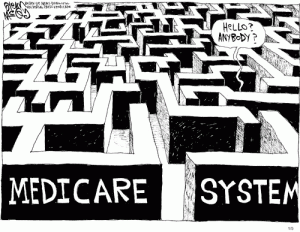
I’d say a lot of this boils down to Medicare not being available overseas. Many I talk to say that.
Great article!
I think all this is true. It also makes little sense that Medicare is not available overseas. It would almost certainly save the country money if this were changed.