

By Steve Moran
I am 71 years old, and I am living this experience. Don’t get me wrong. I have a great life at 71, and there are things about being this old that are amazing that I wish I had when I was younger. Better perspective, more peace, more chill.
But it comes with challenges: more time at the dentist and doctors’ offices, the need to pay more attention to diet and exercise. I am not as strong, don’t move as fast, and take longer naps.
We need to be more honest, more frank about the decision to move into senior living. We rarely want to talk about this out loud.
People don’t move into senior living communities because they’ve decided it’s a great lifestyle choice.
They move in because something has changed. Either decline has already started, a fall, a diagnosis, a moment when living alone no longer feels safe or manageable, or they can see decline coming, and they’re trying to get ahead of it. Or they are watching a spouse or partner decline.
That’s essentially the whole universe of move-in motivations. Crisis entry or anticipation entry. And right now, the vast majority are crisis entries.
I’ve been thinking about this a lot lately, partly in response to a yet to be publicly released white paper by my friend Russell Rush called The Isolation Economy. Russell makes a compelling case that senior living should reposition itself around connection and belonging rather than care and safety. I agree with him about the problem. I’m less sure about the solution.
My Pushback
Here’s where I push back: Russell’s argument nudges toward a world where people choose senior living the way they choose a gym membership: proactively, enthusiastically, because it sounds like a great idea. And Russell is far from the only person making this argument. I want that to be true. But I don’t think it is. And I don’t think pretending otherwise actually helps us.
The honest reality is that senior living will always be decline-adjacent. That’s not a failure of marketing. It’s human nature. Nobody thinks seriously about where they’re going to live when they can no longer fully manage on their own until they start to face that question. That’s not pessimism; that’s just how people work. It is why we have pharmacies, funeral homes, cemeteries, and hospitals.
So What Can Actually Change?
The entry-causation ratio can change, and it’s a huge opportunity. Right now, crisis entries outnumber anticipation entries by a wide margin. What if we could flip even part of that? What if we could help more people decide to move into senior living while they still have choices … while they can still participate fully in community life, while they’re still healthy enough to build friendships and establish routines?
The Payoff For Senior Living
The payoff isn’t just philosophical. It’s financial. Earlier entry means a longer length of stay. It means higher acuity, which means less staff time per resident. It means residents who are capable enough to help shape the culture of the community rather than just inhabit it. It means a fundamentally different and better operating model.
But I think the way you get there isn’t by pretending decline isn’t coming. It’s by making the anticipation of decline feel like wisdom rather than defeat.
There’s a version of this that I find genuinely compelling, and I’ve heard it resonate with people in their late 60s and early 70s when it’s said plainly: “You’ve been smart about every other big decision in your life. Why would you wait until you’re in crisis to make this one?”
That’s not denial. That’s not spin. That’s an honest appeal to the kind of person who plans ahead, who thinks clearly about the future, who has spent a lifetime making good decisions, and doesn’t want to stop now.
The goal isn’t to make senior living something it isn’t. The goal is to make choosing it earlier feel like the smart move, because it genuinely is.
That’s a different pitch than “connection-first wellness ecosystem.” But I think it’s a more honest one. And in my experience, honest usually works better.


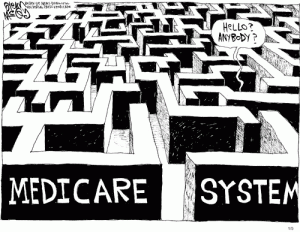



The barrier to moving in before you have to is the financial aspect. Senior living is incredibly expensive, and I believe the day is coming when fewer people will be able to afford it. The tail end of the baby boomer generation doesn’t have the retirement incomes or investments their parents had. Annual rent increases of 8% and more over time is unrealistic for most people even if they have planned well for retirement. To stretch resources for 10 or 20 years (if you move in while you are in your late 60’s or 70’s) is unsustainable. I believe people live longer if they choose senior living for many reasons, but then they worry about running out of money. People are retiring later, too. When they do retire, they look for part-time work to supplement their incomes. To jump from the workplace to a senior community is not where people see themselves ending up at age 70 which is the age many people are choosing to work until. The seventh decade of life can still be quite enjoyable in your own home. It would take a crisis to move most people, and then you would be praying you don’t live long.
I agree with both viewpoints. At 79, I see a need for community, support, care and not lifestyle. I am happy in my current home, I have all the comforts, control, socializing that I need. Nobody is telling me what to do or not do. I do not have to subject myself to a management that might not be competent and might not care about me and be in a place where I have no say. However, I am still healthy. For me, a senior living community would need to offer QUALITY, reliable care and guarantee that it will be available when needed. The trend now, in spite of what marketing promotes, is that the care part is being degraded to the minimum mandated and “hidden” from prospects. Most prospects don’t even ask questions about it and do not visit AL, MC, and if SN – if at all available. Figuring out the cost of care is very hard, as each facility has its own algorithms to calculate the cost of care. One cannot compare it for the same person with the same needs across different facilities. Contractually, facilities do not guarantee anything about providing the care one might sign up for. Even if they offer something today, there is no guarantee or even promise that they will offer that later. There is no no contractual obligation to have the needed space or have it on campus. While many join a community with care in the back of their mind, there is nothing to ensure that they will get it or that they get quality for the huge charges. This article starts to highlight the hidden issues of what senior living communities offer and do, but there are many more the way they are run today. They are by no means the nirvana in their pictures with always laughing seniors.
Amen!