

By Rebecca Wiessmann
In this episode of Tech Tuesday, Steve talks with Angela Fairhurst, founder and CEO of Geri-Gadgets, about dementia, caregiving, play, and why the best senior living technology may not always have a screen, sensor, or subscription. You can watch the full episode here: High-Tech, High-Touch: Finding the Balance in Senior Living Technology.
Angela Fairhurst did not set out to become a senior living entrepreneur.
Her background is television production — music, variety, entertainment. Then her mom developed dementia. Like so many family caregivers, Angela found herself suddenly living in a world she did not choose and could not fully understand until she was inside it.
She looked for products that would help her connect with her mom. What she found frustrated her.
Some products felt childish. Some were too complicated. Some were not safe to put in the mouth. Some could not be cleaned properly. And many did not honor the dignity of a person living with dementia.
So Angela started inventing.
The result is Geri-Gadgets, a line of medical-grade silicone engagement tools designed to be safe, washable, durable, and — most importantly — human.
Not high tech in the way we normally talk about technology.
But maybe exactly the kind of technology senior living needs more of.
The Misdiagnosis That Changed Everything
Angela’s mother was first diagnosed with Alzheimer’s. She was then treated with one antipsychotic after another. Each medication created terrible side effects. Each led to a hospitalization.
After the seventh antipsychotic, her mother was finally diagnosed with Lewy body dementia — a condition where many antipsychotics can be especially problematic.
By then, her mother was scared, struggling to communicate, and sometimes kicking or biting.
Angela eventually moved her mom from a larger setting into a smaller memory care community. That smaller environment made a huge difference. But even there, one need remained painfully obvious: her mother needed engagement.
She needed touch.
She needed connection.
Angela noticed her mom touching shiny magazine paper. That small observation became the beginning of a much bigger idea. There was a sensory need that was not being met.
And the answer was not another screen.
It was something her mom could hold.
A Tactile Bridge
Angela describes Geri-Gadgets as a “tactile bridge.”
That is the right phrase.
For families visiting someone with dementia, conversation can become hard. Questions can become stressful. The old ways of connecting may no longer work.
But touch still works.
Play still works.
Curiosity still works.
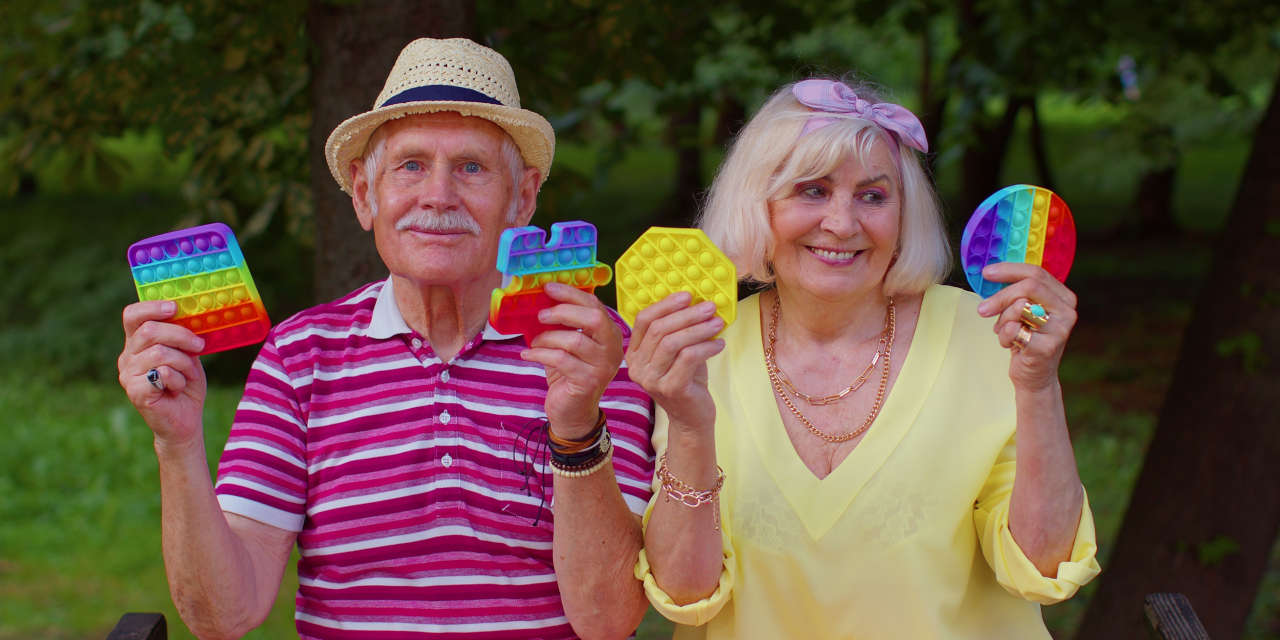
Angela’s products are made from silicone, which she says is the closest material to human skin. The pieces can be squeezed, pulled, stacked, arranged, tapped, chewed on, or simply held. There are buckets with fidget pieces, Tetris-like shapes, and flowers that can be arranged in a reinforced vase.
The point is not to complete a task correctly.
The point is to create a moment.
That matters because dementia care is full of failure for everyone involved. The person living with dementia struggles to remember, speak, and respond. The family member struggles to know what to say. The caregiver struggles to find ways to engage while also doing a dozen other things.
A failure-free object changes the dynamic.
There is no wrong answer.
A resident can build something elaborate. Or they can lay a piece flat. Or they can hold it. Or they can put it in their mouth. Angela’s point is that even those small interactions can matter.
They can calm.
They can connect.
They can give a person a sense of accomplishment.
The Problem With Too Much Tech
One of the most interesting parts of the conversation is Angela’s caution about technology.
She is not anti-tech. But she worries that senior living can become so focused on measuring things that it forgets to touch people.
We can measure sleep. We can measure urine. We can measure movement. We can measure doors opening and closing.
All of that may have value.
But, as Angela says, “You can’t hug a robot. You can’t hug metal.”
That is the balance senior living leaders have to keep wrestling with. The best technology should support human care, not replace it. It should give caregivers more room for connection, not turn residents into data points.
And sometimes the most useful “technology” is not digital at all.
Sometimes it is a silicone flower.
Sometimes it is a shape.
Sometimes it is something soft enough to catch, safe enough to chew, and interesting enough to start a moment.
What Operators Should Notice
For senior living operators, the practical question is obvious: How would something like this work in a community?
Angela says communities do not need a set for every resident. A memory care neighborhood might have shared kits. Assisted living might have one. A visitation area might have one available for families who do not know how to connect during visits.
That last idea is worth pausing on.
Families often walk into memory care carrying grief, guilt, awkwardness, and fear. They do not know whether to ask questions. They do not know what to do when their loved one repeats the same thing again and again. They do not know how to visit when conversation has become difficult.
Providing them with a simple engagement tool is more than just an activity idea.
It is a mercy.
It gives them somewhere to start.
Angela also points out that the products can be wiped down, washed with soap and water, and run through a dishwasher. They are not toys that fall apart after a few uses. They are designed to be used in real care environments.
Activity directors use them in groups. Residents can engage with each other, not just with staff. Physical therapists can use them for grip and strength. Caregivers can use them to help calm someone during stressful moments, such as showers, appointments, or periods of agitation.
This is not complicated.
That is part of the beauty.
DARE: Don’t Argue, React, Or Explain
Angela also shares a caregiving acronym that deserves to be written on the wall of every memory care community:
DARE: Don’t Argue, React, Or Explain.
That is hard.
Steve talks about how family members often want to correct his stepfather. They want to say, “I just answered that.” They want to bring him back to reality.
But short-term memory loss is not stubbornness — it is a disease.
Angela says short-term memory can be as short as 30 seconds. When someone asks the same question again and again, they may not realize they are repeating it.
So the goal is not to be right.
The goal is to be present.
Angela tells the story of a woman whose mother with dementia believed every day was her birthday. The daughter kept correcting her. Angela’s advice was simple: Tell her happy birthday.
Why steal the celebration?
Why insist on accuracy when joy is sitting right there?
We Are Never Too Old To Play
One of Angela’s most compelling ideas is that play should not disappear as people age.
“We play sports,” she says. “We play board games. We should play until the day we die.”
That is a surprisingly radical statement in a senior living world that often turns engagement into programming, calendars, and compliance.
Play is different.
Play is human.
Play does not require a cognitive score. It does not require memory. It does not require a person to perform adulthood in a way that makes the rest of us comfortable.
Play allows a person to simply be.
That may be one of the most important lessons from this conversation. Technology in senior living does not have to be dazzling. It does not have to be expensive. It does not have to require training manuals, monthly fees, or a dashboard.
The best technology may be the thing that helps a caregiver sit down, slow down, and connect.
Because in the end, senior living does not need to choose between high tech and high touch.
It needs to remember that high touch is the point.