
By Jack Cumming
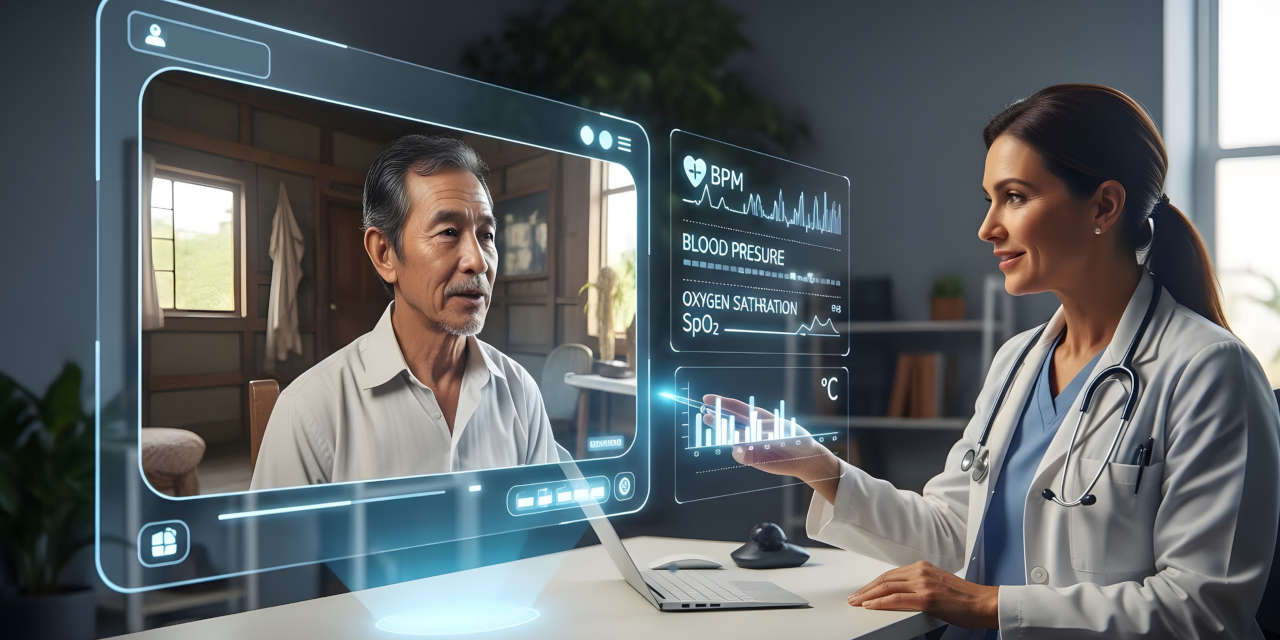
Imagine never having to leave your home to receive routine medical advice. For now, people regularly have to go to a doctor’s office in order to consult a physician about what’s concerning them. It may be life altering, or it may be nothing. For most non-emergency medical interactions, the physician’s office is a starting point.
The Congregate Advantage
That may soon change with the enormous advance unleashed by the rapidly expanding capabilities of neural network based artificial intelligence. Soon, if technological deployment follows its potential, we’ll be able to complete those initial interactions with a doctor by just picking up our smartphone and having at it.
The opportunities for senior living are enormous. If a person aging in a single-family home, can have easier, more productive medical access from there, think of how much more is possible for a cluster of older people, most of whom are intensive users of medical care. Picture a clinic suite set aside on the senior living campus.
As medical equipment is developing, it is becoming more intelligent and sufficiently automated that a bright person can quickly learn to operate it. For instance, looking at the retina can be like having a window into the vascular and other structures of the inner body.
Such an onsite clinic can be equipped with a digital retinography system. My most recent DRS exam was reviewed by a costly Ophthalmologist, but one has to believe that AI might do the review more systematically, with greater insight, and at lower cost. This is the kind of special application robotic solution, i.e., the DRS equipment, that is likely to be most effective with AI enhancement.
The Opportunity
The cost is more than an individual might buy but bring 200 or 300 residents together on a campus and an investment of roughly $15,000 in a critical device can make sense. It becomes a reason for people to move into congregate living, say a CCRC, rather than staying put in their own homes.
Checking for common afflictions of old age, e.g., hypertension, balance, incipient diabetes, etc. can be done more conveniently, at much lower cost, and with more empathy than in today’s impersonal medical system.
There is a money opportunity as well, as such onsite services can be integrated into the larger medical reimbursement system. Our national medical system is a mess, high cost without commensurate outcomes, so evolution is inevitable. Congregate living offers the opportunity to be on the cutting edge of that evolving reform.
How We Got Here
We’ll look at how we got here as a way of grasping fully the emerging opportunities ahead. Not all advances in medicine have been positive. At one time, we had a doctor who not only made house calls, but who also knew us and our health history because of the close relationship families had with their family doctor. Since then, medical practice has become much more complex but also rushed and, increasingly, impersonal.
One of the unforeseen developments, possibly related to the 1965 health insurance enactments, was the exponential growth in medical specialties and subspecialities. The relationship with a family doctor changed, just as ads began to appear advising us to “Ask your doctor.” We only saw our family physician briefly before being referred to a specialist.
High-Cost Specialists
As it now turns out, as our bodies age and our frailties increase, we acquire an entire bevy of specialists. Since many older people no longer drive, or are reluctant to drive, an unfortunate concomitant is that people spend inordinate time getting to and from doctors’ visits that are no more than routine.
Despite the commonsense solution of video visits, the complexities of that 1965 Great Society reimbursement structure, and its later amendments, have prevented such convenience from taking hold.
At least, though, through much of these transition decades, if we went to the hospital, there was a physician we knew there to help us through those dire moments. He was usually our family physician. He knew us. Not anymore.
Alone In the Hospital
Not only don’t physicians make house calls anymore, but they also don’t go to hospitals. Instead, in our moment of greatest anxiety, we are greeted by a stranger, a hospitalist, who takes over our care. He knows the hospital, but he doesn’t know us.
This depersonalization of the physician relationship is likely to help hasten the transition to a more empathetic AI virtual care interaction which will be more comprehensive than the most gifted specialists. We wrote about that in an earlier article. It appears that change should come soon to medical care. We’ll need fewer of those high-priced, super whizz specialists, and more nurse-type nurturers to bring care to medicine.
Sooner or Later?
How quickly, might these changes come about? That’s up to the marketplace. Already some senior living enterprises are embracing the potentiality by having inhouse Medicare Advantage with characteristics for middle income and more affluent people derived from successful PACE (Program of All-inclusive Care for the Elderly) concepts.
Change could come quickly. Just look at how quickly we absorbed smartphones into our daily lives. AI delivered medical information and recommendations can come into our lives just as rapidly as smartphones have over the past decade and a half. That means that by 2040, not so long from now, AI delivered medical care may be norm.
Once we experience better medicine, with greater convenience, at lower cost and get used to it as we got used to automated banking, we will love it just as we now love having smartphone information at our fingertips, all day, every day, everywhere.
This is part of a series considering how AI, robotics, and technology in general can take senior living from laggard to leader.