


By Jack Cumming
James Michener was a prolific author of my mother’s generation. In fact, she shared a small English class with him at Swarthmore. In his time, Michener was well known and highly regarded. Less well-known, though, is his heavily researched 1994 novel Recessional, about life in a CCRC.
Medicine in a CCRC
The significance for this article, though, isn’t that the novel is about a CCRC. The hero of the novel, the Executive Director for The Palms CCRC, is a medical doctor, buffeted by the winds of legal profiteering that can impact even competent physicians. Andy Zorn, MD, wants a safe harbor where he can use his knowledge for compassionate care. I don’t know of many CCRCs managed by physicians, but Michener makes it sound only logical. That’s significant.
Michener’s ED, Andy Zorn, though, is not hired to be a physician. John Taggart, the novel’s capitalist multi-facility owner of retirement communities, is strictly a businessperson, and he has sought out Andy Zorn more for his business acumen than for his medical knowledge. For Taggart, it’s central to his business success to be respected by physicians, but not to be beholden to them. Who better for that than an MD, who knows how to turn a profit?
1994 Approaches Continue in 2026
What stands out from reading this novel is how little senior living and medical delivery have changed since Michener’s 1994 book. The medical needs of older adults were central to aging then as now. Then as now, though, few CCRCs included medical services.
Yet there’s considerable evidence from PACE that interweaving medical practice with older adults as they go about their everyday lives improves outcomes and saves money. America spends more on health care than on any other industry. The financial opportunity is vast.
Senior living in general has not figured out how to profit from the opportunity. Some forward-thinking senior living organizations have worked out custom Medicare Advantage programs. Christian Living Communities and Juniper Communities come quickly to mind. St. Paul’s Senior Services in San Diego has a robust PACE (Program of All-Inclusive Care for the Elderly) program.
Not Our Job
Many senior living leaders say that primary medical care isn’t part of their responsibility. If anyone suggests that the continuum product offering might be better if it were fully integrated and responsive, they are apt to be told that isn’t part of what CCRCs do. And they’re right. They don’t.
Still, the problem of multiple medical bills confronting a frail or dying person who relied on a CCRC, as depicted by Michener on page 132, remains as big an injustice today as it was when Michener was leading the research for the book. Ask LeadingAge or other trade associations about the challenge, and it’s not even on their radar.
It Starts with Discussion
Here are some thoughts to get a conversation started, though it’s not my intent to suggest the solution. Solutions are for others, more entrepreneurial than I, to think through, to experiment with, and to find the solution that takes us into the second half of the 21st century.
One hope is that no ideas are rejected out of hand or just ignored by those responsible for senior care leadership. All ideas should be granted thoughtful consideration in comity with the suggester. Embracing ideas is a sign of excellence. Defensive naysaying is a hallmark of mediocrity. Who would have thought that Jeff Bezos could upend Sears Roebuck and seize that behemoth’s potential? Sears didn’t. Macy’s didn’t.
There are many approaches to transforming medical care in which senior living can play a beneficial part. Erickson Senior Living has communities of sufficient scale to support onsite primary care clinics, and residents love the convenience. Think of how many older adult residents fail to get the assistance they need because of the hassles of having to get themselves to a doctor’s office for the medical profession’s convenience, not for that of the patient.
Scattered Pilot Programs
Some providers are experimenting with custom Medicare Advantage plans. Others might lease onsite space to a local independent physicians association. Some “medical plans” try to get ahead of other medical providers by offering to come to a CCRC periodically or on demand when requested by residents. They only accept patients with original Medicare or contracted plans since that’s their business model. These “plans” have had mixed success, with some lacking reliability in keeping appointments or in handling pharmaceutical needs.
Another intriguing approach is for communities to hire EMTs as security guards. I know of one operator who does this with success. Better might be having paramedics to respond to those recurring emergencies. That is also a response to the expectation of many new residents: that there will be competent on-site staff to respond to them if an emergency presents itself.
What’s To Be Done?
Industry trade associations could take the initiative to seek an approach that benefits the industry, leads the nation toward better healthcare, and proves more responsive to the needs of older adults, particularly those who can no longer simply drive to a doctor’s office. Not long ago, Bob Kramer gave industry visibility to an article by the New York Times’s Paula Span calling for “geriatric ERs.” Why don’t more communities at least have a geriatrician on staff serving residents and the larger community beyond the walls? Many ER transports could readily be avoided with telemedicine or with a practitioner onsite licensed to evaluate middle-of-the-night falls, etc.
There’s a huge opportunity here for proactive discussions within the inner circles of trade associations or among strategic thinkers who guide enterprises serving older people. Responding to the needs of older adults should not be stagnant or socio-economically subdivided. Let’s look at the larger need and opportunity that can build on what the industry does well.






Just because there is always a nurse on duty, doesn’t mean you will get medical care.
Thank you, Mary Teri Walsh, for your comment. I agree with you. There are many gradations of nurses. There are nursing assistants, certified nursing assistants, licensed practical nurses, registered nurses, and nurse practitioners. Moreover, registered nurses can present with an associate degree, a bachelor’s degree, a master’s degree, or even a doctorate in nursing.
The key distinction is whether the “nurse” is licensed to provide initial assessments or not. If no RN is on duty, transport to an emergency facility may be necessary, in which case it might be better to just call 911 in the first place to avoid delay in getting assessed and treated.
In addition, there are emergency medical technicians and paramedics who have training comparable to that of LPNs and RNs respectively. Some CCRCs, very few, have EMTs and paramedics on their security staff. That is one of those seemingly minor residential details that can make a big difference in one’s time of need.
In addition, there are sophisticated telemedicine hookups that can allow a trained on-campus worker to connect remotely with an emergency room doctor. That may be the best approach of all, but it’s still highly experimental and may encounter regulatory pushback. In short, it’s complicated.
My thought in the article is that having a smooth care continuum available instantly as needed could help CCRCs live up to their implied care promises. That would mean having primary response medicine available on demand 24/7. As it is, when a resident calls for help, the resident can’t know how qualified the responder will be, while a 911 response is trained for emergencies.
It would mean availability of physicians as needed, most likely by telemedicine hookup. We already have a hint of both the efficacy and the cost efficiency of something like that with the PACE (Program of All-Inclusive Care for the Elderly), but that is artificially very limited due to legislation.
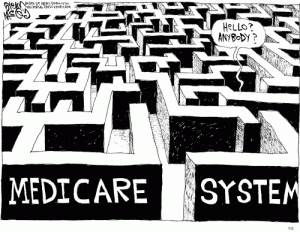
You’ve touched on a big challenge with American health care. It doesn’t work seamlessly. It’s convoluted. It’s managed in a political context with heavy special interest lobbying. And, not surprisingly, it’s insanely expensive compared to other sectors of our economy.
One of my neighbors in the CCRC where I live didn’t post her reaction to the article, but she wrote to me as follows: “Your article today in Foresight (Can Senior Living Be Medically Responsive?) really hit home with me! That situation is one of the major reasons I may one day have to move from here.”
The industry may be turning a deaf ear to that kind of resident anxiety, but prospective future residents do hear it, and some are deciding to stay put and rely on 911 and expediency rather than risk that things may not be fully what they expect.