

By Rebecca Wiessmann
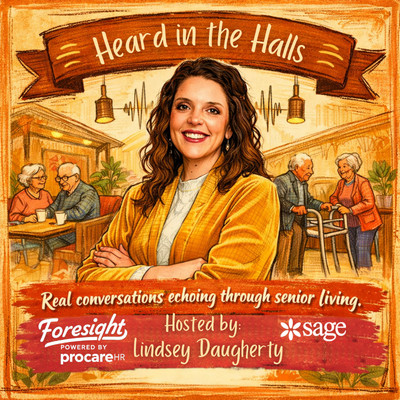
This article is the first in a new content creator series, Heard in the Halls, featuring Lindsey Daugherty of Sage. Listen to the first episode HERE.
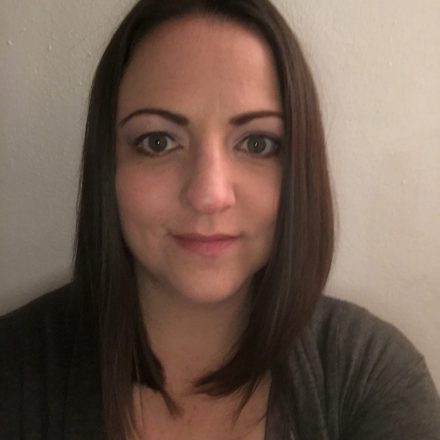
Senior Living Foresight’s newest content creator, Lindsey Daugherty, doesn’t show up as a commentator who just discovered senior living last week. She shows up as someone who “grew up” in it — starting as a volunteer, then moving into caregiving, nursing, and leadership roles across the continuum.
Now, as Head of Community at Sage, she’s stepping into a different kind of role: supporting the industry at scale, while still keeping her feet planted in the realities of the floor.
What Sage Is — And Why It Matters To This Series
Sage describes itself as senior living technology built to keep up with care across the continuum. In the conversation, Lindsey puts it in plain terms: at its core, Sage is a nurse call system — but not the old “push button on the wall and hope for the best” version. Instead, she describes a mobile, app-based workflow tool that helps caregivers see who’s on shift, communicate in real time, and understand resident activity and insights.
That matters because this series isn’t just about “cool tech.” It’s about what happens when the people doing the work finally have visibility, context, and support — and what happens when they don’t.
The Premise: One Hallway, Many Truths
The title “Heard in the Halls” is not a metaphor Lindsey picked because it sounds good on a landing page. It’s a description of how senior living actually operates. In every community, the hallways are full of conversations — caregivers, nurses, physicians, executive directors, regional leaders, investors — all walking past the same residents, seeing different things, and caring about different outcomes.
And then Lindsey drops the real issue: those perspectives often aren’t connected.
The Priorities Of The Series
This series is built to surface what most people already feel but rarely say out loud:
1) Bring siloed perspectives into the same conversation.
Lindsey describes senior living as “one human, many lanes” — different goals, different agendas, and not enough time at the same table.
2) Tell the truth from the floor up — not from the brochure down.
The show aims for a realistic point of view that captures how care actually happens, including where communication breaks down.
3) Make room for the family voice.
Families overhear fragments, get partial updates, and live with uncertainty — often without full context. The series wants families at the table, not waiting in the lobby of the story.
4) Move the industry toward proactive care and fewer “surprises.”
When teams can understand what’s happening in real time, the goal shifts from reaction to prevention, better interventions, and more thoughtful care planning.
The Big Promise
“Heard in the Halls” is going to do something simple and disruptive: listen carefully, connect perspectives, and push senior living toward collaboration that feels more like a round table than a relay race.
And if it works, the payoff is bigger than operational improvement. It’s cultural. It’s trust. It’s the possibility that senior living starts telling the truth in a way that makes people lean in — instead of brace for impact.